 Guide On Map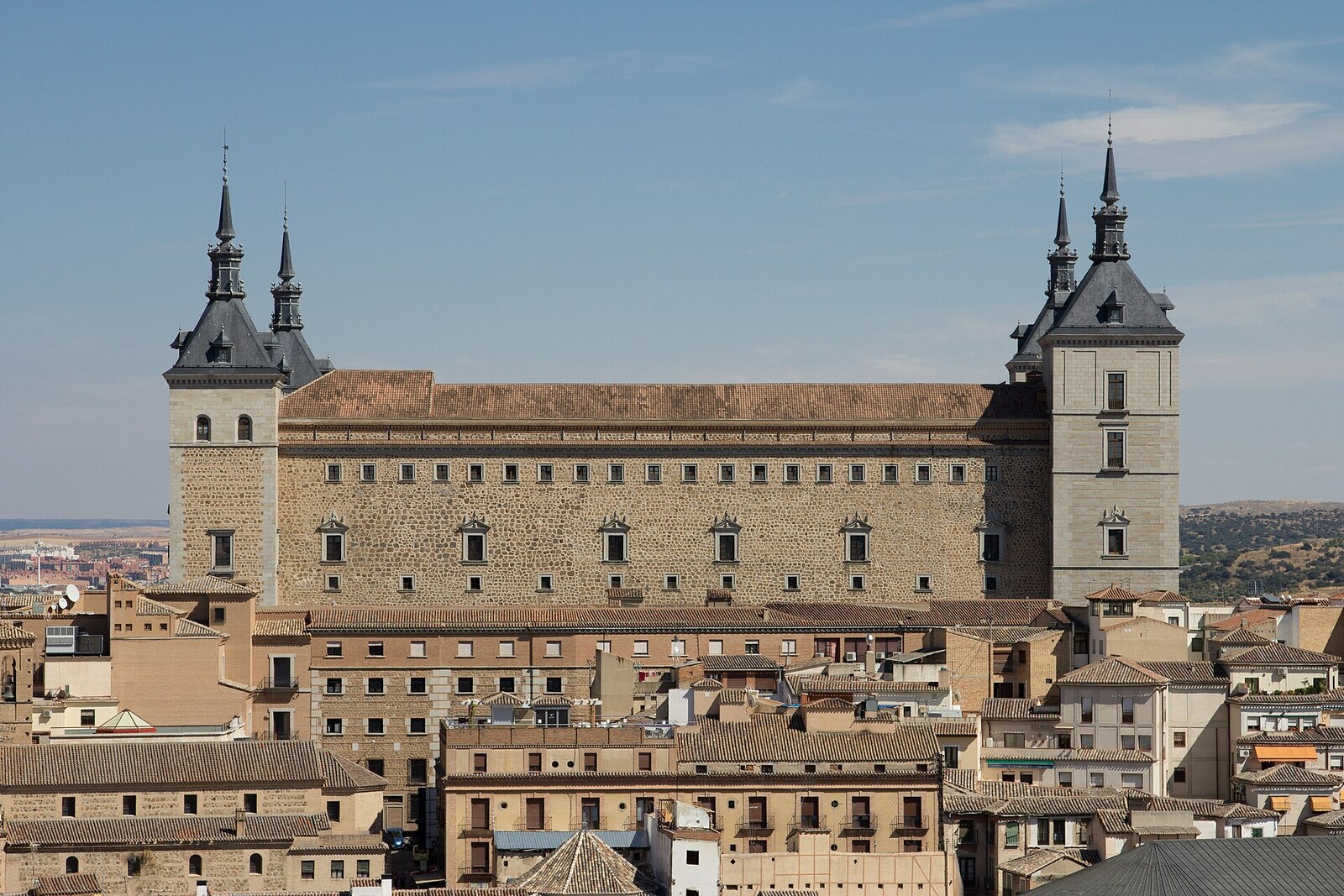
Look around first
What to notice
- Four corner towers
- Damaged office walls
- Old telephones
- Facsimile of the log page
The story of the place
Four corner towers form an even silhouette on Toledo's highest rock; behind this façade stands a former royal fortress, later occupied by a military academy. Its name comes from an Arabic word meaning “fortress,” and here it is borne out by the thick walls, basements, and cisterns. After the war, the façades and breaches were reconstructed from Renaissance drawings, and the lost southwestern tower was rebuilt. The Army Museum now occupies the main floors, while the Library of Castile-La Mancha operates at the top.
On July twenty-first, nineteen thirty-six, Colonel José Moscardó ordered about seven hundred thousand rifle cartridges removed from the Toledo arms factory and brought up here, to the top of the hill. The Republican government demanded that the ammunition be sent to Madrid to suppress the military uprising. Moscardó, Toledo's military commander, joined the rebels and refused to carry out the order.
His men could not hold the entire city. They retreated into the Alcázar of Toledo—a former royal fortress that then housed a military academy. The word “alcázar” comes from the Arabic “al-qasr,” meaning “fortress.” Here the name literally describes the building's setting: a rock in the highest part of Toledo, thick walls, basements, and cisterns. The cadets had left for summer vacation, so the core of the garrison consisted of about eight hundred Civil Guards gathered from across the province. Soldiers, volunteers, roughly five hundred women and children—mainly the guardsmen's families—and captured opponents held as hostages took shelter with them. More than one thousand five hundred people were inside altogether.
Two days later, a telephone rang in Moscardó's office. Lawyer Cándido Cabello, one of the leaders of the Republican militia in Toledo, was seeking the fortress's surrender. Beside him was the colonel's detained twenty-four-year-old son, Luis Moscardó. Cabello threatened to have Luis shot if the garrison did not capitulate within ten minutes, and handed him the receiver.
The call itself is recorded in the war log. It says that father and son said goodbye, after which Moscardó refused to surrender. The long dialogue later printed in books and engraved on commemorative plaques is not a transcript: the exact lines appeared in postwar retellings. Nor was there an immediate shooting at the telephone. Luis remained imprisoned for another month, and on August twenty-third he was killed with a group of other prisoners elsewhere in the city. Historians do not consider this execution to have carried out the ten-minute ultimatum. Moscardó himself learned of his son's death only after the siege had ended.
His refusal meant that the people inside would continue waiting for help under fire. Forces loyal to the Republican government surrounded the Alcázar of Toledo and used artillery, aircraft, and underground charges. The families and wounded were moved into the basements. On September eighteenth, sappers detonated a charge beneath the southwestern tower: the tower collapsed, the explosion was followed by an assault, but the defenders held the breach. On September twenty-seventh, troops of General José Enrique Varela, allied with the rebels, entered Toledo, and the siege ended.
All that remained of the building were charred façades, breaches, and piles of stone. The present even silhouette with four towers was reconstructed only after the war from Renaissance drawings; the southwestern tower, blown up by the sappers, was rebuilt. Reconstruction was completed by nineteen sixty. The Army Museum now occupies the main floors, while the Library of Castile-La Mancha operates at the top.
Inside the museum, the former office of the academy's director is displayed as it was after the siege. Its damaged walls, furniture, and several old telephones have been left in place, but the museum does not claim that the call was received on any particular one of them. Nearby lies a facsimile of the log page for July twenty-third—a brief official entry from which the Alcázar of Toledo's most famous story grew.
Useful on site
Exterior viewing is always available. Army Museum: Tuesday–Sunday 10:00–17:00, last entry 16:30; Monday closed; general admission 5 euros.
Checked: June 24, 2026. Check the official source before visiting.For the route's theme, an exterior circuit is enough; plan a full museum visit separately so that the military exhibition does not consume the rest of the walk.