 Guide On Map
Mengjia and Ximending: Old West Taipei
From Longshan Temple through Ximending to North Gate (Cheng'en Gate)
Guide On Map on your phone
Open the walk like a regular app
It takes about 10 seconds to install. No app store needed.
The whole path
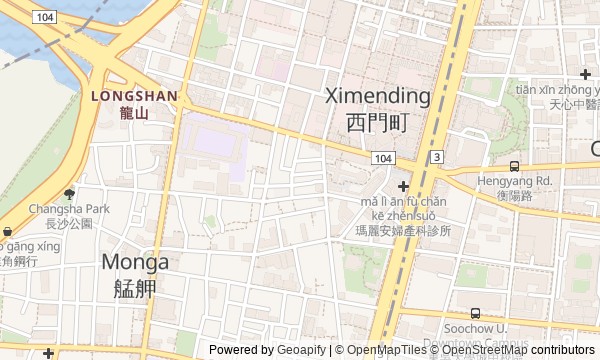
Route map
About the walk
You will walk from old Mengjia into Ximending—from active temples and craft shops to a former market, pedestrian streets, a public hall, and the surviving city gates.
At the beginning, temple courtyards, incense burners, and displays of home altars will set the course. At the main altar, a question will arise: why did a new hall have to be built around the old figure? Then the red-brick houses will reveal two street-facing sides, while another temple introduces judges and guards among its deities.
After that, the route reaches a stage inside a former market hall and the noise of Ximending. Here, the asphalt was once handed over to artists and dancers—but the first experiment did not save the neighborhood. The ending is more restrained: a hall of brief ceremony and gates that once had to be opened from within.
The story separates documents from temple and family traditions. After the walk, you will be able to read west Taipei through shop doors, temple layouts, and old entrances to the city.
Why this order
Longshan Temple establishes Mengjia as a temple center, so Xiyuan Road comes next: its workshops grew up right beside the temple on a steady stream of orders. From the displays, Guangzhou Street leads to Bopiliao Historic Block, where you can see how a new thoroughfare forced merchants to turn their shops around. North of the block, Qingshan Temple reveals another community of migrants and another way of arranging protection around a shrine. From there, the route leaves temple-centered Mengjia for The Red House: the former market becomes the threshold of entertainment-minded Ximending. Immediately beyond it, the pedestrian streets continue the story of commerce at the scale of an entire neighborhood. Crossing Zhonghua Road takes you from street trade to Zhongshan Hall—the site of an official change of administration. North Gate (Cheng'en Gate) completes the line with an earlier scene: after the hall where power was transferred across a table, there remains the arch through which it entered the city.
Those who want to understand old west Taipei through specific places Lovers of urban history, temples, and commercial neighborhoods Those interested in human episodes rather than a survey lecture
Those looking for a walk focused only on contemporary Taipei Those who prefer nature routes to city streets Those not suited to a dense historical section on foot
Before you go
Treat Longshan Temple and Qingshan Temple as active shrines: do not block passageways, do not interrupt prayer, and take a moment to look around before photographing a ritual or people. At Bopiliao Historic Block, the line of the alley itself matters, so the walk will not lose its point even if individual rooms are inaccessible. Treat The Red House, Zhongshan Hall, and their interior programs as independent extras: access may depend on exhibitions and events. At North Gate (Cheng'en Gate), stay in pedestrian areas and choose a viewing point without stepping into traffic.
When to go
Allow enough time for a slow look around the temple courtyards and displays in the first half of the route. If you want to see Ximending turn into an evening stage, start so that you reach it close to dusk—but do not end the walk there: Zhongshan Hall and North Gate (Cheng'en Gate) give the route its necessary historical ending.
Backup plan
If you cannot enter Bopiliao Historic Block, The Red House, or Zhongshan Hall, keep the order of the stops and read them from outside: the curve of the street, the brick volumes, and the public facades already explain the route’s transitions. In rain, spend longer in accessible temple spaces and make the open sections of Ximending shorter. If barriers or works restrict the approach to North Gate (Cheng'en Gate), do not try to get closer by crossing the road: end the story from a safe viewing point where the gate and the modern city around it are visible.
Route conditions
Surface. Paved — 2 km (data covers 66% of the route)
Facilities. Toilets — 12; drinking water — 15
Elevation. Ascent — 37 m; descent — 35 m
OpenStreetMap extract of June 18, 2026: database data, not a check on the ground. Data © OpenStreetMap contributors, ODbL licence
Walk plan
Open in maps ↗- 1
Longshan Temple
Here you will see why the shrine was, for settlers, a place of prayer, judgment, and mutual aid all at once. - 2
Xiyuan Road–Buddhist Article Street
It shows how steady demand from the temple turned a family craft into the specialization of an entire street. - 3
Bopiliao Historic Block
It will explain why one row of shop houses acquired two street-facing sides. - 4
Qingshan Temple
Adds to Mengjia a community temple that sought protection during an epidemic. - 5
The Red House
It links the former municipal market with the theatrical and cinematic life of Ximending. - 6
Pedestrian Ximending
It will show that the pedestrian district emerged after a long experiment that initially failed to bring the expected result. - 7
Zhongshan Hall
It explains why the former public hall received a new name after a fifteen-minute ceremony. - 8
North Gate (Cheng'en Gate)
The route ends at the only city gate to preserve its Qing-era appearance.
Route features
Everything you need stays in the browser
Progress, saves and your trip plan are stored on this device.
Add Guide On Map to your home screen so the walk opens outside the browser.
How we handle sources, maps and corrections: our editorial standards