 Guide On Map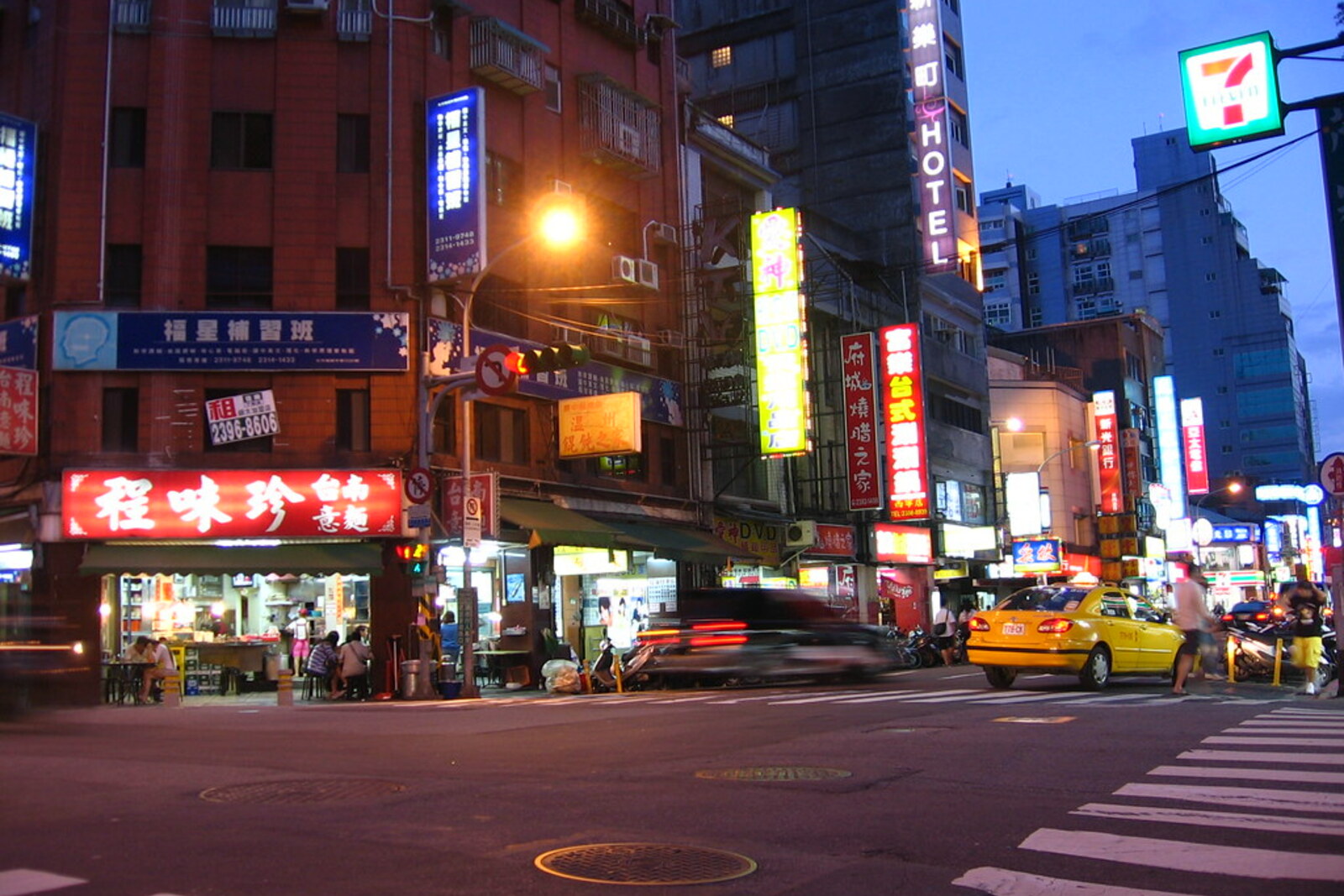
Look around first
What to notice
- Light-colored tiles
- Street performance spaces
- Commercial signs
- The boundary between the pedestrian zone and asphalt
The story of the place
Ximending is made up of Hanzhong Street, Emei Street, and Wuchang Street, ordinary streets with commercial signs and spaces for street performers. Light-colored tiles at the edge help you spot the boundary beyond which the pedestrian section turns back into asphalt. The district’s name came from the Western Gate, long dismantled east of here, by present-day Zhonghua Road.
On June eighth, nineteen eighty-five, city planners closed the roadway here and invited students and artists. Some drew directly on the asphalt, while others break-danced. Officials needed to prove to residents and merchants that a street without cars could bring in shoppers. Owners of movie theaters, clothing stores, and record shops were risking their own revenue: visitors had to be kept at the storefronts, not have their way made more difficult.
Ximending was chosen for the experiment because young people already came here to watch movies and buy things unavailable in ordinary department stores. But a crowded opening alone was not enough. Shoppers were leaving for the new shopping districts of eastern Taipei, construction of the metro made it harder to reach Ximending, and the neighboring Zhonghua Market was demolished. The first pedestrian district did not attract enough visitors.
When the municipality officially marked out its boundaries in nineteen ninety, local merchants created the Ximending Pedestrian Area Management Committee. They took on coordinating events, cleaning, and street conditions. The city recognized the committee, but it had no legal status: merchants could reach agreements among themselves, but they could not compel the different city services to act together.
It took nearly a decade to fix this. Municipal specialists discussed the project with residents and business owners, involving young people in the design of squares and signs. In nineteen ninety-eight, a complete overhaul of the paving, lighting, and performance spaces began. The new pedestrian zone was completed the following year, and Ximen Station opened almost at the same time. Shoppers returned, and over the next three years the merchants' committee became an official association with broader participation by shop owners.
Street performances here are still organized according to rules that grew out of the same history. Artists register in advance and receive one of the designated spaces by lottery. The area itself remains a network of ordinary streets—Hanzhong Street, Emei Street, and Wuchang Street. Traffic is closed on a schedule: later on weekdays and earlier on weekends. Light-colored tiles show where the pedestrian zone ends and asphalt begins again.
The name came earlier. In nineteen twenty-two, the Japanese colonial administration called this part of the city Ximending—“the neighborhood by the Western Gate.” Baocheng Gate stood east of today’s pedestrian streets, by present-day Zhonghua Road, but it had already been completely demolished in nineteen oh five. All that the gates left here was the name; the first experiment with closing streets left artists, dancers, and people in the roadway.
Useful on site
The pedestrian zone is accessible around the clock as a city street; the density of people, street performances, and promotional events rises noticeably in the evening, on weekends, and on holidays.
Checked: date not specified. Check the official source before visiting.Do not block performances or walkways for a photograph. In the crowd, keep an eye on your belongings and choose a place to stop at the edge of the flow.