 Guide On Map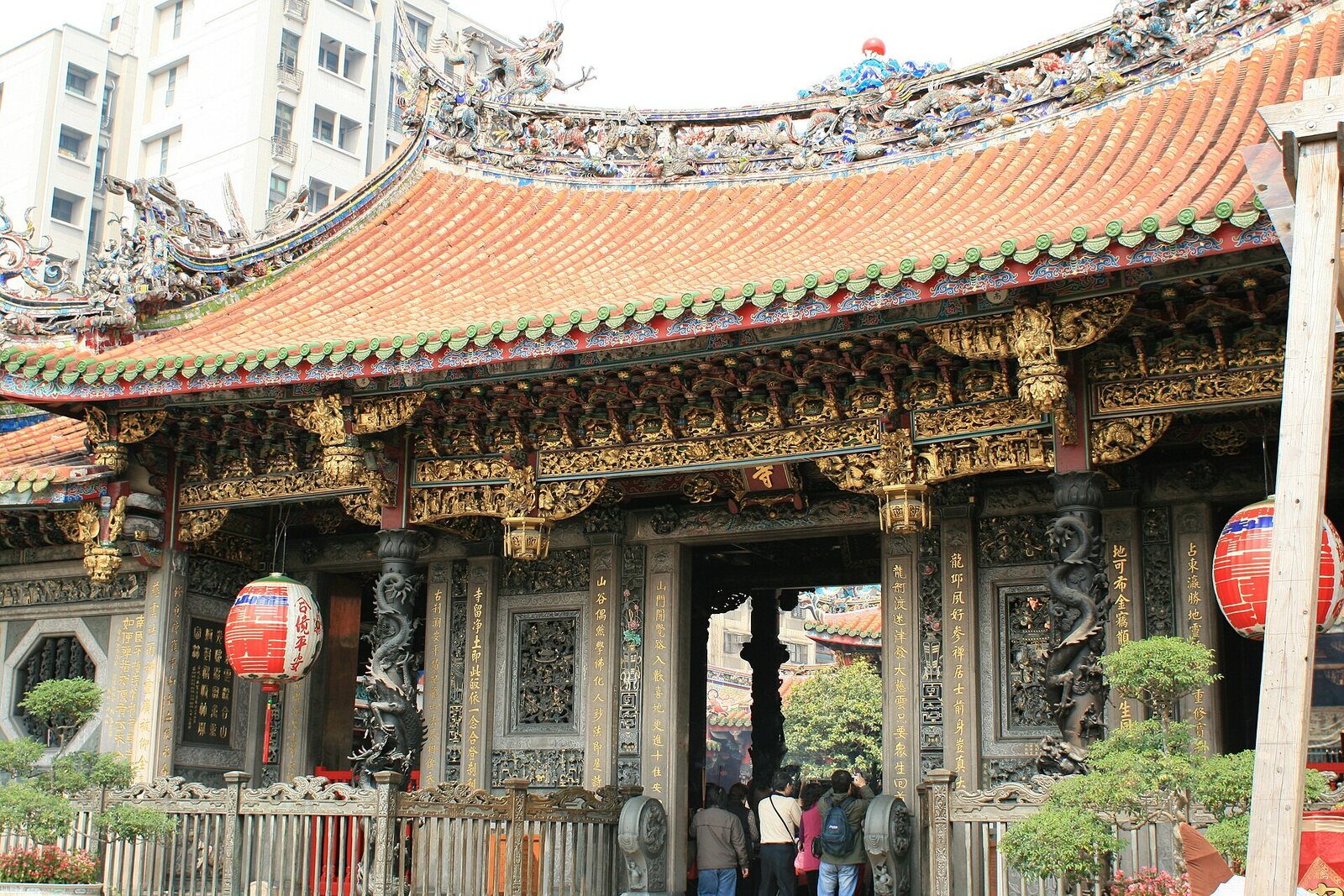
Look around first
What to notice
- The figure of Guanyin
- Two red divination half-moons
- The carved altar
- The roof of the main hall
The story of the place
The roof above the central hall, the heavy beams, and the carved altar belong to the postwar reconstruction: the former wooden shrine burned down, and craftsmen reassembled it to the same scale and silhouette. When Mengjia was a riverside settlement with port trade, settlers from three Fujian counties gave the temple the name of their home shrine in Anhai; Dragon Mountain has nothing to do with Taipei’s hills. The two red wooden half-moons by the altar remain a working object: people throw them and read their position as an answer to a question.
In the main hall, people come first of all to Guanyin, the Buddhist bodhisattva of compassion. In the rear courtyard, they ask other deities for luck in studies, trade, a sea voyage, or marriage, but the temple was established specifically for this figure on a lotus throne. She is older than the building around her.
In seventeen thirty-eight, settlers from three counties in southern Fujian jointly paid for the construction of a temple in the riverside settlement of Mengjia, as present-day Wanhua was then called. They lived by trade through the port and brought a consecrated image from Anhai Longshan Temple in the city of Anhai. The name means “Dragon Mountain” and repeats the name of that home temple; it has nothing to do with Taipei’s terrain.
The settlers needed a place where they could remain a community of their own. Before Guanyin, they prayed, gathered to discuss common affairs, and heard legal disputes, asking the deity to judge between those in conflict. In time, a merchants’ association operated here: it collected fees from boats and paid for roads, the ferry crossing, night patrols, and aid for the poor. So from the beginning, the temple handled matters that went far beyond worship.
The hardest test of this bond came in nineteen forty-five. Taiwan was then under the rule of Japan, and American aircraft were bombing Taipei. During air raids, Mengjia residents had grown used to taking shelter in the main hall, beneath Guanyin’s large altar table.
On the night when incendiary bombs struck the temple, no one was beneath the altar. Temple tradition explains this by an invasion of mosquitoes: people could not bear the bites and went home. There are also stories of a woman in white who supposedly caught falling bombs with her hands. These are legends. Another thing is reliably known: the wooden hall burned down; the images, carvings, and old inscribed boards inside were destroyed, but there were no human casualties in the temple itself. The figure of Guanyin was found in its former place. Her face had blackened with soot, but the fire did not destroy her; the iron railing around her had melted.
The residents linked the survival of the people and the statue to Guanyin’s intercession. For those who had previously chosen her altar as a refuge, this became a reason to trust the temple even more strongly. However, they could not rebuild the hall at once: after the war, there was not enough money. Work began only in nineteen fifty-five. The architect Wang Shinan sought to restore its former dimensions and contours, and craftsmen completed the new main hall by nineteen fifty-nine.
The present roof, beams, and carved altar appeared after the bombing. Guanyin remained the same. Even today, people ask questions before her by throwing two red wooden half-moons onto the floor: one must land with its flat side up, the other with its convex side up. Such an answer is considered consent. People receive it before the figure around which the main hall had to be rebuilt.
Useful on site
Daily 06:00–22:00; major temple dates and the lunar calendar sharply change the density of people and the rhythm of rituals.
Checked: date not specified. Check the official source before visiting.Give way to people praying, and do not stand between a person and the altar. Examine interior details without flash photography or fuss.