 Guide On Map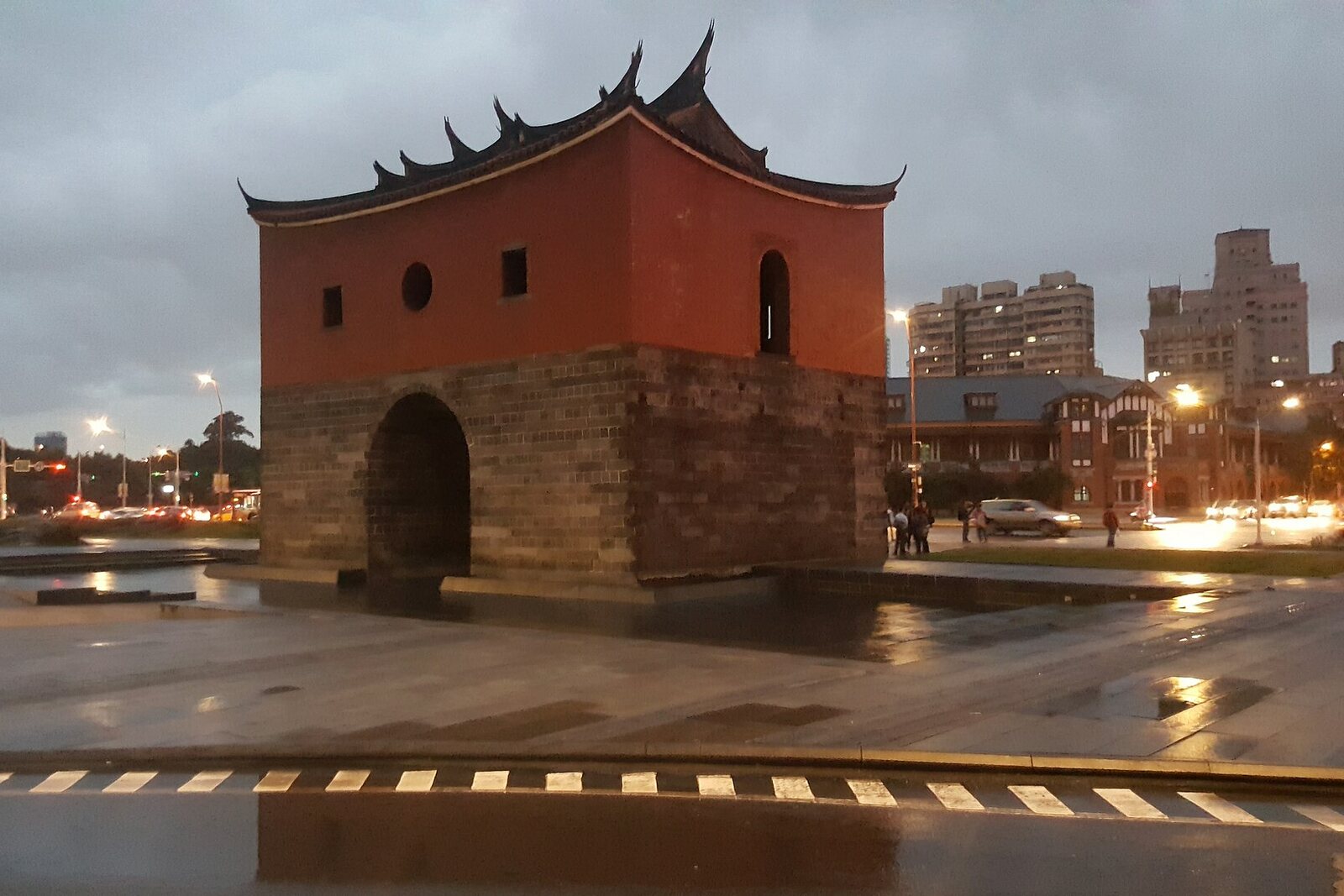
Look around first
What to notice
- Stone arch
- Red gate tower
- Plaque reading “Cheng'en Gate”
The story of the place
Above the northern arch, a plaque reading “Cheng'en Gate” has survived—the “Gate of Receiving Imperial Favor.” When builders completed Taipei's stone fortifications in eighteen eighty-four, the main ceremonial entrance was placed here. Qing imperial officials arrived by sea, came up from the river wharves through commercial Dadaocheng, and entered the city from the north. Ordinary townspeople were expected to use the South Gate.
On June seventh, eighteen ninety-five, it was no longer imperial envoys standing by the closed arch. The Qing Empire had ceded Taiwan to Japan. The leaders of the republic proclaimed on the island tried to resist, but after Keelung fell, they left Taipei. Soldiers left without commanders or provisions looted shops and government warehouses.
The merchants of Dadaocheng decided to ask the Japanese troops to enter the city and stop the looting. Twenty-nine-year-old Koo Hsien-jung, who traded in imported goods and coal, volunteered to deliver the request. He set out by rail to meet the Japanese, reported that the defense had collapsed, and led an advance unit to North Gate (Cheng'en Gate). The route from Keelung naturally led here. But the gate leaves were locked, the walls were surrounded by a moat, and the unit had no heavy siege equipment.
The passage was opened by Chen Fa, a forty-five-year-old shopkeeper near the gate. Her husband, who had previously worked as a carrier, had gone blind; Chen supported him, their four children, and her elderly mother-in-law. The unrest threatened her family, her goods, and the money she had saved.
The details survive in two versions. An award citation claimed that Chen Fa brought a bamboo ladder under fire. Chen's daughter-in-law, interviewed in nineteen thirty-seven, told a different story. She and her mother-in-law were drying salted vegetables on the inner side of the wall when they saw the Japanese soldiers. First, Chen lowered a long red cloth with a weight tied to it and a loop for a foot. Two or three men climbed up. Then Chen and her son brought a ladder, and more than a dozen soldiers climbed over it. They found the key in the room above the passage and threw open the gates from inside. According to the family account, the defenders did not interfere, and there was no shooting at the gate.
Japanese troops entered Taipei through North Gate (Cheng'en Gate) without a battle. Koo Hsien-jung became an intermediary for the new administration, received posts, and later became one of the island's wealthiest entrepreneurs. Chen Fa was awarded five silver yen and a certificate. She died five years later, but the family kept the certificate: two decades later, it was found with Chen's granddaughter.
Now there is no wall, moat, or outer fortification around the arch. The locked gate leaves are gone, along with the key that the soldiers sought in the room above the gate. What remains is the stone arch with its red tower—the only one of Taipei's five gates to preserve its Qing-era appearance. Above that same passage, the words are still written: “Gate of Receiving Imperial Favor.”
Useful on site
As of the 2026-07-01 check, North Gate (Cheng'en Gate) requires up-to-date access verification: the tourist listing notes a temporary closure for repairs, with reopening planned in 2026. The historic site can be viewed from outside, but fencing may restrict access.
Checked: date not specified. Check the official source before visiting.View the structure only from permitted pedestrian areas. If work or fencing blocks the view, do not step into the roadway for a closer shot.