 Guide On Map
How Diocletian's Palace Became Split
From Golden Gate through the palace halls to People's Square (Pjaca)
Guide On Map on your phone
Open the walk like a regular app
It takes about 10 seconds to install. No app store needed.
The whole path
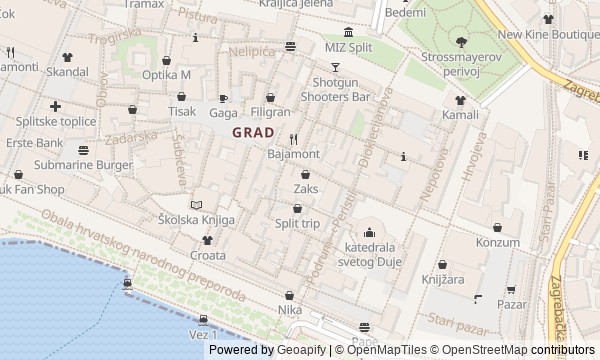
Route map
About the walk
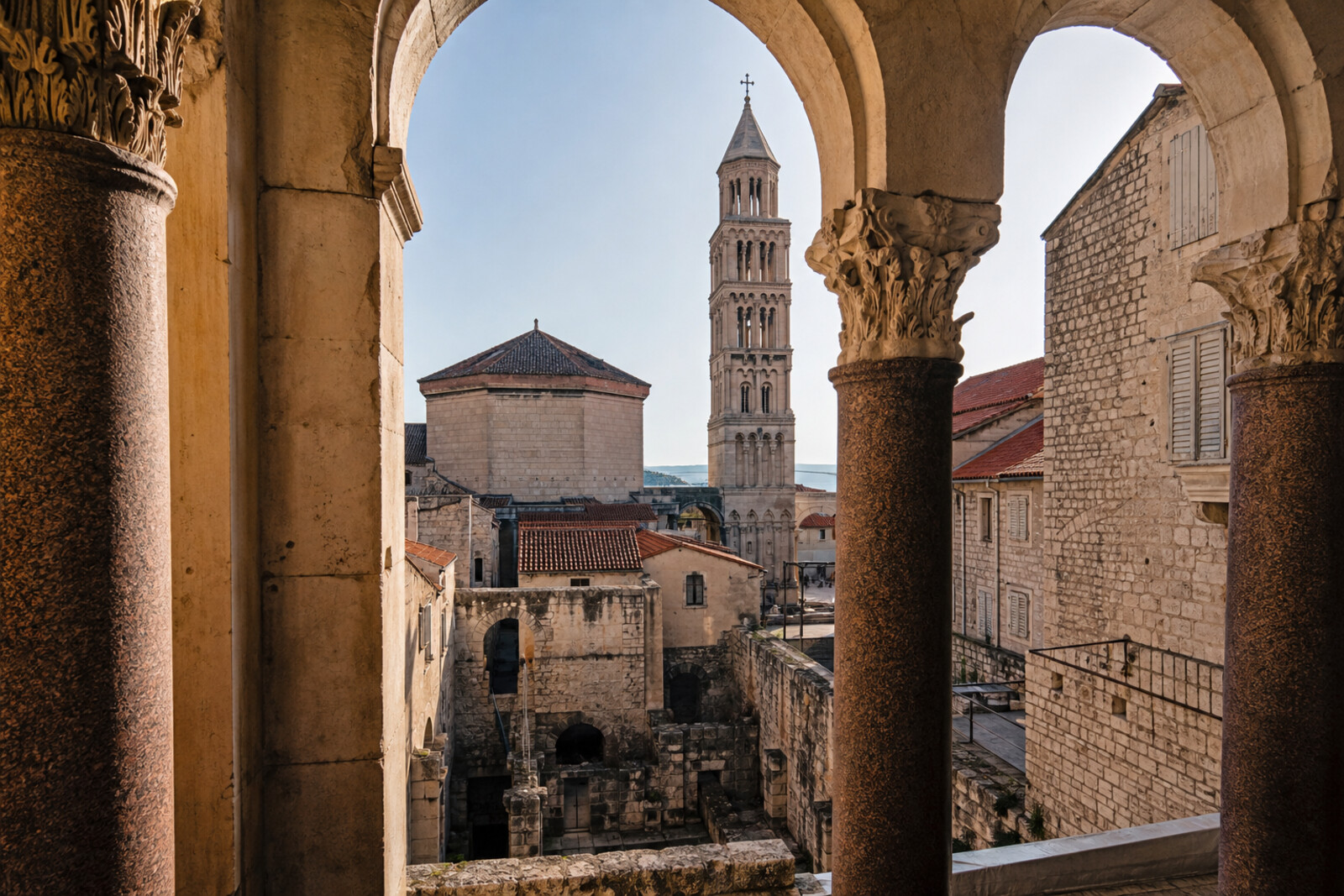
You will enter Split through the Golden Gate of Diocletian's Palace. You will follow its main street to the Peristyle, look into the former shrines and the round Vestibule. Then you will descend beneath today's houses, emerge at the sea-facing facade, and return to the western gate. Beyond it, the city square will be waiting.
Along the way, the Roman residence will look less and less like a monument standing apart. Columns will turn up inside residential facades. The Cathedral of Saint Domnius will hold services in the imperial tomb. Beneath the streets, the outlines of vanished rooms will remain.
Why were four plinths left above the main entrance when no trace of the statues has been found? How did an unnamed king end up on the side of a baptismal font? What can the stripes and grooves on the gate tell us?
The story will stick to the facts, mark legends and disputed attributions as such, and test major changes against the stone itself. After the walk, you will read central Split as a palace that its townspeople occupied, dismantled, and adapted for their own lives.
Why this order
Golden Gate will set out the original Roman plan: from the main northern entrance, a straight street leads to the Peristyle, where the site of imperial ceremony became a city stage. On either side of the square, two neighboring shrines show the sharpest change of use: first Diocletian's Mausoleum, turned into the Cathedral of Saint Domnius, then the Temple of Jupiter (Baptistery of St John). The southern exit from the Peristyle continues the palace sequence in the Vestibule; descending from here into the Palace Substructures lets you compare the vanished upper rooms with their lower plan. The central corridor leads to the sea, so the Riva shows how the palace facade became part of port life. Returning through the southern passage and the cross street brings you to Iron Gate: after the sea facade, you will see how a landward passage was taken over by the court and commerce. One step beyond the western wall completes the route at People's Square (Pjaca), where city government moved.
Those who want to understand the layout of Diocletian's Palace on site Those interested in the lives of ancient buildings after Antiquity Those who enjoy stories whose conclusions rest on a stone detail or a document
Those looking for an overview of all of old Split rather than one palace core Those uninterested in rebuilding and disputed attributions Those who prefer a panoramic walk without a dense historical narrative
Before you go
The route combines open city spaces with an active cathedral and museum interiors. For entry to the Cathedral of Saint Domnius and the Temple of Jupiter (Baptistery of St John), choose clothing that covers your shoulders and knees, speak quietly, and be ready to postpone your visit during a service. Access to individual parts of the cathedral complex and the halls of the Palace Substructures may be controlled by tickets; before your walk, check the current conditions at the official ticket counters, especially if you want to climb the Bell Tower of Saint Domnius Cathedral. The underground spaces are cooler than the Riva, the floor is uneven in places, and crowds quickly build up at the Peristyle and near Bronze Gate. Save the map in advance: after the stop on the waterfront, you need to return inside the palace rather than continue along the outer wall.
When to go
It is best to start in the morning, while it is easier to study the details and hear the story at Golden Gate and the Peristyle. If you go later, check access to the religious and museum spaces in advance and allow extra time for a line, a service, or a temporary entry restriction.
Backup plan
If the interiors are inaccessible, the route still holds together. At the Cathedral of Saint Domnius, walk around the octagonal Roman structure and study the medieval doors from the threshold; at the Temple of Jupiter (Baptistery of St John), focus on the portal and the headless sphinx. The Vestibule can be understood as the passage between the Peristyle and the southern part of the palace, while instead of the ticketed halls of the Palace Substructures, you can take the accessible central corridor or walk around the palace to the Riva along ordinary streets. From the waterfront, the arches of the southern facade and the position of Bronze Gate are easy to read. Then return to the western axis, pass through Iron Gate, and finish the walk at People's Square (Pjaca): the main line of transformations will remain clear even without the paid interiors.
Route conditions
Surface. Paved — 968 m (data covers 81% of the route)
Stairs. Flights: 15, 82 m in total
Access. Wheelchair — no; stroller — limited (stairs)
Facilities. Toilets — 5; drinking water — 6
Elevation. Ascent — 5 m; descent — 11 m
OpenStreetMap extract of July 4, 2026: database data, not a check on the ground. Data © OpenStreetMap contributors, ODbL licence
Walk plan
Open in maps ↗- 1
Golden Gate
The main entrance sets the scale of the residence and raises the question of why its owner did not return to power. - 2
Peristyle
The square will explain why the palace ceremonial layout suited the new urban community. - 3
Cathedral of Saint Domnius
Here, the palace's change of owners becomes literal: a new community will occupy the main memorial building of the former ruler. - 4
Temple of Jupiter (Baptistery of St John)
The font and statue will show how objects from different centuries were brought together around an ancient building's new purpose. - 5
Vestibule
The rotunda will separate the Roman layout from the housing that restorers removed in the twentieth century. - 6
Palace Substructures
The lower rooms preserve the plan of the lost quarters and explain the benefit that city waste brought to the ancient masonry. - 7
Riva and the Southern Facade
The waterfront will extend the story of the palace to the harbor, quarantine trade, and a vanished warehouse complex. - 8
Iron Gate
Traces on the side walls reveal the sequence of the guard post, the city court, and the shops. - 9
People's Square
The final stop will show how Split's political center moved beyond the palace walls and changed the language of administration.
Route features
Everything you need stays in the browser
Progress, saves and your trip plan are stored on this device.
Add Guide On Map to your home screen so the walk opens outside the browser.
How we handle sources, maps and corrections: our editorial standards