 Guide On Map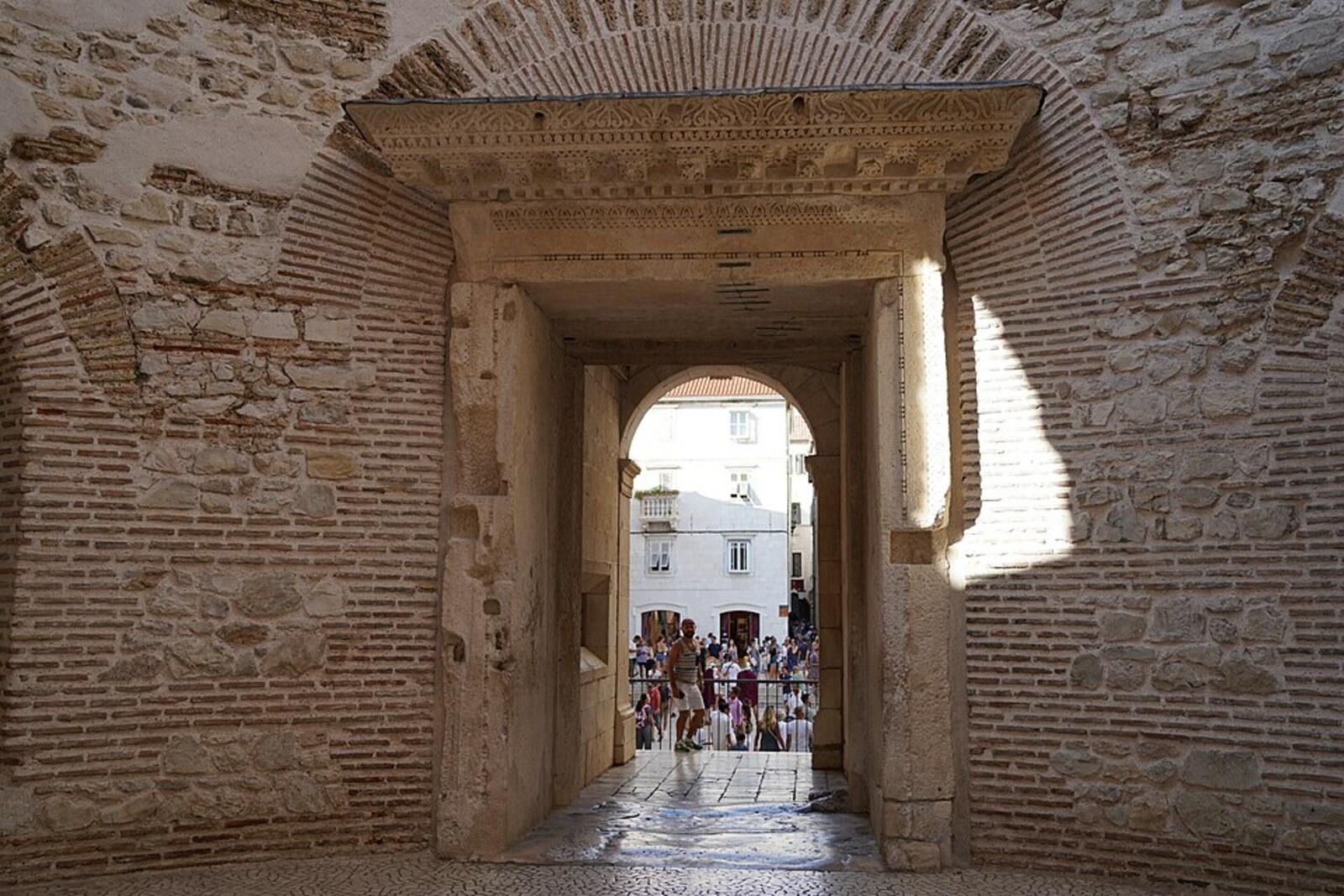
Look around first
What to notice
- Round walls
- Opened semicircular niches
- Open opening of the dome
- Restored floor structure
The story of the place
The name “Vestibule” preserves this room's former function—serving as an antechamber. From the open Peristyle, people entered here into a tall covered rotunda, then went on into a rectangular hall before Diocletian's private quarters. The round walls with semicircular niches, doors, and staircases mark the boundary beyond which the part of the palace open to everyone ended. Now, beneath the open opening of the dome, Dalmatian klapa ensembles sing without instruments: the concave walls amplify their voices.
As recently as the middle of the twentieth century, people lived inside this rotunda. They kept poultry here and grew vegetables. The round hall was divided by floor structures and additions; walls, doors, and utility rooms appeared in the ancient niches.
Housing began to be arranged here as early as the Early Middle Ages. The imperial quarters had long lost their former owners, but the thick walls gave townspeople a ready-made basis for houses. At the beginning of the sixteenth century, Marko Marulić, a writer from Split, still managed to describe the golden shimmer of the mosaic on the dome. His record preserved evidence of decoration that later disappeared: the marble facing was carried away, the mosaic crumbled, and only the lower part of the dome remained.
In nineteen fifty-five, Jerko Marasović, a young architect at the Urban Institute of Dalmatia, began studying the rotunda. He sought to recover the ancient structure from beneath later alterations. He was in his early thirties; he left a steady post in monument protection for work in which he could personally conduct measurements, excavations, and restoration. An error here would remain in stone and concrete: visitors would take a restorer's guess for Roman masonry. Marasović therefore insisted on first establishing how the building was arranged, and only then deciding what to restore.
His group found the original staircases running from the Peristyle beneath the rotunda to the Palace Substructures, determined the arrangement of the lower level and the ancient floor level. From nineteen fifty-five to nineteen fifty-seven, builders restored the lower vaults, reinstated the floor structure between the levels, and opened up the blocked semicircular niches. The upper rotunda and the passage beneath it once again became two separate rooms. The housing inside disappeared, and the route from the Peristyle through the Vestibule to the former residential part of the palace became accessible as a continuous sequence of halls.
The name describes this place's former function: a vestibule is an antechamber. From the open Peristyle, a person entered a tall covered rotunda, and from here went on into a rectangular hall before Diocletian's private quarters. Historians cannot reconstruct the exact ceremonial, but the direction of movement is confirmed by the walls, doors, and staircases: this was where the part of the palace open to everyone ended.
Now the round room is used by klapa groups—Dalmatian ensembles that sing without instruments. The tall concave walls amplify their voices, which is why performers choose this very spot. Beneath their feet is the floor structure restored by Marasović's group, and above them is the open center of the lost mosaic dome.
Useful on site
Open around the clock as a passageway, unless there is a temporary closure.
Checked: June 24, 2026. Check the official source before visiting.Stand by the wall, not in the middle of the flow of people. If a klapa is singing here, wait until the song ends and do not speak loudly: the acoustics amplify every sound.