 Guide On Map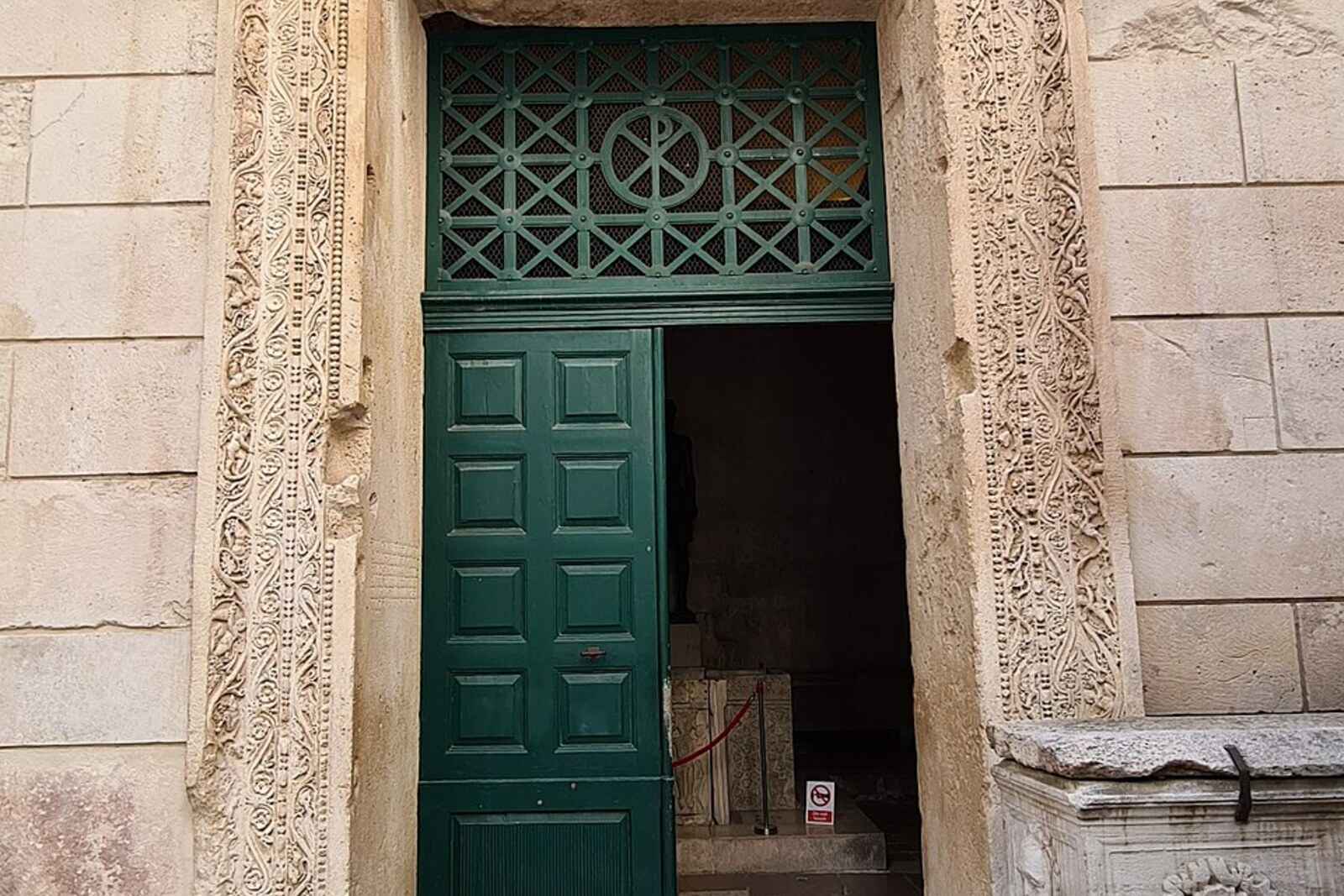
Look around first
What to notice
- Cross-shaped stone font
- Slabs with carvings
- Relief of a ruler on a throne
- Bronze statue of John the Baptist
The story of the place
The name “Temple of Jupiter” sounds more certain than the sources allow. This rectangular temple in the western part of the palace sanctuary has also been attributed to Asclepius and two-faced Janus. Diocletian bore the honorary name Iovius, which linked him to Jupiter, but historians still cannot determine which god this particular building served.
There is more clarity about its Christian purpose. When the former mausoleum opposite became a cathedral, its community turned the neighboring pagan temple into a separate baptistery. The baptistery was dedicated to John the Baptist, the preacher who, according to the Gospels, baptized Jesus in the Jordan River. Here, a person entered the Christian community through baptism.
The stone font took its present form around the middle of the thirteenth century. At that time, new carved seats for the clergy were being installed in the cathedral. To make room for them, an eleventh-century altar screen was most likely dismantled—a stone partition separating the priests at the altar from the congregation. The old marble slabs were not thrown away. Builders carried them across the Peristyle and assembled them in the baptistery into a cross-shaped basin, in place of an earlier font.
Twelve slabs were built into its walls; carving survives on six. One is particularly awkward for confident labels: a ruler sits on a throne, a person stands beside him, and another lies prostrate before them. The ruler is usually identified as Petar Krešimir IV or Demetrius Zvonimir—Croatian kings of the eleventh century. Neither attribution has been proven; there is even debate about which church the slab came from. One thing is reliably known: the relief had already served in an altar screen, then the clergy ordered it reused, and the scene with the king survived in the wall of the font.
Seven centuries later, another human figure was added to the same font. In nineteen fifty-three, the Split archbishop Frane Franić asked Ivan Meštrović to create a statue of John the Baptist for the baptistery. The sculptor was then living in Syracuse, New York, in the United States, and earning a living by teaching. Following his imprisonment during the war years and his departure from the country, he had not returned to his homeland for more than ten years, but he continued sending works to Split.
Meštrović modeled the statue specifically for this cramped interior. He portrayed an emaciated John with sunken eyes and placed in his hand a shallow vessel for baptism by pouring. The bronze was cast in nineteen fifty-nine and installed here a year later.
Now Meštrović's John stands opposite the cross-shaped font. In his hand is a vessel for water, and in the stone wall before him the unnamed king still sits, on a slab that medieval builders removed from the altar screen and gave to the baptistery.
Useful on site
Access depends on the seasonal schedule and tickets for the cathedral complex; check the ticket office at the Peristyle on the day of your visit.
Checked: June 24, 2026. Check the official source before visiting.The room is cramped, so let people exit and do not block the entrance. If you cannot get inside, the portal and sphinx are clearly visible from the street; admission may be covered by a separate ticket for the cathedral complex.