 Guide On Map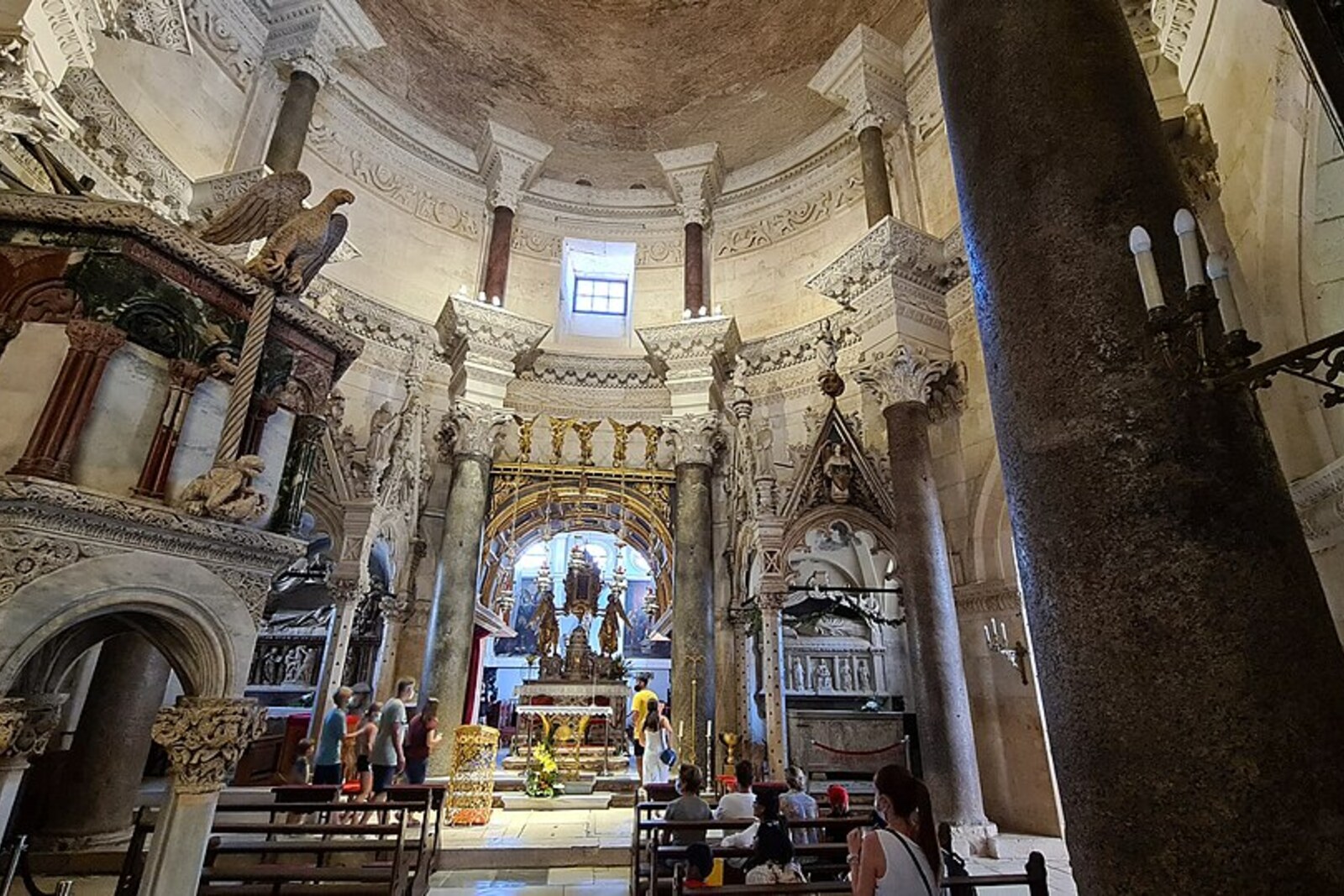
Look around first
What to notice
- Octagonal structure
- Red granite columns
- Roman cornice with medallions
- Altar by the north wall
The story of the place
The cathedral's octagonal structure once served as the tomb of a Roman ruler within his palace. Beneath the dome, red granite columns and a cornice with round medallions have survived, in which images of the ruler and his wife can be made out. The porphyry sarcophagus is no longer in the center, and by the north wall stands an altar with remains venerated as the relics of the city's patron saint. Once a year, the reliquary is carried from here through the streets in a procession.
In the seventh century, settlers from the destroyed Salona converted this octagonal tomb into a cathedral—the principal church of their bishop. The fittings of the imperial cult were removed from the room, Diocletian's porphyry sarcophagus disappeared from the center, and altars appeared in the niches. The church was dedicated to the Assumption of the Blessed Virgin Mary, but the people of Split call it the Cathedral of Saint Domnius.
Saint Domnius was the bishop of Salona, the Roman provincial capital not far from here. He led the Christian community at precisely the time when Diocletian and his co-rulers decided to destroy it. The edicts required churches to be demolished, sacred books to be burned, clergy to be imprisoned, and Christians to be forced to sacrifice to the Roman gods. For the bishop, complying with the demand meant renouncing what his community supported him for and recognized him as its leader.
On April tenth, three hundred four, Marcus Aurelius Iulius, governor of Dalmatia, ordered Saint Domnius executed in Salona's amphitheater. His existence is confirmed not by a later hagiography: archaeologists found a tombstone inscription with Saint Domnius's name, his rank as bishop, the word “martyr,” and the day of his death. There is no evidence that Diocletian personally handled Saint Domnius's case. The emperor issued the edicts; the local governor passed the sentence.
Several centuries later, settlers from Salona sought a place for their episcopal church within the palace's protected walls. They occupied the mausoleum of the man under whom their former bishop had died. A medieval chronicle attributes this decision to John of Ravenna, the first archbishop of Split: supposedly, he cleared the tomb of pagan images and ordered Saint Domnius's remains brought here from the ruins of Salona. The chronicle was written down about six hundred years after the events, and modern historians doubt even that its John was one person rather than a composite image of several bishops.
There is no complete certainty about the remains either. After the destruction of Salona, Pope John IV sent Abbot Martin to take the relics of Dalmatian martyrs to Rome; Saint Domnius is depicted among them in a mosaic in the Lateran Baptistery. Therefore, the identity of the bones venerated in Split cannot be proven. Yet as early as the tenth century, a written source calls the former mausoleum the church of Saint Domnius and reports that the townspeople believed his relics to be here. Thus, the executed bishop's name became attached to both the cathedral and the city itself: Saint Domnius became Split's patron saint.
Inside, the mausoleum's red granite columns still stand, and medallions survive on the Roman cornice in which portraits of Diocletian and his wife Prisca are seen. The imperial sarcophagus is not in the center. By the north wall stands an altar with remains venerated as Saint Domnius's relics; on May seventh, the reliquary is carried from here in a city procession.
Useful on site
Tourist hours and ticket packages vary by season and are not consistently published in a single official schedule; check at the ticket office on the Peristyle. Visiting stops during services.
Checked: June 24, 2026. Check the official source before visiting.This is an active church: observe the dress requirements, mute your phone, and do not view the interior during a service. Entry to the complex and the climb up the bell tower may be arranged separately.