 Guide On Map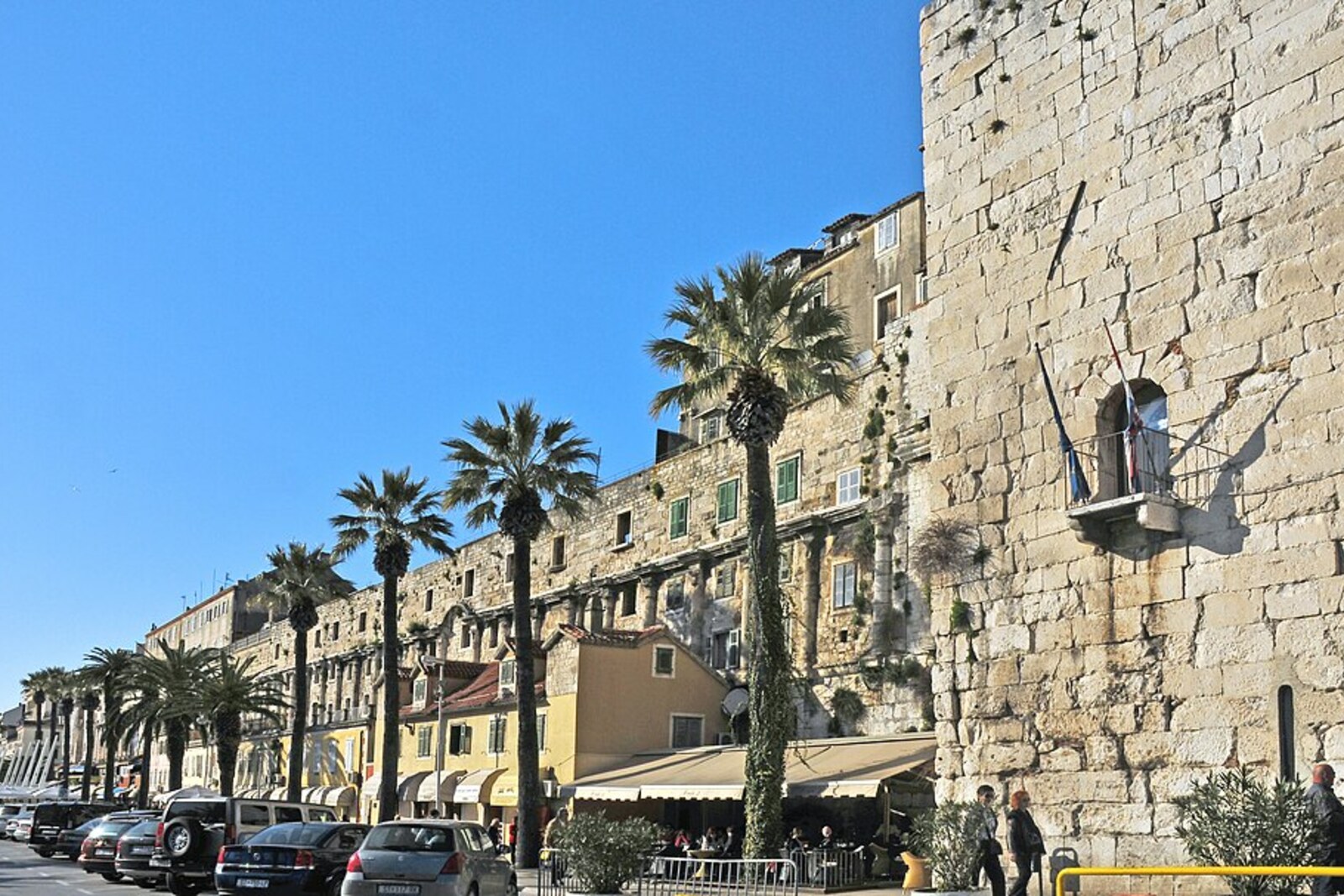
Look around first
What to notice
- Southern facade of the palace
- Large arches of the upper level
- Southern gate
- Houses and shops along the facade
The story of the place
The palace's southern wall once stood at the working edge of the harbor: excavations brought to light an ancient quay about twelve meters from the facade. On the strip of land between it and the palace walls, vessels were unloaded and small boats were hauled ashore. Above were the emperor's private rooms, while the small gate in the southern wall apparently provided a service passage to the water. Over time, residential houses and shops were added to the Roman facade, and they still form the edge of the waterfront today.
In Split, Riva is the name given to the waterfront in front of the southern facade of the palace. The street signs bear a different name—the Croatian National Revival Waterfront. It commemorates the cultural and political movement of the nineteenth century: its participants sought a common literary language and the unification of Croatian lands divided by borders within the empire. The official name remained on maps, but in everyday speech the shorter “Riva” prevailed. This is where people meet, sit in cafés, hold celebrations, and honor athletes.
The distance from the palace wall to the water is deceptive. During excavations, archaeologists found an ancient quay wall about twelve meters in front of the facade. On the area between it and the palace, cargo was unloaded and small vessels were hauled ashore. Above the quay stretched the imperial quarters with their large arches, while the small southern gate most likely served as a descent to the sea and a service entrance. Later, residents built houses and shops into the Roman facade, and they still stand along the Riva today.
In the late sixteenth century, a man appeared on the eastern extension of this waterfront for whom one pier was not enough. Daniel Rodriga, a Portuguese Sephardic Jew and merchant, made his living from long-distance trade between the possessions of the Ottoman Empire and ports on the Adriatic Sea. His family belonged to a community whose persecution forced many people to leave the Iberian Peninsula. Rodriga wanted to secure for such merchants the right to live and conduct business safely in the lands of the Republic of Venice.
In fifteen seventy-seven, he proposed to Venetian senators that a caravan route be run through Split, which Venice governed at the time. By the harbor itself, a customs house, warehouses, and a lazaretto were to be built—a closed complex where people and goods underwent quarantine. Rodriga invested his own money, negotiated with Ottoman officials, and promised to direct through Split trade that was going to Venice's competitors.
Alvise Loredan, appointed by Venice as head of Split, sought to have the proposal rejected. He openly objected to a large city enterprise being managed by a Jew together with other Jewish merchants. The project was delayed by customs disputes, lack of funds, and opposition from trade rivals. Rodriga continued to submit petitions and look for partners.
Fifteen years later, the trading station officially opened. The site was chosen just beyond the palace's southeastern tower: caravans could enter from land without passing through residential quarters, while processed goods were sent by sea to Venice. In the enclosed courtyards, merchants, drovers, and cargo were kept for about forty days. Copper, wool, silk, hides, rice, and spices were kept separately, disinfected, and only then transferred to ships.
The flow proved so great that by the middle of the seventeenth century the Venetians had expanded the lazaretto four times; its buildings stretched for more than two hundred meters along the harbor. Split became one of Europe's main ports for trade with the Ottoman Empire. Rodriga was appointed consul of Jewish merchants, and his community received the privileges he had sought together with permission to build.
When caravan trade declined, the premises housed barracks, a prison, a warehouse, and a theater. The eastern part was dismantled for the railway, and the remaining buildings were severely damaged by the bombings of nineteen forty-three and nineteen forty-four. After the war, they were demolished; the last tower was removed before the construction of the Tourist Palace in nineteen sixty-eight.
Nothing of the lazaretto remains above ground. The eastern part of the waterfront is still called Obala Lazareta, and Rodrigina Street runs within the palace walls.
Useful on site
Open around the clock as a public waterfront.
Checked: June 24, 2026. Check the official source before visiting.Move toward the seaward side of the waterfront so that the facade fits in your field of view. The Riva is noisy and sunny; it is easier to listen away from the flow of people coming out of the gate.