 Guide On Map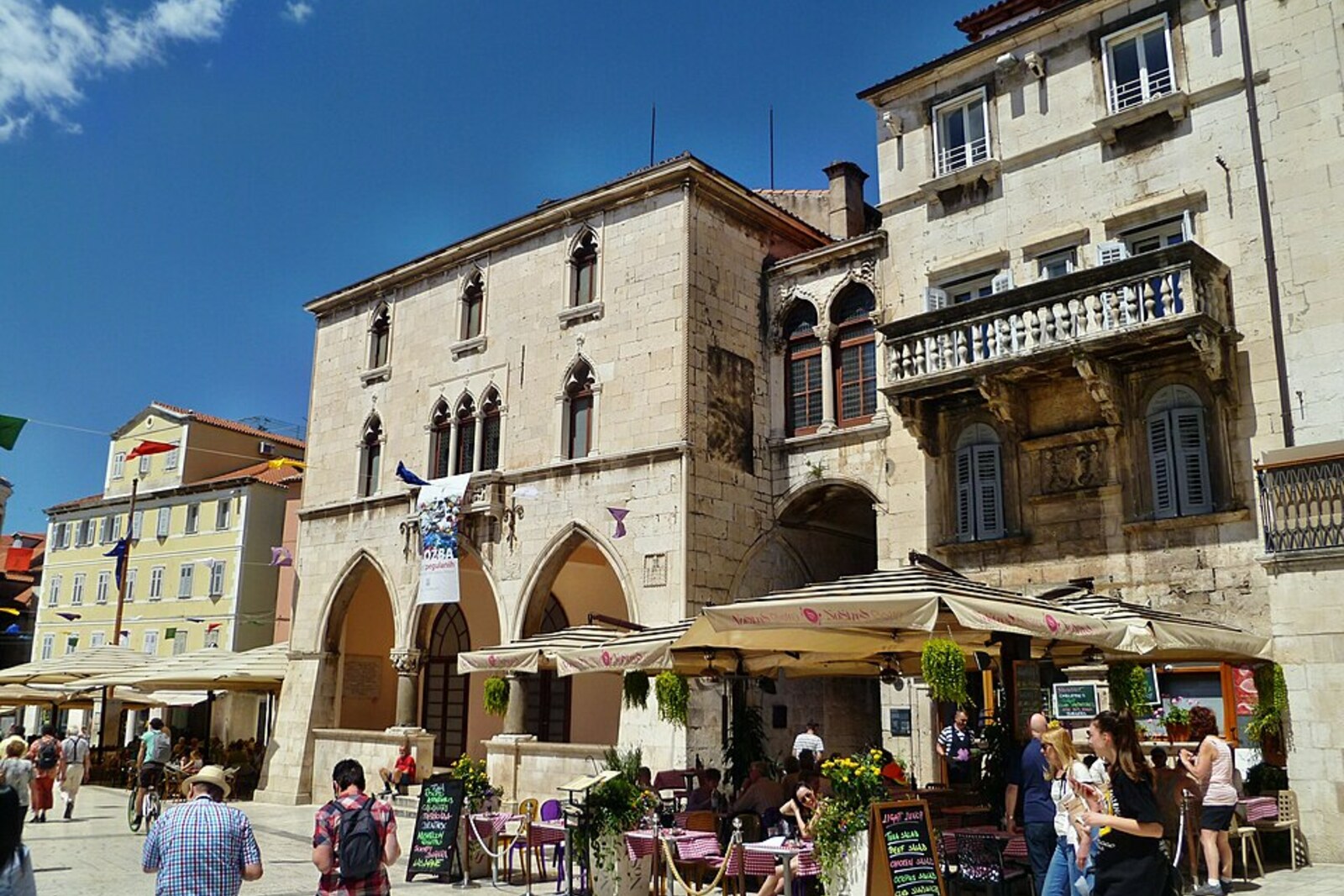
Look around first
What to notice
- The stone façade of Old City Hall
- The three arches of the loggia
The story of the place
Beyond the Iron Gate, the residents of medieval Split began building houses as early as the thirteenth century. The new district grew around the Church of St Lawrence and St Lawrence's Cemetery, so today's People's Square was initially called St Lawrence's Square. Later, the city councillors placed a city hall, a chancery, the palace of a prince appointed by Venice, and a prison here. Decisions were announced in the square, court cases were heard, and goods were checked against municipal measures. Split no longer fit within Diocletian's Palace, and the administration of the city that had grown beyond its walls was organized beside the western entrance.
In the nineteenth century, the square was called Gospodski Square. For twenty years, the municipality was led by Ante Bajamonti—a physician who left his practice for city politics. He brought water to Split, expanded the harbor, introduced gas lighting, and enjoyed broad support. At the same time, Bajamonti sought to keep Dalmatia separate from Croatia and increasingly tied its future to Italian culture.
His chief opponent was Gajo Bulat, a Split lawyer and leader of the People's Party. Bulat lived by his legal practice and worked to shift city institutions, courts, and schools to the Croatian language. An ordinary legal case gave him the chance to damage Bajamonti's reputation. Bulat represented Bishop Josip Juraj Strossmayer, who had invested forty thousand florins in Bajamonti's company. Having gained access to its papers, the lawyer discovered incorrect accounts, neglected affairs, and unpaid dividends. He made the results of the audit public.
Among Bajamonti's supporters were members of an armed shooting society. Its premises were also here in the square, in Prini House. After members of the society attacked even soldiers of the city garrison, Bulat demanded that the Austrian administration dissolve the municipal council. In eighteen eighty, the council was dissolved, and an appointed commissioner began governing the city until the elections.
Bulat prepared for the vote for another two years. His supporters published the bilingual newspaper Split and distributed it to the city's farmers, whom the former administration regarded as reliable voters for Bajamonti. In the elections of eighteen eighty-two, the supporters of the Croatian-oriented People's Party won twenty-eight seats against eight.
The first meeting was opened by the oldest councillor, the merchant Ivan Brajević. He was the first to speak Croatian in the municipal council. The councillors elected the lawyer Dujam Rendić-Miočević as head of the city and resolved to conduct meetings in Croatian, then introduce it in primary schools. Bajamonti retained his seat in the Diet of Dalmatia, but his party lost its former importance. Bulat first became assistant to the new head of the city, and from eighteen eighty-five he himself led the municipality and completed the reconstruction of the municipal building in this square.
In nineteen twelve, the city council systematically established the names of streets and squares for the first time. Gospodski Square was named People's Square—in memory of the victory of the People's Party supporters and the transition of city administration to Croatian. Of the former municipal complex on the north side, the three-arched loggia of Old City Hall has survived; an exhibition hall is now open inside. The officials' offices have disappeared from here, but the official address still states whose victory the city council decided to preserve in the name.
Useful on site
The square is open around the clock. Under the summer schedule from 30 March to 31 October 2026, Old City Hall is open Tuesday through Sunday 10:00–20:00, closed on Mondays and public holidays; last entry is 30 minutes before closing.
Checked: June 24, 2026. Check the official source before visiting.Walk around the edges of the square to see how closely institutions, homes, and cafés stand together. This is not a museum courtyard, so do not block entrances or the work of the establishments.