 Guide On Map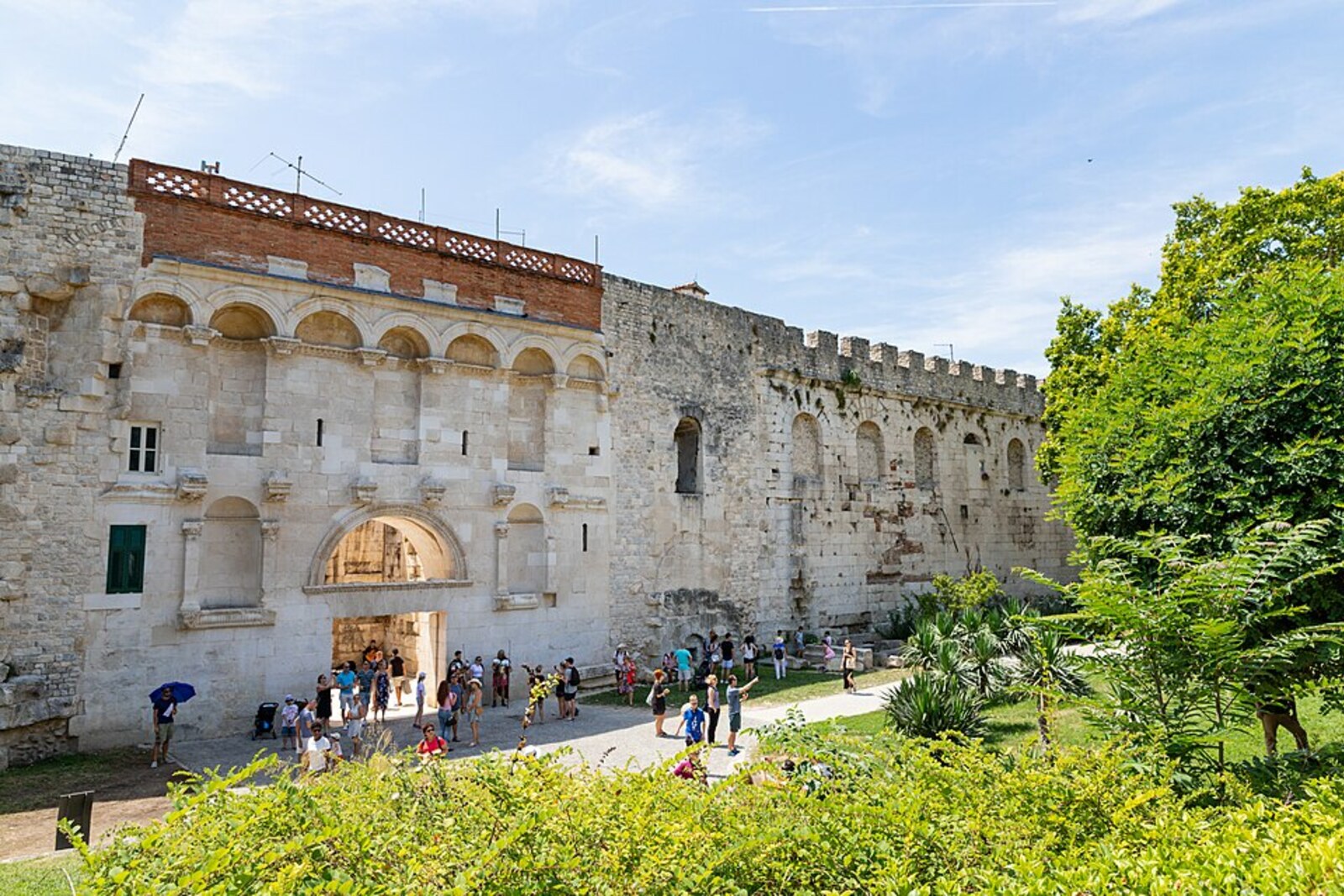
Look around first
What to notice
- Outer arch
- Stone pedestals above the arch
- Grooves for the raised portcullis
- Inner courtyard of the passage
The story of the place
There was never any gold here: the Golden Gate received its name only in the sixteenth century, under Venetian influence. In Roman times, this northern passage led to the road to Salona, the capital of Dalmatia; in the Middle Ages, it was called the Roman Gate. The outer doors admitted visitors into an enclosed courtyard, beyond which stood a second line of defense, while guards above could lower a portcullis. Two octagonal towers protected the passage on either side, and four stone pedestals remain above the arch from a plan that may never have been realized in statues.
On June first, three hundred five, Diocletian passed through this gate—a Roman emperor who had voluntarily abdicated a month earlier. Before him, emperors usually left office through murder, defeat, or death. Diocletian left alive and according to a procedure announced in advance.
He had prepared this transition for many years. The empire was governed by four men: two senior emperors and two junior co-rulers appointed by him as successors. This arrangement was later called the Tetrarchy, rule by four. Diocletian expected the senior rulers to step down one day, the junior rulers to take their places, and new successors to be chosen in turn. The rulers' own sons received no advantage.
Diocletian's Palace in Split was built precisely for Diocletian's retirement. The Golden Gate faces the road to Salona, the capital of Roman Dalmatia and the emperor's homeland, near present-day Solin. This was the main overland entrance: the outer doors admitted the arriving visitor into an enclosed courtyard, second doors awaited ahead, and guards above could lower a portcullis. Two octagonal towers stood on either side. Through an entrance like this, Diocletian entered not a temporary refuge but a residence designed for a man who retained imperial honors although he no longer commanded armies and officials.
On May first, in distant Nicomedia, he assembled the military, announced that he was ill and tired, named the new rulers, stepped down from the platform, and climbed into a carriage. That same day, Maximian, his western co-ruler, also laid aside the imperial title. A month later, Diocletian entered his new life here.
The test of his system began almost immediately. One of the new senior emperors died, and soldiers proclaimed his son Constantine, although Diocletian had intended the position for someone else. In Rome, Maxentius, the son of the retired Maximian, proclaimed himself emperor. Maximian returned to support his son and put on the imperial purple again. In place of four rulers chosen in advance came rivals with armies and dynastic claims.
Diocletian was summoned from Split to a meeting of former co-rulers. He helped compel Maximian to abdicate once more, but refused to return himself. A late Roman author attributed this reply to him: if his interlocutors saw the vegetables he had grown with his own hands in Salona, they would not urge him to become emperor again. This is a literary reworking, recorded decades later, not a transcript of the conversation. Diocletian's own choice is confirmed by his action: he never accepted the title again and returned to this palace.
Maximian could not remain in retirement. He tried to take the title from Constantine, lost, and was forced to die. Maxentius died in a war against that same Constantine. Constantine eventually became sole emperor. Diocletian did not live to see it: he spent his final years here, behind the gate through which he had entered after abdicating.
The Romans called this passage the Northern Gate, and in the Middle Ages it was called the Roman Gate. The name Golden Gate appeared only in the sixteenth century, under Venetian influence; there was no gold decoration here. Four stone pedestals survive above the arch and are associated with planned images of the four rulers. Restorers found no traces of attachments for statues, so it is unknown whether the statues were ever installed at all.
Useful on site
Open around the clock as part of a city street.
Checked: June 24, 2026. Check the official source before visiting.View the facade from outside, near the Statue of Grgur Ninski: the opening itself is narrow and people are constantly passing through. Do not linger in the middle of the passage.