 Guide On Map
Smolensk Along the Fortress Wall: From Lopatinsky Garden to the Dnieper
From Kopytenskie Gate through the center and Cathedral Hill to Dnieper Gate
Guide On Map on your phone
Open the walk like a regular app
It takes about 10 seconds to install. No app store needed.
The whole path
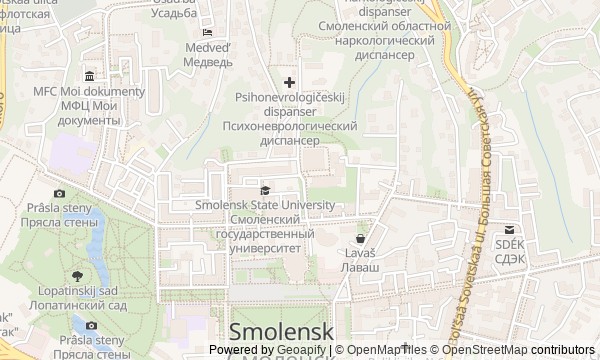
Route map
About the walk
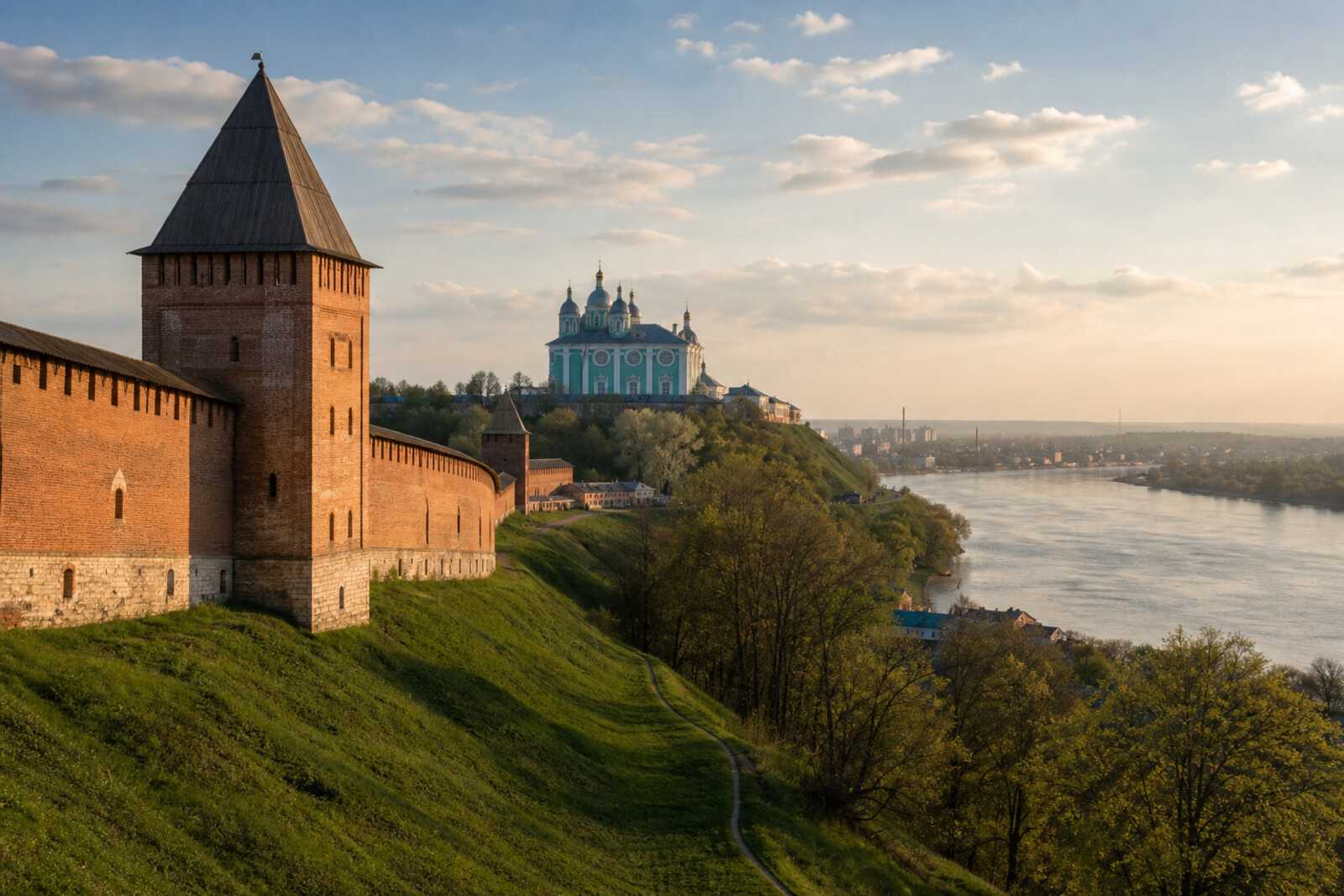
The route begins at Kopytenskie Gate, crosses the earthworks of Lopatinsky Garden and central Smolensk, climbs Cathedral Hill, and ends by the Dnieper. Along the way, you will find a brick wall, an earthen citadel, a city garden, a cathedral above the slope, and a gate beside a former river crossing.
You will see Smolensk not as a string of monuments, but as a fortress repeatedly adapted to new wars and to life in peacetime. Why will an explosion fail to open the road into the city? Why will large windows appear in a defensive tower? How will a fire lit by human hands come to stand beside a human grave?
The story stays close to human decisions and surviving objects. It separates what can be confirmed from legend and leaves ceremonial rhetoric aside.
By the end of the walk, you will be able to read the Smolensk Fortress Wall through the turns of its gates, its embankments, its altered towers, and the traces of a vanished bridge.
Why this order
Kopytenskie Gate sets the starting measure of the stone fortress: the defensive turn in its passage has survived here. From there, the route crosses Lopatinsky Garden to the Royal Bastion, an earthen citadel built to replace a section of wall destroyed by an explosion. At its rampart, a monument commemorating the city’s defenders in 1812 connects the shape of the fortification with the battle fought on this very position.
From this military landscape, the route continues to Gromovaya Tower. Inside the wall, you can see how a defensive structure was adapted first as an archive and then as housing. The neighboring Heroes’ Memory Square carries that transformation into the open air: fortress masonry becomes the boundary of a memorial and a place of burial. Beyond it, Blonye Garden reveals the peaceful center behind the wall, where memory was preserved through music, a school, and a monument.
From the city garden, the road climbs to Assumption Cathedral, which served as a refuge during the occupation of Smolensk. The final descent to the Dnieper brings the route back to gates and defense: at the former crossing, the wall, the river, and Moscow Road once again come together as a single military position.
Anyone who wants to understand the layout of the Smolensk fortress on the ground Anyone drawn to human decisions within a larger military history Anyone who enjoys long historical walks with climbs and descents
Anyone expecting a quick overview of the main sights without a detailed story Anyone who finds long walks over uneven ground difficult Anyone who prefers a light walk without military history
Before you go
Most of the walk is outdoors, so choose footwear suitable for slopes, stairs, and uneven surfaces; the earthen ramparts can be slippery after rain. Plan a visit to The Formidable Seventeenth Century inside Gromovaya Tower separately: its tiered defensive structure is easiest to understand from within, though the route still works without going inside. Assumption Cathedral is an active place of worship, not an exhibition hall: check the service schedule before visiting, dress appropriately, and put conversation and photography aside if a service is underway. Keep a respectful silence in Heroes’ Memory Square. Bring water: there is a noticeable climb before the cathedral, followed by a descent to the river.
When to go
Begin in good daylight: you will need it to make out the bend in the gate, the shape of the ramparts, the monument’s inscriptions, and the details of the fortress masonry. Allow extra time at Gromovaya Tower if you plan to go inside. Do not rush the stretch from Blonye Garden to the cathedral—the climb is better taken with pauses, and a visit to the church should not be forced into a rigid schedule.
Backup plan
If Gromovaya Tower is closed, examine it from several sides: its faceted form, enlarged windows, and the neighboring break in the wall still tell the story of its alterations. If the cathedral is closed, remain in the square and read the hill as a natural fortification through its slopes, staircase, and the position of the church above the city. On wet or icy ramparts, do not look for shortcuts across the grass—keep to maintained paths. If passage through a particular site is closed, do not go beyond the barriers; continue to the next stop along an accessible city street.
Route conditions
Surface. Paved — 1.8 km (data covers 41% of the route)
Stairs. Flights: 2, 31 m in total
Access. Wheelchair — no; stroller — limited (stairs)
Facilities. Toilets — 6
Elevation. Ascent — 23 m; descent — 88 m
OpenStreetMap extract of July 4, 2026: database data, not a check on the ground. Data © OpenStreetMap contributors, ODbL licence
Walk plan
Open in maps ↗- 1
Kopytenskaya Tower and Kopytenskie Gate
Here you will understand why damaged gate leaves still did not mean an open entrance to the fortress. - 2
Royal Bastion
The earthen ramparts show what replaced the demolished towers and how this section withstood another assault. - 3
Monument to the Defenders of Smolensk on the Fourth and Fifth of August, Eighteen Twelve
The monument marks the position held by two successive groups of Russian troops before their withdrawal. - 4
Gromovaya Tower
The altered tiers explain how the tower successively became an archive, a dormitory, and a museum. - 5
Heroes’ Memory Square
Here, a military necropolis, the Eternal Flame, and the fate of the man who lit it come together. - 6
Blonye Garden
This peaceful stop will show how many years the composer's family needed to preserve his music and carry on the work that had been started. - 7
Assumption Cathedral and Cathedral Hill
The cathedral emerges as a refuge where a single conversation with a military commander saved people and church valuables. - 8
Dnieper Gate and Dnieper Embankment
The final stop brings together the gate, the river, and the site of the counterattack near the destroyed crossing.
Route features
Everything you need stays in the browser
Progress, saves and your trip plan are stored on this device.
Add Guide On Map to your home screen so the walk opens outside the browser.
How we handle sources, maps and corrections: our editorial standards