 Guide On Map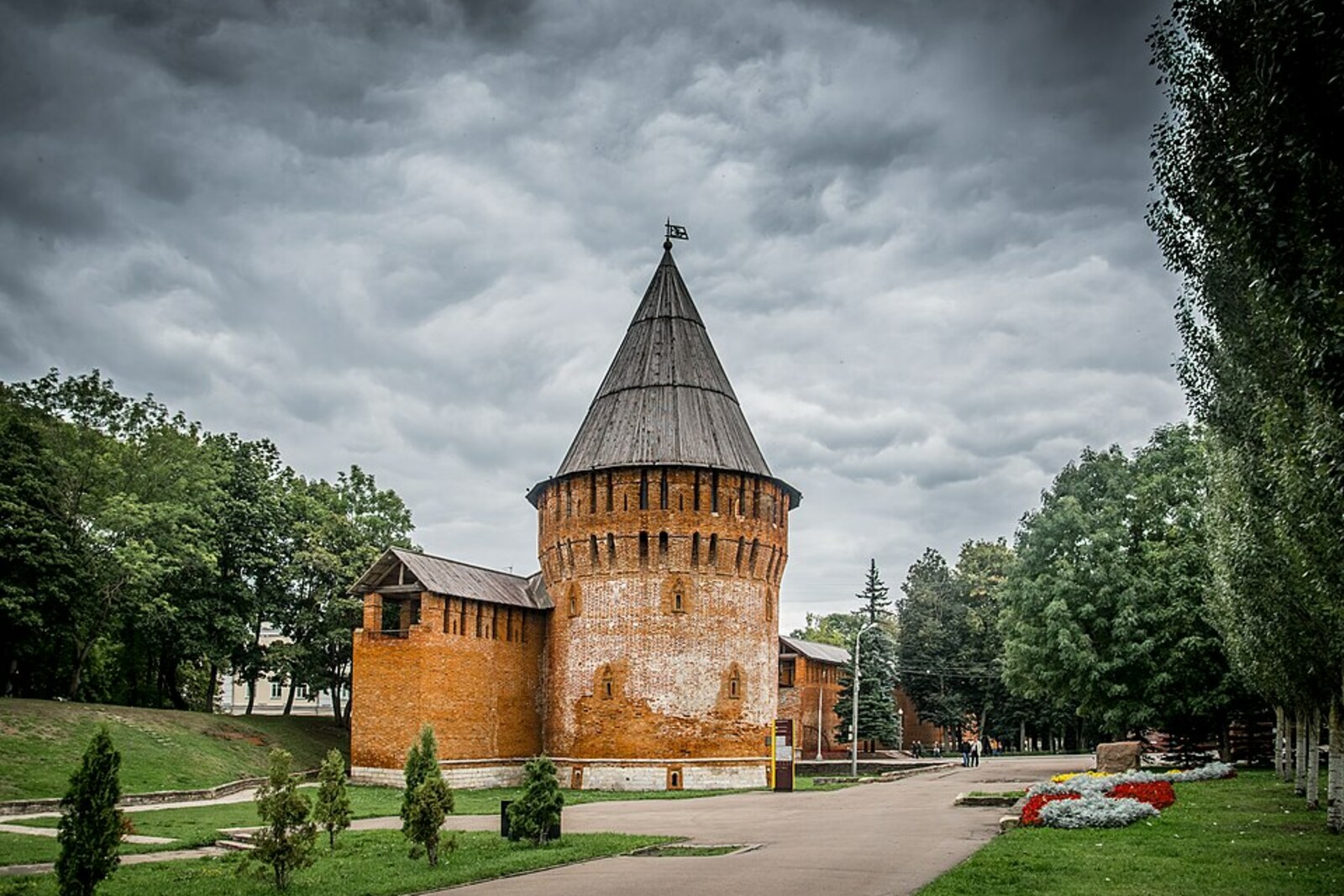
Look around first
What to notice
- Sixteen-sided structure
- Battlements
- Narrow loopholes
- Vaulted floors
The story of the place
The sixteen-sided, four-tiered structure projects outward at a bend in the Smolensk Fortress Wall, allowing the garrison to keep both the distant approaches and the adjoining wall sections under fire. The narrow loopholes were used against attackers at a distance, while the firing apertures beneath the battlements covered the ground right at the tower's base, where the enemy could come right up close. A marshy lowland once stretched in front of this section, and the tower acquired several names before its present one finally became established.
In nineteen fifty-four, students from the Smolensk Pedagogical Institute were moved into this fortress tower. They were training to become teachers, but they slept and studied inside a structure designed for a garrison and cannons. The choice of dormitory was dictated by postwar necessity: Smolensk lay in ruins, almost all its housing had been destroyed, and the students needed at least a roof over their heads.
It was possible to house people in the tower because of an earlier conversion. In the eighteen forties, the provincial administration established its main archive here: Gromovaya Tower stood closer to the governor's residence than any other tower. The builders filled in the gaps between the battlements, replaced the missing roof with an iron one, installed brick vaults between the tiers, and enlarged the narrow loopholes into large windows. The officials gained rooms for documents, while the tower gained floors and daylight, without which a dormitory could hardly have appeared there a century later.
Originally, everything was arranged differently. Fyodor Kon, who supervised construction of the Smolensk Fortress, erected a sixteen-sided, four-tiered tower here at a bend in the wall and projected it forward. From the loopholes, the garrison could fire on the approaches and adjoining sections of the wall; from the projecting firing apertures beneath the battlements, it could fire on the area right at the tower's base. The fortress was built from fifteen ninety-five to sixteen oh-two; during the siege of sixteen oh-nine, documents already referred to this tower simply as the Round Tower.
The name Gromovaya appeared much later and became firmly established only by the end of the nineteenth century. Its origin has not been precisely determined. Some associate the name with lightning over this open, elevated site, while others link it to the roar of the tower's cannons. There is also a theory involving the nearby Church of Elijah: in folk tradition, the prophet Elijah was regarded as the master of thunder. Earlier names included Tupinskaya Tower—after the obtuse angle of the wall or the end of Ilyinskaya Street—and Topinskaya Tower, after the marshy ground in front of the fortification.
Beginning in nineteen sixty-seven, restorers returned the battlements, narrow loopholes, and stairways within the walls to the tower, and in nineteen seventy-seven a military history exhibition opened here. The museum called “The Formidable Seventeenth Century” now operates inside. The vaulted floors between its tiers remain, although they did not exist in Fyodor Kon's time: they were built to hold the provincial administration's papers, and a hundred years later the future teachers lived above them.
Useful on site
Daily 11:00–18:00; ticket office until 17:30; the last Monday of the month is a maintenance day. Hours checked 2026-06-24.
Checked: June 24, 2026. Check the official source before visiting.The indoor exhibition requires separate admission and involves climbing stairs. If you remain outside, compare the narrow loopholes with the later large windows.