 Guide On Map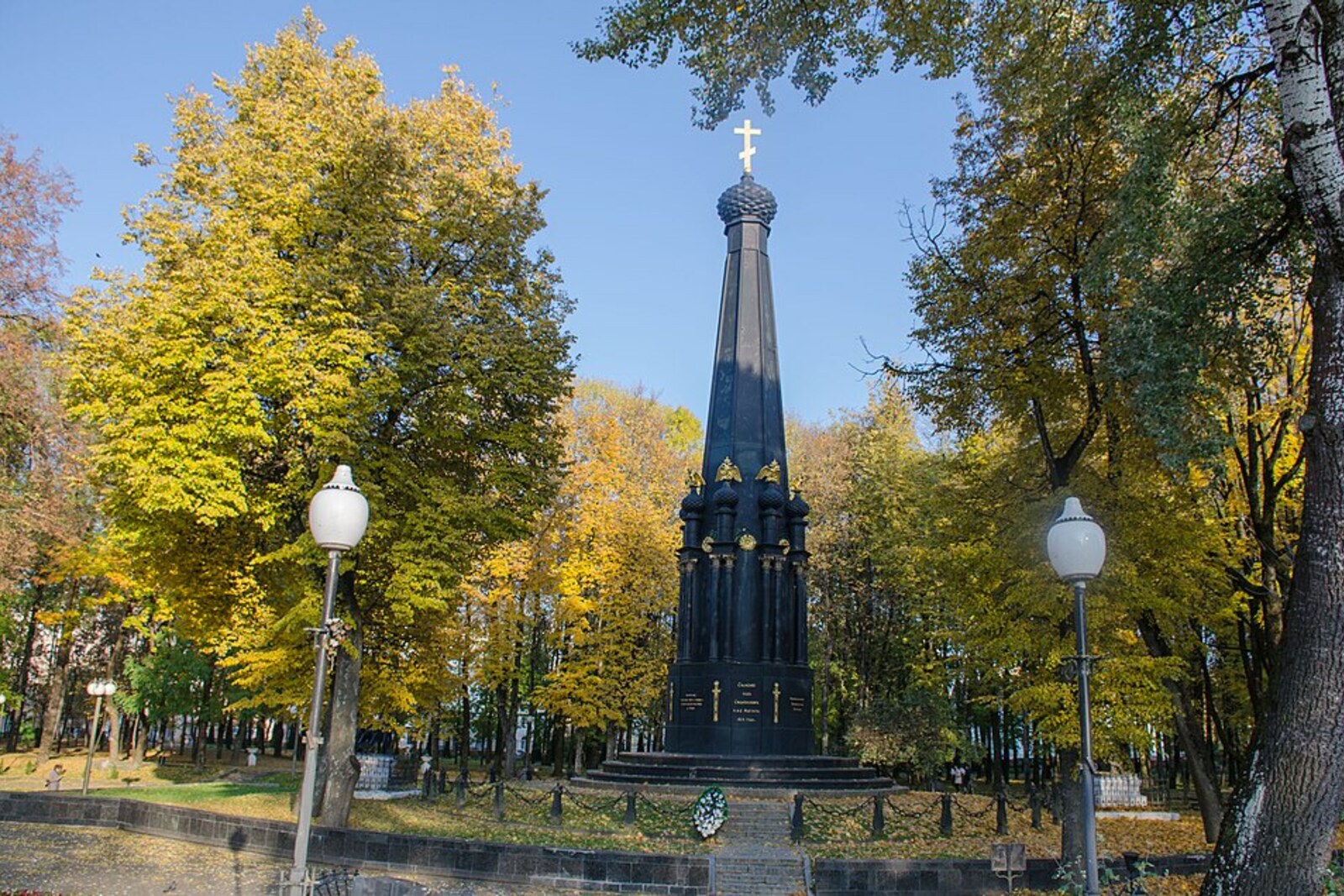
Look around first
What to notice
- Cast-iron monument
- Image of the Smolensk Hodegetria
- Relief plan of the battle
- Earthen rampart behind the monument
The story of the place
On the night of August fourth, eighteen twelve, Major General Ivan Paskevich, commander of the Twenty-Sixth Infantry Division, urged corps commander Nikolay Raevsky not to fight in front of Smolensk. A ravine lay behind the field position, and guns could not be moved across it. If the French cavalry outflanked the left flank, the infantry would have had to retreat toward the city through enemy troops, abandoning the artillery.
Raevsky needed to hold out until two Russian armies arrived. The French emperor Napoleon Bonaparte had moved troops across the Dnieper south of Smolensk and led them toward the city, into the rear of the Russian formations that had marched west. By capturing Smolensk and the Moscow Road, he could cut off their further retreat. Raevsky had about fifteen thousand men left, including a division battered in the previous battle and several hundred convalescing soldiers from the city hospitals.
By dawn, Raevsky had positioned the guns on the old earthworks and the infantry in front of the outskirts. He armed the soldiers discharged from the hospitals and stationed them on the brick wall. Paskevich was assigned the right sector of the defenses, including the Royal Bastion, an earthwork behind the present monument.
French Marshal Michel Ney sent infantry here to break through the defenses and enter the city. One of his columns climbed onto the bastion and almost captured the rampart. An officer had already galloped off to Raevsky with a report that the fortification had been lost. But the attackers had not seen a battalion of the Oryol Infantry Regiment concealed beside the rampart. The Oryol troops charged with bayonets and drove the French column off the bastion.
While the first report was on its way to Raevsky, it ceased to reflect what was happening. Another officer arrived soon afterward and reported that French soldiers had supposedly captured the only bridge across the Dnieper. Raevsky divided his last reserve: he sent two battalions to the bastion and rushed to the bridge with the other two. There he found the Russian guard in perfect order—there was no enemy at the crossing at all. When Raevsky returned here, Paskevich told him that the Oryol troops had already recaptured the rampart.
By evening, the main Russian forces appeared on the heights of the right bank. Raevsky's corps had accomplished the purpose for which it had remained in the city. At midnight, it was relieved by the Sixth Corps of General Dmitry Dokhturov, which was to hold Smolensk for one more day. On August fifth, the French assaulted the fortifications along the entire southern edge of the city but could not break through the defenses. During the first hour of the night leading into August sixth, the Russian troops received orders to leave, blew up the bridge, and continued their retreat along the Moscow Road. Napoleon occupied Smolensk after they withdrew, but he failed to encircle and destroy the two armies.
The defenders named in the monument's title are the soldiers of two successive groups: Raevsky's and Paskevich's men, who held the Royal Bastion on August fourth, and Dokhturov's troops, who continued the defense on August fifth. These dates follow the Russian calendar used at the time; by the modern calendar, the battle took place on August sixteenth and seventeenth.
Twenty-nine years later, on November fifth, eighteen forty-one, a cast-iron monument designed by architect Antonio Adamini was unveiled here. Emperor Nicholas I ordered such monuments to be erected at the sites of the principal battles. Of the seven monuments built in this series, the one in Smolensk is the only surviving original.
Lopatinsky Garden did not yet exist at the time: a military parade ground lay in front of the entrance to the Royal Fortress. On the eastern side of the monument, beneath the image of the Smolensk Hodegetria, a relief plan of the battle is mounted. Behind the cast-iron columns, the earthen rampart still rises—the rampart from which the battalion of the Oryol Infantry Regiment drove back Ney's column.
Useful on site
Exterior viewing during daylight hours; the monument is located in Lopatinsky Garden.
Checked: June 24, 2026. Check the official source before visiting.Walk all the way around the monument: its story is distributed across its different sides. Do not limit yourself to the overall silhouette—an important part of the design lies in the text.