 Guide On Map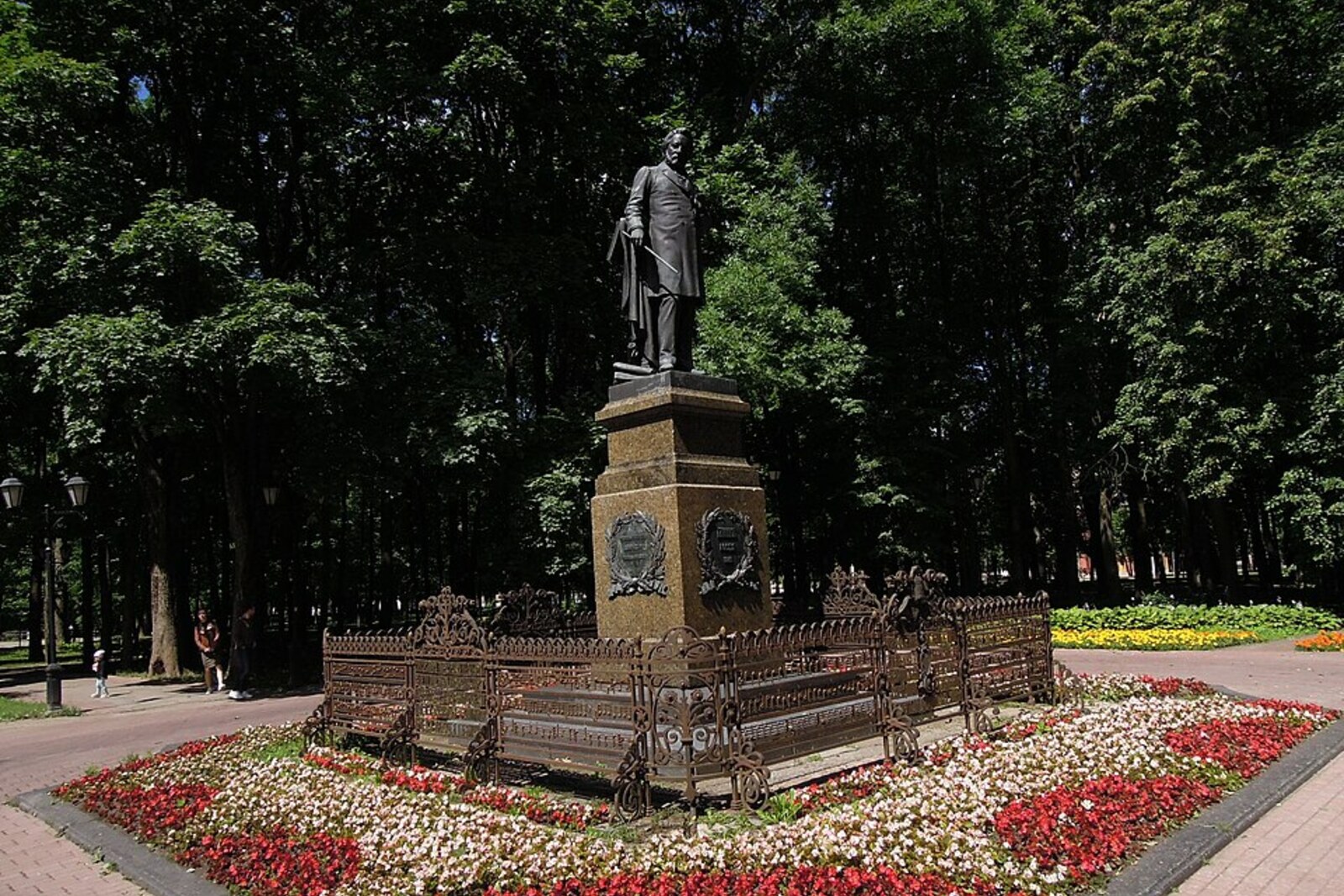
Look around first
What to notice
- Bronze figure of Mikhail Glinka
- Conductor's baton
- Fence resembling musical staves
- Philharmonic building
The story of the place
Today this is a city garden with a broad, level area among the trees: a bronze figure of Glinka stands in the center, surrounded at the edge by a cast-iron fence. Its bars resemble musical staves into which twenty-four excerpts from his music are woven. The Smolensk Regional Philharmonic operates opposite, while the monument stands with its back to a music stand and a conductor's baton in hand. In official documents, the garden bears the composer's name, but in local speech it remains Blonye.
The name “Blonye” is older than the trees here. In the Smolensk region, the word referred to low-lying meadowland used as urban pasture. By the end of the eighteenth century, cattle were no longer grazed here: officials had set aside the level ground for parades and military drills. In eighteen thirty, Smolensk governor Nikolay Khmelnitsky secured the relocation of the parade ground and ordered a garden to be laid out. Women from the city's noble families planted trees and flowers alongside him. The old term for an empty meadow became the name of the city garden.
Fifty-five years later, the garden was prepared for the unveiling of the first standalone monument to a composer in Russia. Mikhail Glinka was born in the village of Novospasskoye in Smolensk Governorate. His operas A Life for the Tsar, later renamed Ivan Susanin, and Ruslan and Lyudmila became a starting point for several generations of Russian composers. The building opposite the monument also connected him with Smolensk. In eighteen forty-eight, at the Nobles’ Assembly—a club and hall for the local nobility—people from Glinka's native region held a celebration in his honor and asked him to play his own compositions.
After the composer's death, one hundred eight Smolensk nobles submitted a petition: they wanted to collect donations throughout the country and erect a monument specifically here. The fundraising took years. On May twentieth by the calendar then in use, June first by today's calendar, in eighteen eighty-five, a broad temporary staircase resting on three arches was built from the balcony of the Nobles’ Assembly to the garden. The choir and orchestra took their places on it. Mily Balakirev, a composer and Glinka's pupil, conducted the final “Glory” Chorus. The covering was then removed from the bronze figure, and the mayor accepted the monument from the committee.
Among the guests stood Glinka's younger sister, Lyudmila Shestakova. She had not come for the family's place beside the monument. After her brother's death, Shestakova took charge of his manuscripts and publications. She commissioned a copy of the orchestral score of Ruslan and Lyudmila; the original was soon destroyed in a fire, and the copy she had commissioned preserved the music. Shestakova published the complete scores of her brother's works at her own expense.
During the celebrations in Smolensk, she proposed opening the Glinka School of Music in the city and contributed the first one thousand rubles. There was not enough money: the appointed deadlines passed, but the school still did not open. Only in nineteen oh six did the composer's nephew, singer and teacher Alexander Glinka-Izmailov, obtain permission and open it. Shestakova had died several months earlier and did not see the result of her contribution in Smolensk.
The openwork fence was installed around the monument the year after its unveiling. Its bars depict musical staves, while the bronze symbols form twenty-four excerpts from Glinka's compositions, including excerpts from the scores that Shestakova helped preserve and publish. The composer himself stands holding a conductor's baton, with his back to a music stand—a support for sheet music. The temporary staircase resting on three arches has long since disappeared; the building of the Nobles’ Assembly opposite is now occupied by the Smolensk Regional Philharmonic. In official documents, this is the garden named after Glinka, but in local speech it is still Blonye.
Useful on site
City garden; check locally for the seasonal schedule of individual entrances before an early or late visit.
Checked: June 24, 2026. Check the official source before visiting.It is best to walk all the way around the monument: the musical notation extends across the entire fence. All the main details can be seen during an ordinary visit to the garden from its paths.