 Guide On Map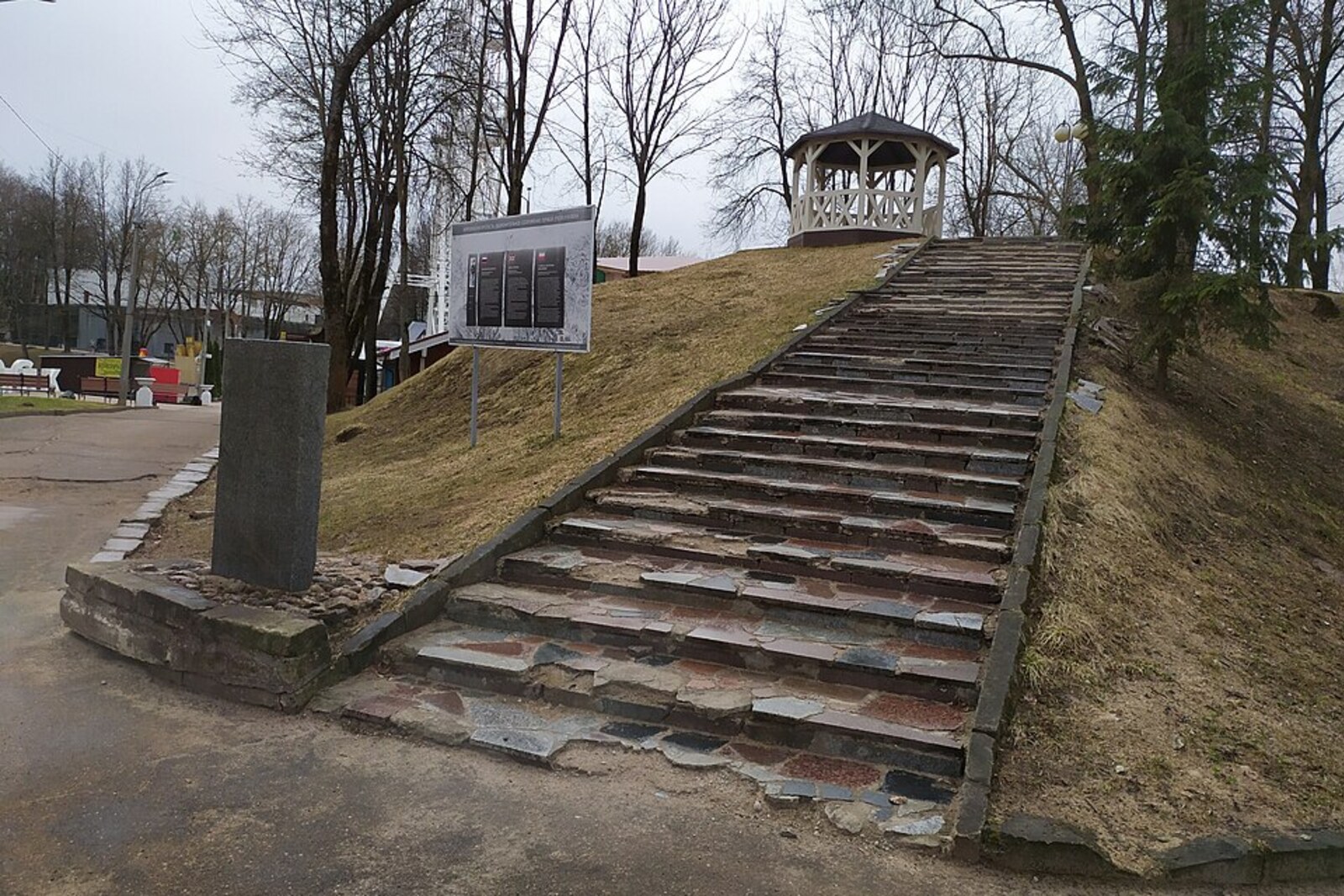
Look around first
What to notice
- Five earthen projections
- Pond in the former moat
- Bridge on the site of the only entrance
- Sealed arches beneath the figures of lions
The story of the place
Under Polish-Lithuanian rule, a pentagonal earthen citadel was built on this site, although in the city it became known as the Royal Bastion. Three of its corners faced the ravine, the moat, and the approaches to the wall; two faced the city, as the garrison intended to keep its residents under control as well. The only drawbridge opened the way into an enclosed military courtyard containing the commandant's quarters, soldiers' quarters, weapons, and gunpowder. The pond occupies part of the old moat, the present bridge marks the site of that entrance, and the arches beneath the lions lead to the former storerooms.
Before the siege of sixteen fifty-four, Colonel Korff, commander of the Smolensk garrison's mercenary infantry, took on work that officers did not usually boast about. He wove baskets to hold earth, laid sod alongside his subordinates, and restored the crumbling rampart. These baskets were placed in rows and filled with soil, forming a parapet capable of stopping a bullet. Korff was assigned the most neglected section of the defenses—the earthen citadel now called the Royal Bastion.
The citadel stood on the site of a breach. In November sixteen ten, sappers serving the Polish king Sigismund the Third blew up a tower and the adjacent sections of the wall here. The breakthrough was stopped, and the people of Smolensk filled the breach with earth. After the city fell, Sigismund's son, Prince Władysław Vasa, who governed the annexed Smolensk region, decided to replace the temporary embankment with a separate fortress. Restoring the three stone towers and the wall would have been too expensive.
From sixteen twenty-six to sixteen thirty-two, an earthen fort modeled on the Antwerp Citadel was built here. Władysław dedicated it to his father and named it the Sigismund Fortress. This is also the origin of the modern name “Royal”: the fortification was built by a prince in honor of the king whose army had left the breach here.
Only in colloquial speech was the structure a single bastion. It is an entire pentagonal citadel with five projections. Three faced outside the city: their guns covered the ravine, the moat, and the approaches to the wall. Two faced into Smolensk. The garrison was to use their guns if the Orthodox residents rebelled. A single drawbridge led into the citadel; beyond the gates stood barracks, an arsenal, powder magazines, and the commandant's house.
By sixteen fifty-four, Smolensk had already been part of the Polish–Lithuanian Commonwealth—a Polish-Lithuanian state—for forty-three years. The Russian army of Tsar Alexei Mikhailovich came to retake the city. Twenty years of peace had left the ramparts without proper repairs, so Korff had to restore the citadel even as the enemy approached.
At three o'clock in the morning during the August assault, Moscow streltsy advanced toward the Royal Fortress carrying wide ladders. They were commanded by Dmitry Zubov, a streltsy commander—the head of a streltsy detachment that was to open the way into the city. There had been no preliminary cannon bombardment: Zubov hoped to catch the garrison by surprise.
Korff's infantry repelled the attack from the rampart. When some of the streltsy reached a neighboring tower, the colonel spotted them and sent another company there. Zubov was killed, and his detachment retreated. Korff was then able to redeploy his soldiers to another section of the wall, where the attackers were already pressing the defenders back.
The assault did not take Smolensk, but no relief came for the garrison. Korff's infantrymen served for pay, and by the end of the siege they were owed wages for five pay periods; desertion began. In September, the city surrendered on condition that the garrison be allowed to leave freely. Korff was accused of treason and ordered to explain why the fortress had been surrendered after the assault was repelled. A military commission acknowledged the achievements of his infantry and released the colonel after the investigation.
Five earthen projections remain of the citadel. The pond in Lopatinsky Garden occupies part of the former moat and the excavation from which soil was taken for the ramparts. The present bridge crosses the site of the only entrance, while the brick-sealed arches beneath the figures of lions lead into the former rooms used to store gunpowder and weapons.
Useful on site
Open park space; some paths may be closed during restoration and seasonal work.
Checked: June 24, 2026. Check the official source before visiting.View the bastion as a single mass of earth, not as a separate hill. Keep to the paths: the steep grassy slopes are particularly unstable in wet weather.