 Guide On Map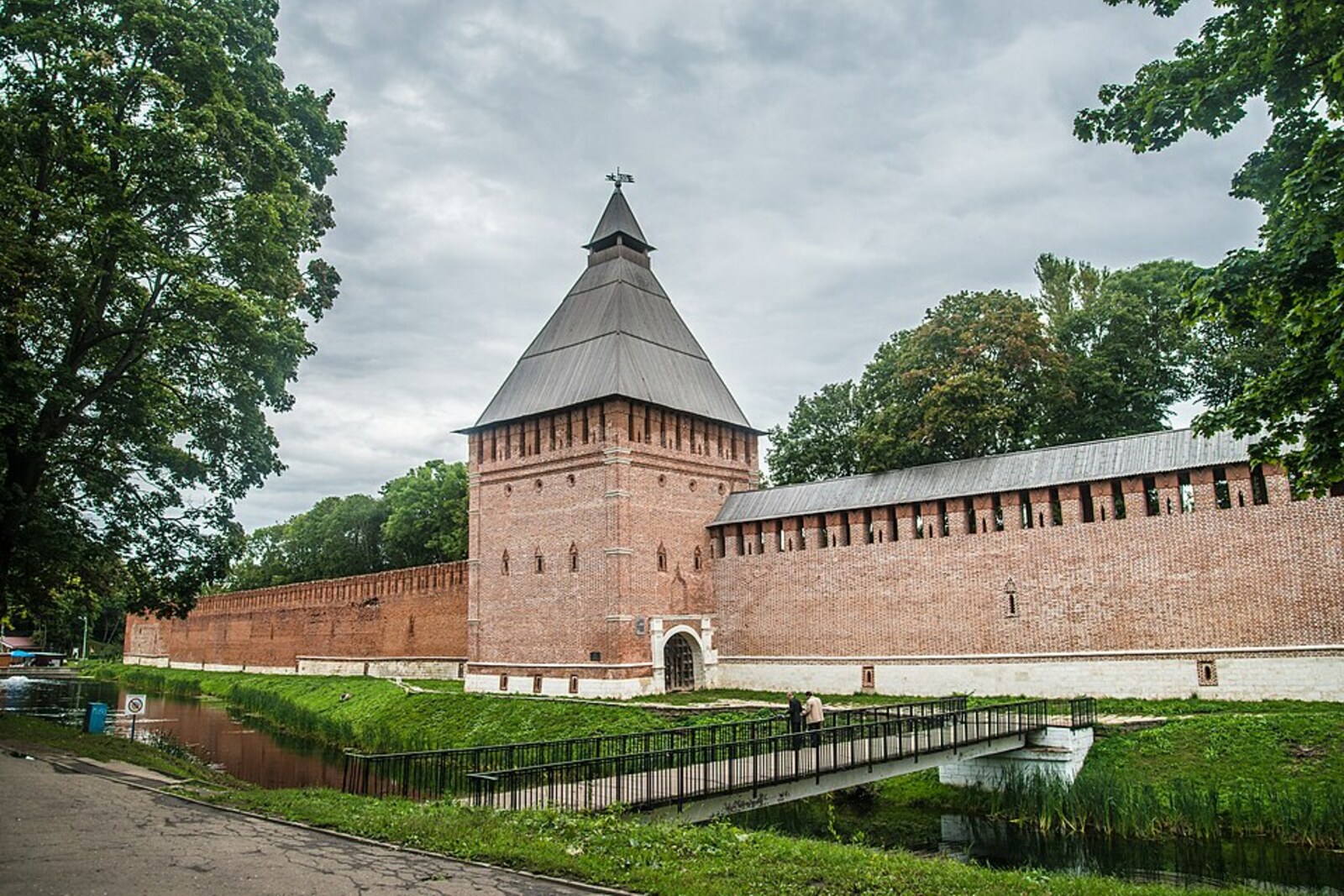
Look around first
What to notice
- Two passageway arches
- The passageway's right-angle turn
- Lower firing slits
- The tower's brickwork
The story of the place
On the night leading into October fourth, sixteen oh nine, Wejher, the starosta of Puck, approached the Kopytenskie Gate. He was a royal official and commander of mercenary German infantry. His soldiers lived on military pay, and now they had to open the way into Smolensk for their army. The miners carried a petard: this was the name for a gunpowder charge attached directly to the gate leaves. To set it in place, they had to reach the tower under fire from the lower firing slits.
Sigismund III, king of the united Polish-Lithuanian state, intended to take the city in a swift assault. His commanders warned him that light cannon were almost useless against walls about five meters thick and proposed limiting the operation to a blockade. The king ordered an assault. The wooden leaves of the Kopytenskie Gate and Avraamievskie Gate seemed more vulnerable than the brickwork.
Mikhail Shein, the Smolensk governor commanding the defense, expected precisely this calculation. On his orders, timber frames—log cages packed with earth, rubble, and stones—were placed in front of the gate towers. According to the garrison roster, sixty-nine defenders and ten cannon were stationed behind the Kopytenskie Gate.
Wejher's petard exploded and damaged the gate leaves, but it did not open a passage for the infantry. The garrison repelled the attack, and Wejher's detachment retreated. The attempt to seize Smolensk quickly failed, and a siege began that lasted twenty months. In the summer of sixteen eleven, the exhausted city was finally captured through other sections of the wall. Shein was wounded and taken prisoner by Kolomenskaya Tower. The army never entered the city through the Kopytenskie Gate.
Before the war, this gate served one of the city's roads. The origin of its name has not been established with certainty. According to local legend, livestock were driven from here to pasture, and the name preserved the clatter of hooves. Another theory is based on the old name “Kopys Gate”: the road to the town of Kopys began here. In the garrison roster of sixteen oh nine, the tower was already recorded as Kopytetskaya Tower.
Beyond the arches, the passage turns at a right angle, in the shape of the letter L. Even after breaking the outer gate leaves, attackers could not have rushed inside in a single stream: in the narrow passage, they would have had to turn under fire from three fighting tiers. This turn has survived. Wejher's petard struck the gate, but it did not turn the passage into a straight road into Smolensk.
Useful on site
Exterior viewing during daylight hours; access may change because of restoration barriers.
Checked: June 24, 2026. Check the official source before visiting.Examine the passageway from both accessible sides: its defensive purpose is clearest from the change in direction. Do not try to enter the tower's closed rooms.