 Guide On Map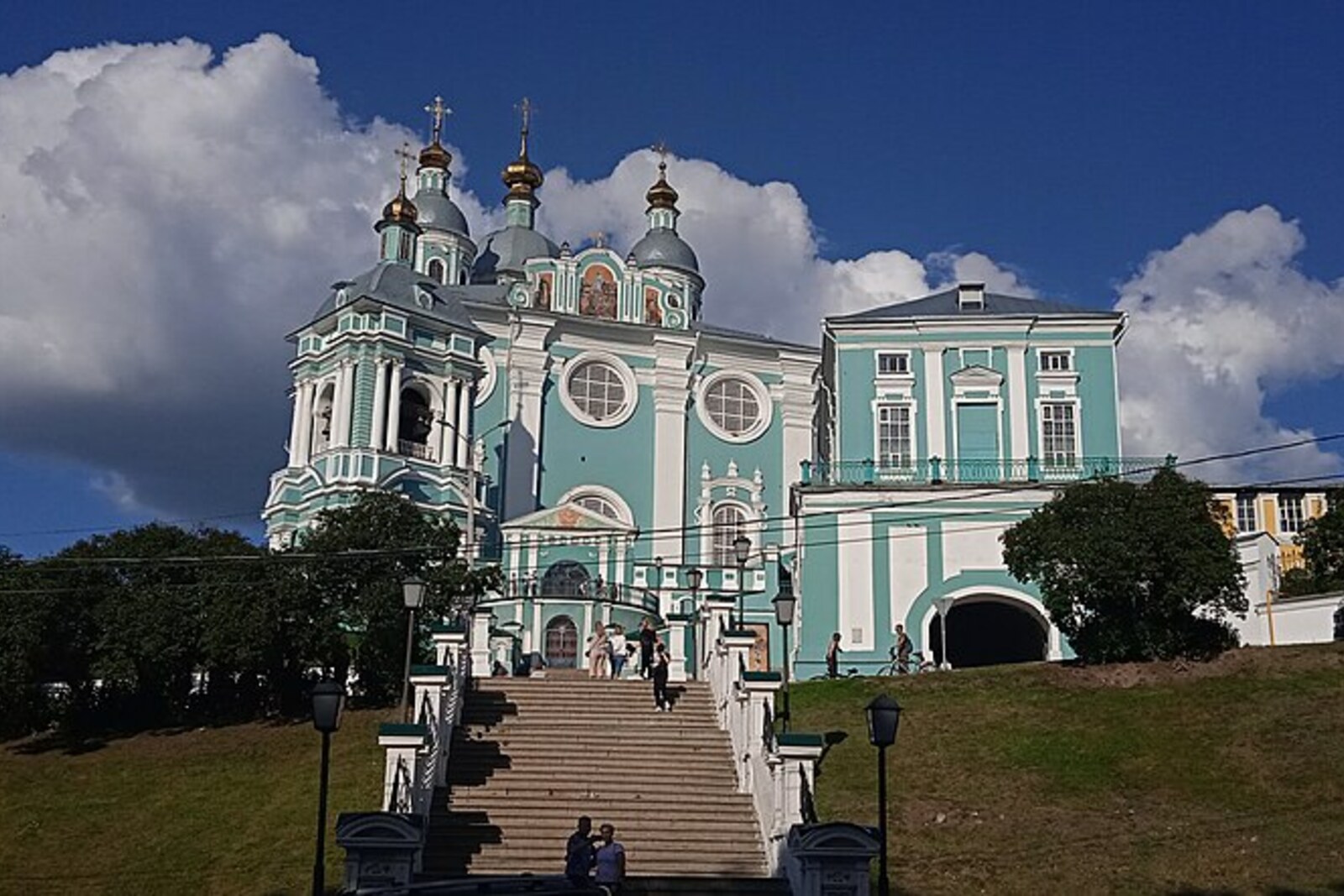
Look around first
What to notice
- Assumption Cathedral
- Cathedral Hill
- Carved, gilded iconostasis
- Choir lofts above the main space
The story of the place
Cathedral Hill is called that quite literally: Smolensk's principal church has stood at its summit since the twelfth century. The ancient cathedral, founded by Vladimir Monomakh, was damaged by the explosion of a gunpowder storehouse when the city fell in sixteen eleven. The old building was later dismantled, and the present one was erected in the seventeenth and eighteenth centuries. It is called a cathedral because the bishop serves here, and the Assumption Cathedral because its principal altar is dedicated to the Assumption of the Mother of God, the church feast marking the end of her earthly life.
It is often said that Napoleon saved the cathedral in eighteen twelve: the emperor whose army had captured Smolensk entered the cathedral, admired its interior, and ordered guards to be posted. The priest who actually secured that guard recorded a different story.
Nikifor Murzakevich served at the nearby Hodegetria Church, named after the Smolensk Icon of the Mother of God, and wrote the first printed history of the city. Shortly before the war, his wife died, leaving him with seven children. He could not leave Smolensk: he had neither horses nor money. He managed to send the two oldest children to relatives, while five remained with their father.
After the fighting near the Royal Bastion, Russian troops left the city. Murzakevich's house and church came under fire, and he brought his children and parishioners to Assumption Cathedral. The people locked the doors, extinguished the candles, and hid in the choir lofts. That day, the principal stone building on Cathedral Hill served simultaneously as a church, a refuge, and a storehouse.
When French soldiers began looting the bishop's residence, Murzakevich ran there. Together with two employees of the ecclesiastical administration, he wrested some vestments from the looters, hid the chrism and the antimensia—consecrated cloths without which the liturgy cannot be celebrated—and then carried seventy-three sacks of copper five-kopeck coins into the cathedral.
Joachim Murat, commander of the Napoleonic army's cavalry and king of Naples, was quartered in the bishop's chambers. Murzakevich pushed through Murat's entourage and addressed him in Latin. Murzakevich asked him to protect the cathedral and the other churches from looters. Murat agreed and posted a guard.
Officers still entered the cathedral wearing their headgear and brought dogs inside, while soldiers climbed the bell tower and rang the bells, but rank-and-file soldiers were no longer admitted to the cathedral. The sacristy and the items brought there survived, and Murzakevich's children and the townspeople sheltering inside lived through the occupation of the city. According to his son's recollection, the guard remained here until the Russian troops returned; the last sentry was taken prisoner by the cathedral.
For Murzakevich himself, the story did not end there. In the fall, he was on his way to visit a sick parishioner when he happened to meet Napoleon returning from Moscow. The priest did not recognize the emperor and, frightened, held out a prosphora to him. After the city was liberated, this gesture was turned into an accusation: Murzakevich was alleged to have ceremonially welcomed and blessed the enemy, and was also blamed for the disappearance of twenty thousand rubles supposedly kept in the cathedral sacristy. He was barred from officiating and deprived of his parish and income; the family moved into the attic of a house assigned for government billeting. In the spring of eighteen fourteen, the criminal chamber acquitted the priest, and that summer the Holy Synod allowed him to return to Hodegetria Church.
That church, once near the present-day intersection of Lenin Street and Dokuchayev Street, no longer exists. Assumption Cathedral retains its carved, gilded eighteenth-century iconostasis—the very one beside which the guard stood while Murzakevich's five children hid in the choir lofts.
Useful on site
Active cathedral. Regular schedule: weekdays—liturgy at 9:00 and evening service at 18:00; Sundays and holidays—liturgies at 7:00 and 10:00, evening service at 18:00. The holiday schedule may differ.
Checked: June 24, 2026. Check the official source before visiting.Climb without hurrying and keep the passage clear. Inside, remember that this is an active church: do not conduct tour discussions during services, and follow the attendants' instructions.