 Guide On Map
Changdeokgung Palace, Jongmyo Shrine, and Old Seoul
From the gates of Changdeokgung Palace through Huwon and Jongmyo Shrine to Ikseon-dong
Guide On Map on your phone
Open the walk like a regular app
It takes about 10 seconds to install. No app store needed.
The whole path
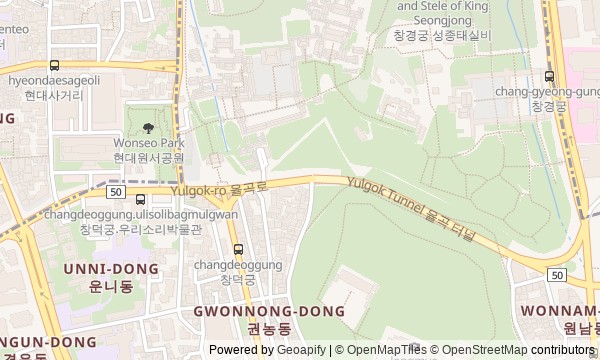
Route map
About the walk
You will enter Changdeokgung Palace through its main gate and move from ceremonial courtyards to residential quarters and the palace garden. Then the road will lead you to Jongmyo Shrine, run along its western wall, and end among the hanoks of Ikseon-dong.
First, you will see how a bridge, a gate, and two neighboring halls sorted people by rank. Beyond them come more personal places: a home built in expectation of an heir, and a library where the king assembled his own circle of officials. Outside the palace walls, the same order appears in ritual, the nighttime checkpoint, and the width of a city plot.
The story will draw on documents and calmly separate them from later legends. You will learn why an heir had to change clothes twice in one day, and why one passage was made high while two beside it were kept low.
After the walk, you will recognize old Seoul's order in the width of bridges, the rows of shrine doors, and the close quarters of hanok lanes.
Why this order
At Donghwamun Gate, you will cross the boundary between city and court, and at Geumcheongyo Bridge see how procession participants were directed into their proper lanes immediately beyond it. After the bridge, that order continues at Injeongjeon Hall and Seonjeongjeon Hall, where one person had to remain a grieving son and become sovereign almost at the same time. Nakseonjae comes next because, after the ceremony of succession, its family side opens up there: the expectation of a child and the quarters prepared for it. From the residential area, the route goes deeper into Huwon, where the king was building support not through kinship but through personally chosen officials. You will then leave the palace for Jongmyo Shrine: the status contested within a family during life was fixed here by a posthumous place at the altar. Outside, the western wall leads to Seosulla-gil, where palace security became control over the city at night. The final turn into Ikseon-dong reveals another system of passageways: these were laid out not for ceremony, but to divide a large estate into accessible urban housing.
Those who want to understand how Changdeokgung Palace works, rather than only see its main halls Those interested in human decisions within court ceremonies Those ready to end a palace walk in ordinary city lanes
Those expecting a short overview of one palace Those looking only for Seoul's most famous views Those who do not want to spend a substantial part of the route in historic complexes
Before you go
First, check access to Huwon: the garden is visited separately from the palace's main grounds, and it may be impossible to depart from the set route on your own. Also confirm the entry format for Jongmyo Shrine on your chosen day—independent visits and group admission may alternate. Do not schedule the two sites too tightly: after the garden, you will need to leave the palace complex and walk to the shrine. Choose sturdy shoes for stone paths and slopes, bring water, and leave room to shorten the walk if the long garden circuit becomes tiring.
When to go
Plan around your Huwon visit time and arrive at Changdeokgung Palace early enough to cover the first four stops without rushing before the garden. After leaving, allow separate time for the walk over and for Jongmyo Shrine entry rules. Ikseon-dong is best left for the end without a strict limit: the route no longer calls for a ceremonial pace there.
Backup plan
If you cannot get into Huwon, do not try to replace it with a random walk through closed garden sections. Finish the palace portion at Nakseonjae, and give the freed-up time to Injeongjeon Hall, the working courtyards, and the walk to Jongmyo Shrine. If the shrine itself is unavailable, Seosulla-gil lets you see its outer boundary, but it cannot replace Jeongjeon Hall and the ritual courtyard: save the stop about ancestors for another day. You can still finish the walk in Ikseon-dong, focusing on how hanoks changed along with the city.
Route conditions
Surface. Paved — 361 m (data covers 9% of the route)
Facilities. Toilets — 8; drinking water — 2
Elevation. Ascent — 48 m; descent — 48 m
OpenStreetMap extract of June 18, 2026: database data, not a check on the ground. Data © OpenStreetMap contributors, ODbL licence
Walk plan
Open in maps ↗- 1
Donghwamun Gate
Here, the palace’s main entrance turns out to be both a program of virtuous rule and a difficult military target. - 2
Geumcheongyo Bridge
This stop will show how a former palace guard fixed the official hierarchy in stone. - 3
Injeongjeon Hall and Seonjeongjeon Hall
Two neighboring halls make it possible to reconstruct the day when an heir exchanged mourning for royal power for a few minutes. - 4
Nakseonjae
Here the discussion of succession to the throne will move from the ceremonial hall into family rooms prepared for the birth of a child. - 5
Huwon: Buyongji Pond and Juhamnu Pavilion
The garden will show how the king sought his own circle of officials among books, manuscripts, and pavilions. - 6
Jongmyo Shrine: Jeongjeon Hall Main Hall
This stop explains how a place at the ancestral altar could become the outcome of a dynastic dispute several generations later. - 7
Seosulla-gil
Here, the court guard will leave the gates and become the service that controlled nighttime movement through the city. - 8
The Alleys of Ikseon-dong
The finale will show how a former palace estate was divided into small houses and passageways for new owners.
Route features
Everything you need stays in the browser
Progress, saves and your trip plan are stored on this device.
Add Guide On Map to your home screen so the walk opens outside the browser.
How we handle sources, maps and corrections: our editorial standards