 Guide On Map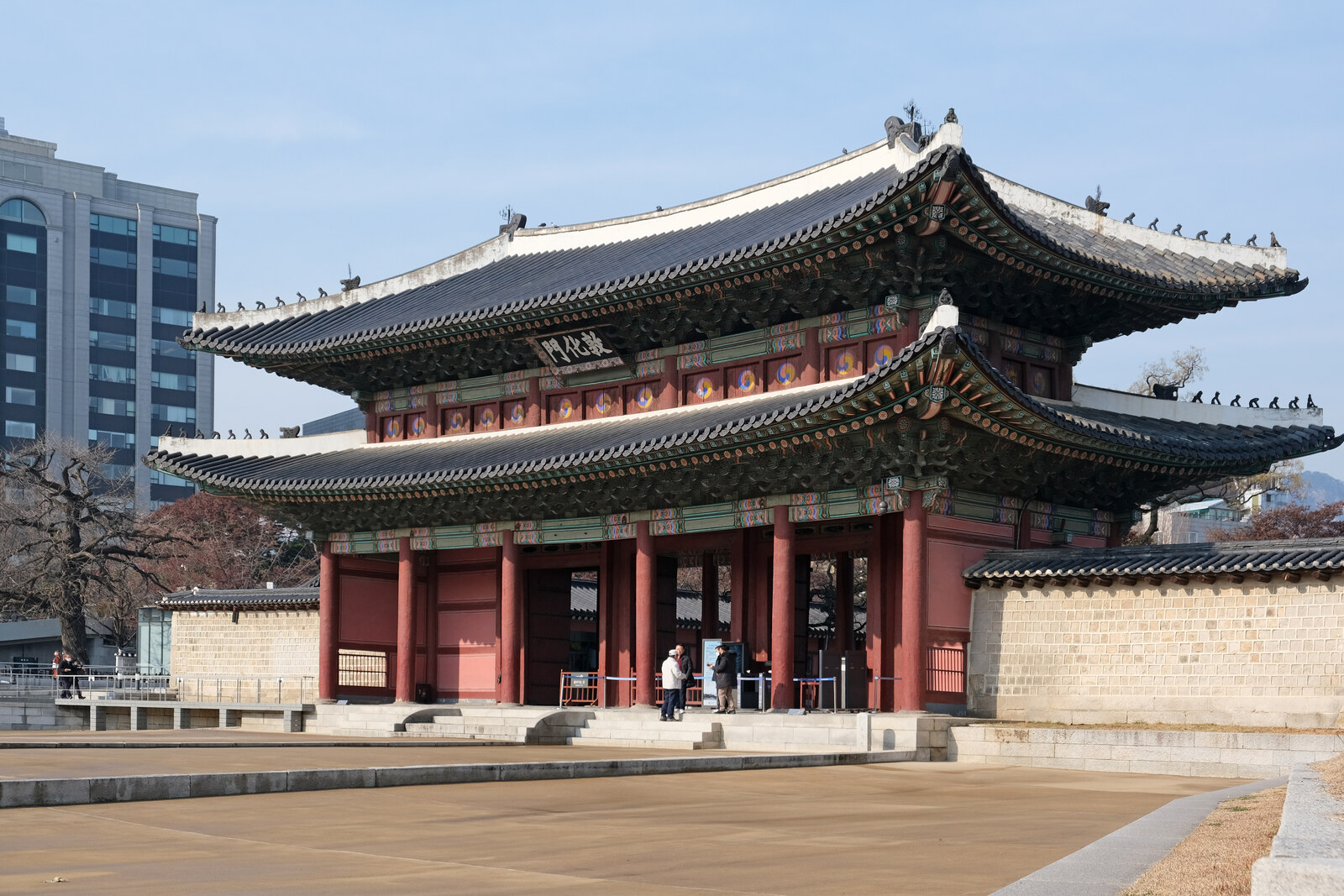
Look around first
What to notice
- Two-story gate
- Heavy wooden gate leaves
- Plaque above the passageway
The story of the place
The interrogation record after the rebellion of seventeen twenty-eight preserves a precise assessment of these gates. The conspirators considered Donghwamun Gate and the neighboring Honghwamun Gate the most difficult to seize. They planned to pile gunpowder by the gate leaves and shoot at it with incendiary arrows.
Donghwamun Gate is the main entrance to Changdeokgung Palace. Here ran the boundary between the city and the court of Korea’s monarchs of the Joseon dynasty. The king rode out through the gate, ambassadors entered through it, and during state funerals a coffin was carried out through it. When Changdeokgung Palace became the court’s main residence, the former entrance was expanded to its present monumental scale.
The name was taken from the Confucian treatise The Doctrine of the Mean. “Donghwa” means instruction and the moral transformation of people through the ruler’s virtue. This program was placed on the plaque above the passageway so that a person would encounter it even before entering the palace.
In seventeen twenty-eight, King Yeongjo had to prove his right to be behind these gates. He ascended the throne after the death of his older half-brother, King Gyeongjong. Yeongjo’s opponents spread rumors that he had poisoned his brother and was not even the legitimate son of their father. They wanted to depose him and put Prince Milpung, a descendant of another branch of the royal family, on the throne.
Yi In-jwa, a provincial yangban—a man from the hereditary service class, but from a politically marginalized clan—led the uprising. He had no standing army. The conspirators gathered relatives, household servants, and slaves, turning their own households into military detachments. In the event of defeat, execution threatened the leader himself, while punishment and confiscation of property threatened his family.
Yi In-jwa captured the city of Cheongju, killed two garrison commanders, opened the state granaries, and led his people toward Seoul. Above the detachment they carried a banner of revenge for the late Gyeongjong. At the same time, accomplices in the capital were preparing to strike at the palace. Donghwamun Gate obstructed their plan precisely because of its design: its heavy leaves could not be quickly opened from within or broken down by an ordinary assault. That was why they devised the plan with gunpowder.
The rebels did not reach the gate. Royal troops defeated them at Anseong and Juksan. Yi In-jwa hid in a mountain monastery, but peasants together with monks captured him and handed him over to the military. The soldiers demanded that the leader be torn apart on the spot. The commander Oh Myeong-hang refused: Yi In-jwa had to appear before the king. He was locked in a cage on a cart and sent to Seoul.
The journey ended here. Yeongjo went up to the second story of Donghwamun Gate and received the prisoners and the heads of the slain leaders of the rebellion before the gate. This was an established ceremony: the king remained behind the closed gate leaves, while outside he was shown those who had tried to reach the palace. Yi In-jwa was then executed on a charge of treason. Yeongjo kept the throne and ruled for nearly another half-century.
No separate object remains from that ceremony. The two-story gate itself survives, and it was already standing here in seventeen twenty-eight. The gunpowder beneath its gate leaves never caught fire, and the captured man was taken through the passageway he had intended to blow up.
Useful on site
Changdeokgung Palace: 09:00–18:00 in February–May and September–October; 09:00–18:30 in June–August; 09:00–17:30 in November–January. Last entry is 1 hour before closing. Closed on Monday.
Checked: June 27, 2026. Check the official source before visiting.Before entering, linger outside: it is from the city side that you can best sense how the gate both connects and separates two worlds.