 Guide On Map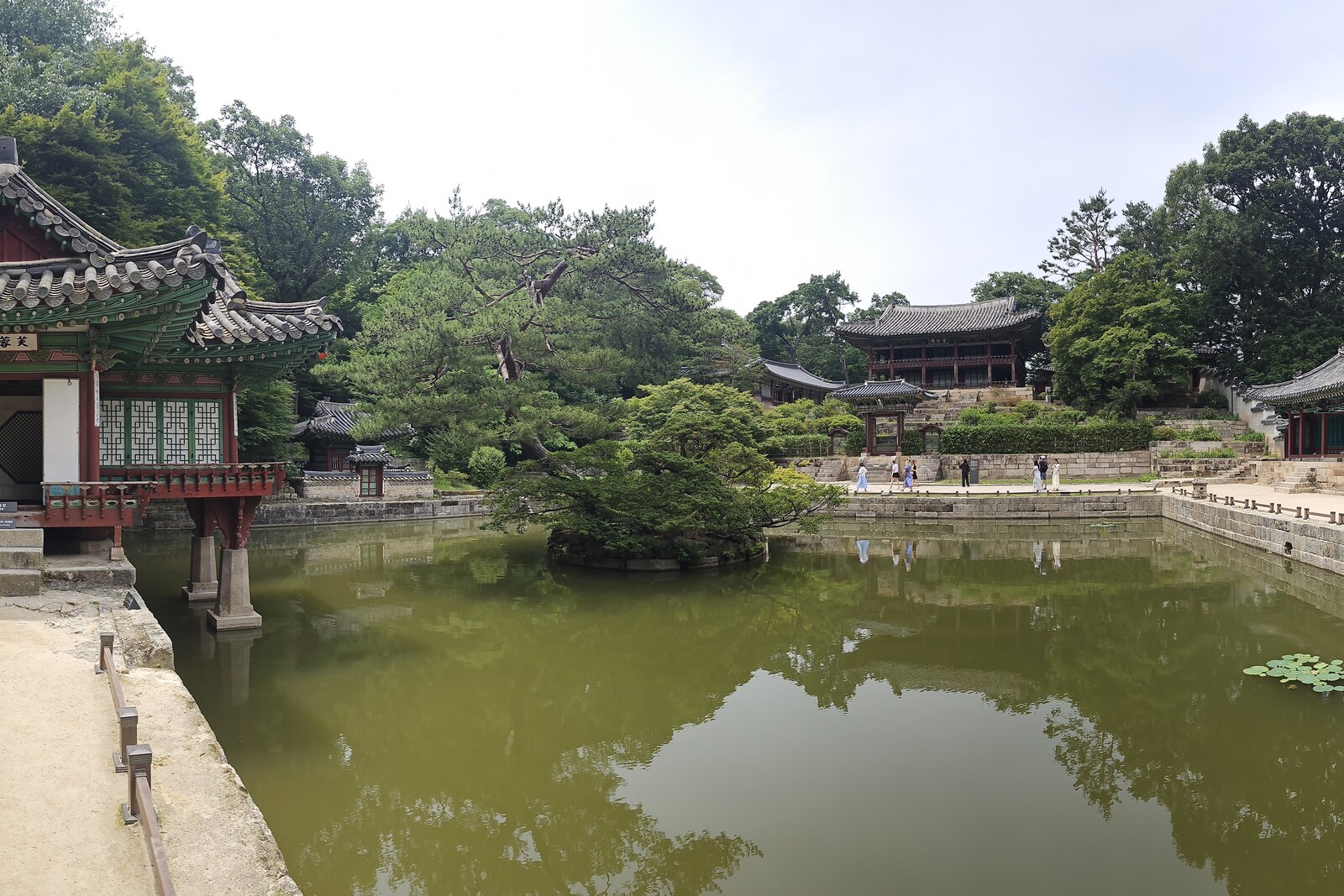
Look around first
What to notice
- Square pond
- Round island
- Two-story Juhamnu Pavilion
- Tall central passage and two side gates
The story of the place
Huwon was the Korean palace's private garden, where the ordinary operation of state institutions was not moved. At Buyongji Pond, a deliberately geometric composition survives: square water and a round island reproduce the old idea of earth and sky. On the north shore, Juhamnu Pavilion rises above the trees; below it stood a collection of royal books, portraits, seals, and writings. There are no editors here now, and the main part of that collection is kept at Seoul National University.
In seventeen seventy-six, the day after ascending the throne, King Jeongjo ordered construction to begin on a two-story building on the north shore of this pond. Courtiers understood the haste. The new king's father, Crown Prince Sado, had died on the orders of his own father, King Yeongjo: he was locked in a rice chest. Jeongjo had grown up among high officials involved in this killing or owing their careers to those who supported it. He now needed scholar-officials whom he could choose and train himself.
A place for them was set aside in Huwon, the palace's private garden. Ordinary institutions remained by the ceremonial courtyards, while here the king could invite selected staff without all the distance of the court. Gyujanggak, a repository of royal writings, portraits, seals, and books, was housed on the first floor of the new building. The upper floor was given the name Juhamnu Pavilion, which can be rendered as “the pavilion of union with the universe.” Jeongjo himself wrote its inscription.
Three years later, the king added four junior editors to the staff of Gyujanggak. All four were sons of aristocrats and concubines. Their origins allowed them to study but closed the usual path to prestigious posts. One of the four was the thirty-eight-year-old Yi Deok-mu, a poor scholar who had received almost no regular education. He copied other people's books for payment; if the commission allowed it, he made another copy for himself. In this way, he built a library while also earning money for his family.
At Gyujanggak, his former trade became state service. Yi Deok-mu collated manuscripts, corrected errors, prepared texts for printing, and organized collections. He remained a junior official: the appointment of the four editors did not remove class restrictions. But he gained a salary, access to books, and his first permanent post. Yi Deok-mu worked in the Gyujanggak system for fourteen years, until his death, took part in preparing numerous editions, and later received other posts. The king acquired people who depended on his choice and could carry out the publishing and research work entrusted to them.
Jeongjo ordered this connection recorded directly in the garden's layout. The gate between the pond and Juhamnu Pavilion is called Eosumun Gate, “the Gate of Fish and Water.” In a court comparison, the king was water, and the officials serving him were fish. A high central passage was made for the sovereign, and two low side gates for his staff. The pond before the gate was named Buyongji Pond, “the Lotus Pond.” Its square basin and round island reproduce the old idea of square earth beneath a round sky.
After Jeongjo's death, Gyujanggak lost its former role in preparing decisions and again became chiefly a book repository. Its collection was moved several times in the twentieth century; now its main part is at Seoul National University. Editors no longer sit in Juhamnu Pavilion. The king's inscription remains on the north slope, and beneath it are one high passage and two low ones, intended for the very fish he gathered by his water.
Useful on site
Huwon can be visited only in a fixed session with a limited quota. Korean sessions usually run every hour; English sessions are at 10:30, 11:30, 14:30 and, from March through November, also at 15:30. Language schedules and seasonality vary.
Checked: June 27, 2026. Check the official source before visiting.Huwon requires separate admission; stay with the group and on the permitted route, even if the detail you need is visible off to the side.