 Guide On Map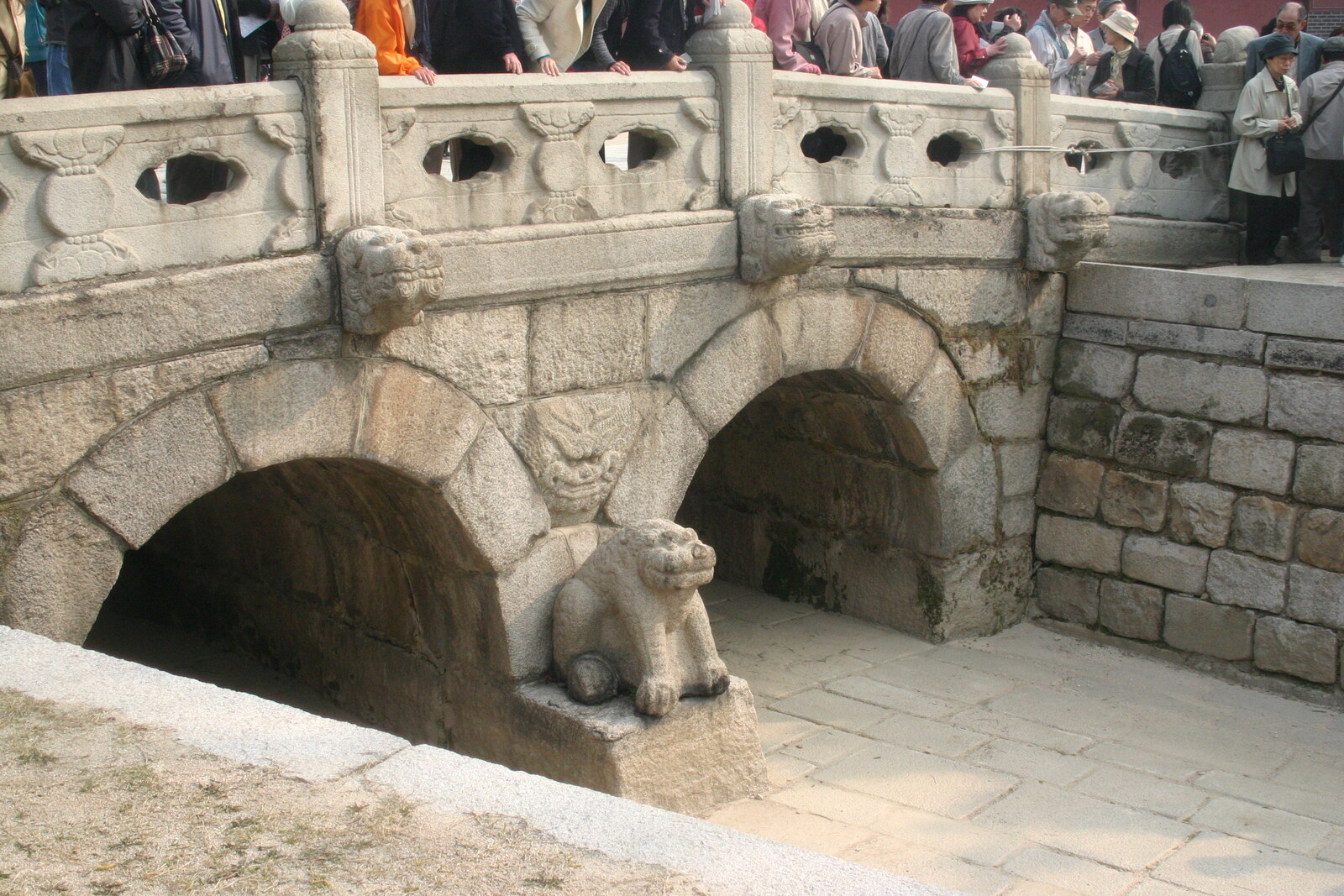
Look around first
What to notice
- Two stone arches
- Wide central lane
- Narrow side passages
- Stone animals and masks
The story of the place
The stream divided the palace grounds in two: the outer courtyard remained on one side, while beyond the water began the road to the halls where the ruler received officials and dealt with state affairs. Two stone arches hold above the water, and the deck is so wide that it resembles a short palace square. The central passage was reserved for the king, while the other participants in ceremonies used the narrow side passages; the animals and masks beneath the parapet were meant to drive away harmful forces. The wooden structures around it burned more than once and were rebuilt, while this stone crossing preserved the palace order in its masonry.
In March fourteen eleven, Park Ja-cheong directed the laying of stone here. In front of the inner Jinseonmun Gate, craftsmen raised two arches over the palace stream and laid a nearly square deck: about thirteen meters long and twelve and a half meters wide. This width was needed so that the king and his entire ceremonial retinue could cross the bridge.
By that time, Park Ja-cheong headed the office responsible for state construction projects. He began as a household servant in the retinue of a nobleman, then guarded the palace gates. One day, the king's brother tried to enter without permission. Park blocked his way and did not yield even after the prince beat him and injured his face. King Taejo punished his brother and drew the guard closer to the court. Park lived by his service and, with every appointment, risked ending up at the bottom again; under the next king, Taejong, he was promoted for his ability to bring major building projects to completion. Thus, the former gatekeeper was put in charge of the entrance route to the new palace.
The stream was laid out here as an internal boundary. The same syllables, “Geumcheon,” could be heard in two meanings: “forbidden stream” and “silk river.” The outer courtyard remained before the water; beyond it began the route to the rooms where the king received officials and dealt with state affairs. Officials were expected to leave personal calculations behind together with the stream. Stone animals at the arches and masks between them were meant to hold back another danger: harmful forces.
The order continued on the bridge itself. The wide central lane was intended for the king, and the side lanes for the other participants in the procession. Park Ja-cheong was building not a short crossing over water, but a place where people immediately took up their proper positions.
Donghwamun Gate appeared a year after the bridge. Later, fires and wars destroyed the wooden buildings of Changdeokgung Palace; they were rebuilt, while the two stone arches survived. Park Ja-cheong's name is not on them. What remains are the broad royal road, the narrow side passages, and the animals beneath the parapet—the work of a former palace guard, which became Seoul's oldest surviving stone bridge.
Useful on site
Changdeokgung Palace: 09:00–18:00 in February–May and September–October; 09:00–18:30 in June–August; 09:00–17:30 in November–January. Last admission is 1 hour before closing. Closed on Monday.
Checked: June 27, 2026. Check the official source before visiting.Do not block the passage, and examine the carvings from both sides: some of the figures are easy to miss if you continue on right away.