 Guide On Map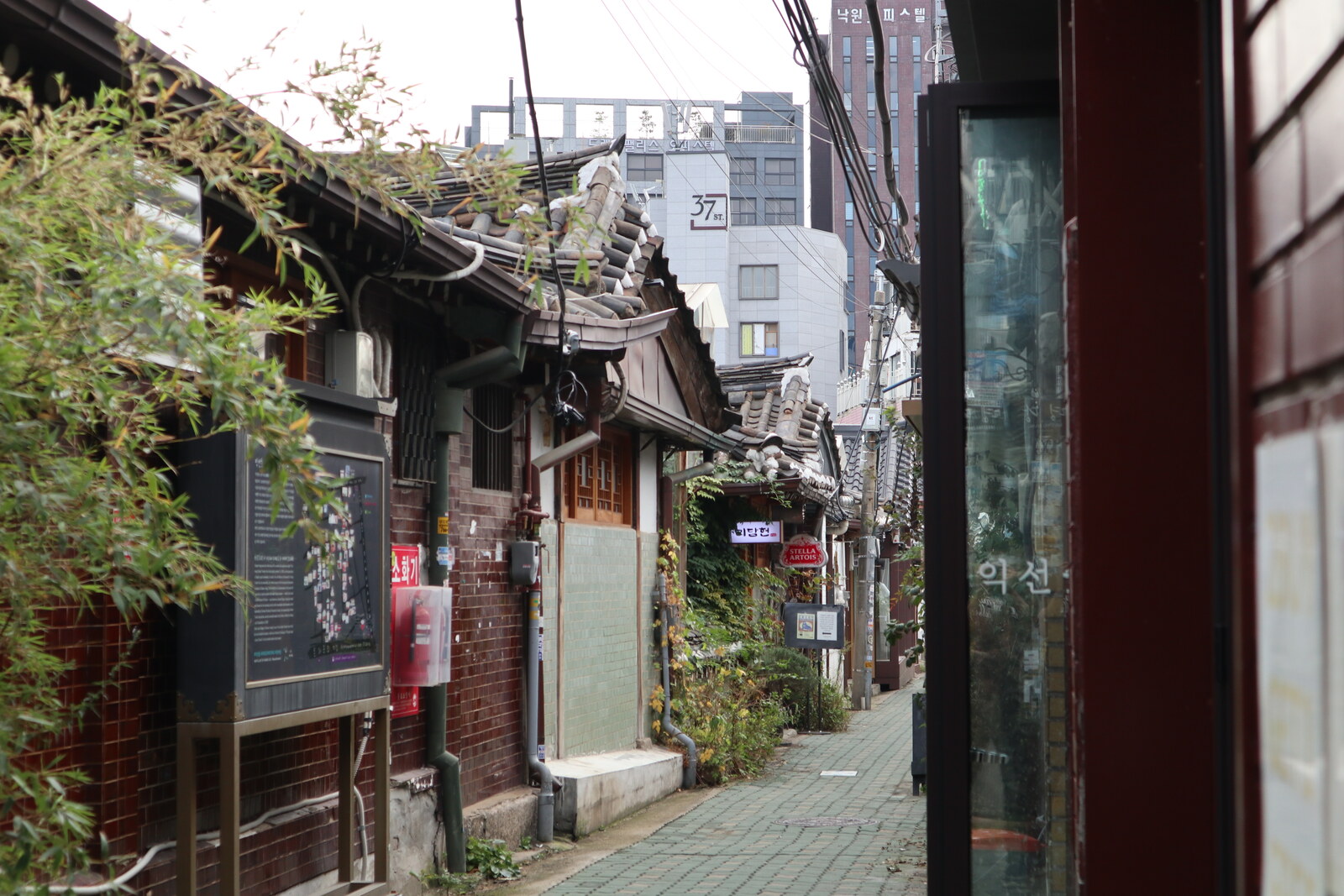
Look around first
What to notice
- Narrow alleys
- Low tiled roofs
- Hanok gates
- Courtyards beneath glass roofs
The story of the place
In Ikseon-dong stand small urban hanoks with wooden frames, tiled roofs, and inner courtyards. They were built for Korean families who needed affordable housing within the city; this approach was later repeated in other hanok neighborhoods. The low roofs stand almost pressed together, courtyards hide behind gates, and narrow passageways remain between the houses. Today cafés, restaurants, and shops operate in the former living rooms, and many courtyards are covered with glass.
These alleys emerged from a deal involving a former palace estate. In the late nineteen twenties, the Korean developer Jeong Se-gwon bought the lands of Nudong Palace—the residence of relatives of King Cheoljong. The large house disappeared, and Jeong divided the plot into dozens of small parcels. Passageways had to be laid out between them so that each new owner would have a separate entrance. That is how the dense grid of Ikseon-dong took shape.
Jeong arrived in Seoul, which was called Gyeongseong under Japanese colonial rule, in nineteen nineteen. A year later, he opened the construction company Geonyangsa. He worked with borrowed money: he built a house, sold it immediately, and used the proceeds to pay off the interest and principal. Unsold housing could bring the entire enterprise to a halt.
Buyers needed affordable homes within the city. Jeong reduced the size of plots, offered installment payments, and adapted the hanok—a Korean house with a wooden frame, tiled roof, and inner courtyard—to dense urban development. He replaced the large estate with compact dwellings for Korean families. Hence the short alleys, low roofs almost pressed against one another, and courtyards hidden behind gates. The layout tested in Ikseon-dong later served as a model for other urban hanok neighborhoods.
The houses sold well, and Jeong became wealthy. He gave part of what he earned from such neighborhoods to societies supporting Korean goods and the Korean language. In nineteen thirty-five, he gave the Korean Language Society a two-story building where philologists compiled a large dictionary. It formed a direct chain: buyers paid for small hanoks, and the developer directed the profits to people preserving Korean words.
According to the recollections of Jeong's daughter, colonial officials demanded that he switch to Japanese-style houses. He refused and stopped housing construction in nineteen forty. Two years later, he was arrested in the Korean Language Society case, tortured, and imprisoned. His release cost him extensive landholdings, transferred to an organization controlled by the Japanese administration. The enterprise begun with loans and the sale of hanoks ended with the loss of most of his fortune.
Now cafés, restaurants, and shops operate in the former living rooms, and many courtyards are covered with glass. Nudong Palace is no longer here. Its land is still divided by narrow passageways between the small plots that Jeong Se-gwon carved out for buyers of his houses.
Useful on site
Public alleys are accessible without a ticket; shop, café, and restaurant hours vary, and some establishments open closer to noon.
Checked: June 27, 2026. Check the official source before visiting.The alleys remain a residential and commercial environment: do not look into private courtyards or linger in doorways for photographs.