 Guide On Map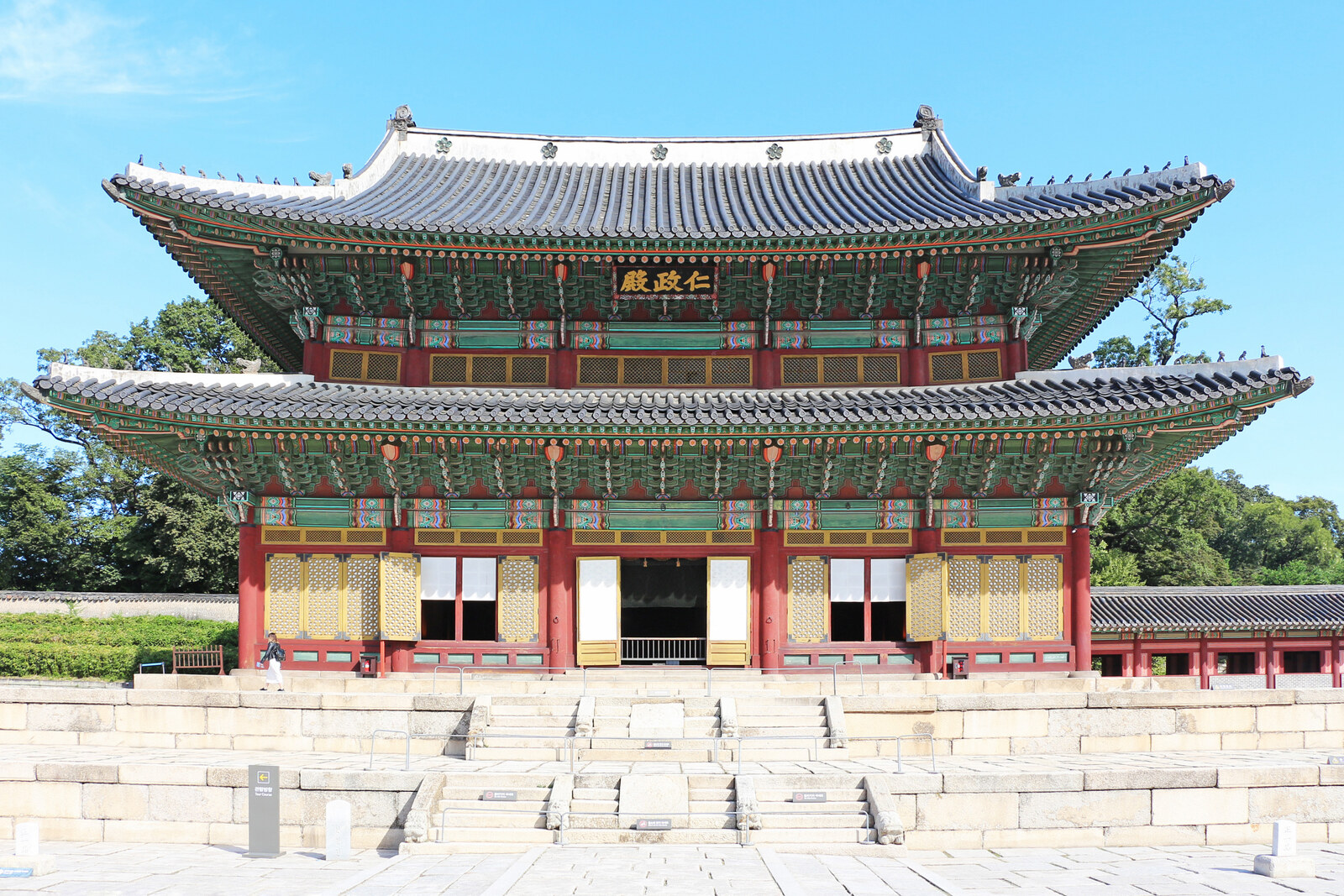
Look around first
What to notice
- Injeongjeon Hall's ceremonial courtyard
- The eaves of the main hall
- Seonjeongjeon Hall's blue roof
- The covered gallery
The story of the place
Two palace halls stand here: Injeongjeon Hall and Seonjeongjeon Hall. In fourteen ninety-four, six days after the death of King Seongjong, his nineteen-year-old son Yi Yung had to bury his father and take his place. In Korea's Joseon dynasty, accession to the throne was not postponed until the end of mourning: the state seal could not remain without an owner.
Seongjong's coffin was placed in Seonjeongjeon Hall, the smaller hall with its blue-tiled roof. Usually, the king reviewed reports and consulted with officials here. For the funeral, the study was turned into a hall of temporary repose: the coffin was kept here until it was sent on to the royal tomb.
At about two in the afternoon, Yi Yung put on an unhemmed mourning garment of coarse hemp cloth. The material indicated the degree of kinship with the deceased: a son was required to wear the harshest clothing. The heir bowed before the coffin, after which a secretary placed Seongjong's will and the state seal beside it.
Then the mourning clothes had to come off. Yi Yung put on a formal robe with dragons and a ceremonial crown with strands of beads. A state councillor knelt, lifted the seal, and handed it to the heir. Yi Yung gave it to a courtier, bowed four times before his father's coffin, and left through Seonjeongjeon Hall's western gate. The courtier carrying the seal walked ahead.
The procession headed for Injeongjeon Hall, the palace's main ceremonial hall. Its name means “Hall of Benevolent Rule.” Envoys were received here, state examinations were held, and the most important court rituals took place. Yi Yung sat not inside the hall but beneath its eaves. The officials bowed to him now as King Yeonsangun.
After the congratulations, the new king returned to the mourning hut, took off his formal robe, and put the coarse hemp back on. The officials changed back as well. An amnesty was declared that same day: many people sentenced to forced labor, exile, and military service were released; those punished for the gravest crimes were not pardoned.
Yeonsangun's reign ended in fifteen oh six. Courtiers deposed him, stripped him of his royal title, and sent him to Gyodong Island. A few months later, he died in exile. That is why he remained Yeonsangun in history—Prince Yeonsan, without the temple name given to recognized kings of Joseon.
The wooden buildings through which he passed, with the courtier carrying the seal walking ahead, have not survived to this day. Both burned down during the Japanese invasion of the late sixteenth century. The present Seonjeongjeon Hall was built in sixteen forty-seven, and Injeongjeon Hall in eighteen oh four. The small blue hall still stands east of the large ceremonial courtyard, and its covered gallery recalls the funeral rites: here the heir received the seal beside the coffin, then went out to the officials as king.
Useful on site
Changdeokgung Palace: 09:00–18:00 in February–May and September–October; 09:00–18:30 in June–August; 09:00–17:30 in November–January. Last entry 1 hour before closing. Closed Monday.
Checked: June 27, 2026. Check the official source before visiting.First take in the whole courtyard, then approach the hall: the distance here tells of power no less than the architectural details.