 Guide On Map
Samarkand of rulers, scholars, and saints
From Gur-e Amir Mausoleum through Registan Square and Siab Bazaar to Shah-i-Zinda Necropolis
Guide On Map on your phone
Open the walk like a regular app
It takes about 10 seconds to install. No app store needed.
The whole path
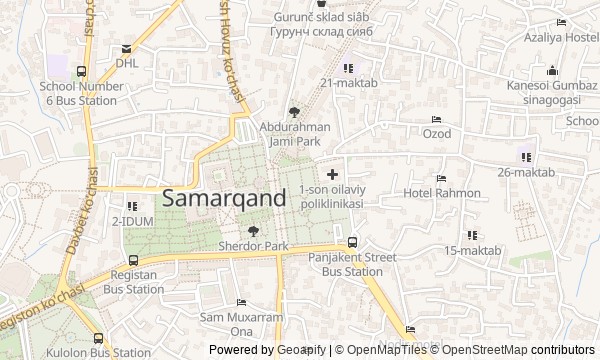
Route map
About the walk
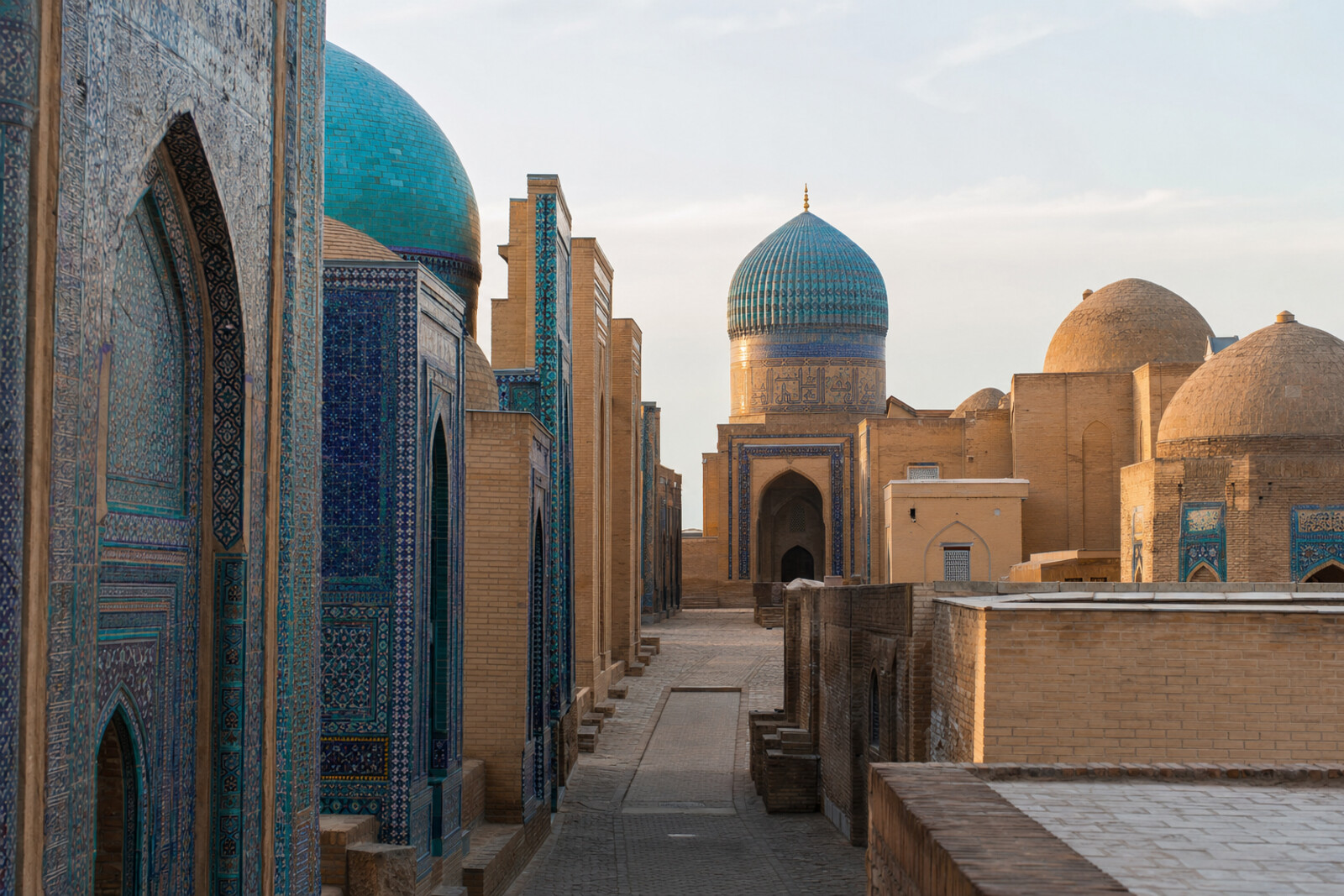
You will begin at Gur-e Amir Mausoleum and make your way through Registan Square to Bibi-Khanum Mosque, Siab Bazaar, and the slope of Afrasiab. The finale is the narrow street of mausoleums at Shah-i-Zinda Necropolis.
At the first stops, grand Samarkand will emerge as a city of urgent decisions. Here, a chamber built too low will force finished work to be dismantled, a man in dirty clothes will demand a public inspection, and a woman will spend years defending the income of two schools.
Further on, the route leads to a mosque, market rows, and the city's ancient boundary. You will learn what will disappear for the sake of a new street and why two neighboring holy sites will tell different stories of salvation.
The account rests on chronicles, inscriptions, and clearly identified traditions. It will not pass off a later legend or a restoration as an obvious fact. By the end, you will be able to distinguish in Samarkand what rulers managed to build, what others carried on, and what people gave a second life in memory.
Why this order
Gur-e Amir Mausoleum poses the route's central question: what happens to a ruler's design when his successor dies before him. At Registan Square, that question moves from a family tomb to the city square, where residents once acted without rulers. The route then unpacks the present ensemble layer by layer: first, Ulugh Beg Madrasa shows a school from the time of the Timurids, while neighboring Tilla-Kori Madrasa shows how, two centuries later, the life of a new school and Friday mosque was sustained. From here, Islam Karimov Street leads to Bibi-Khanum Mosque along the line of the old trade route. After the story of a great construction project, Siab Bazaar shows how the same order reshaped the residential city. Beyond the market rows begins the climb to the edge of Afrasiab: Hazrati Khizr Mosque shifts the story from power over streets to a tradition about saving the fortress. Shah-i-Zinda Necropolis brings the route to a close in reply, because Khidr appears in its legend as well, and the road ends at the sanctuary of a man whom tradition leaves alive.
Those putting Samarkand's main monuments together in one route for the first time Those who want human decisions and their consequences behind the architecture Those who value the distinction between a chronicle, an inscription, and a tradition
Those looking only for a short walk around Registan Square Those wanting an overview of ornament without historical stories Those who dislike long walks and climbs
Before you go
The route includes mosques, tombs, and active places of remembrance, so choose modest clothing, speak quietly, and follow instructions on site. Ask permission before photographing people at the bazaar, and check in advance whether photography is allowed in religious interiors. Do not expect every hall to be open: prayer, restoration work, or local rules may change the order of your visit. Save your energy and attention for Shah-i-Zinda Necropolis—stairs, inscriptions, and many small mausoleums do not go well with rushing.
When to go
The first half of the route works well at an even pace, with time set aside at Registan Square for three different stories. Take a short break at the bazaar, then save most of your time for the final two stops: the route's subject changes here, there is a climb, religious restrictions appear, and Shah-i-Zinda Necropolis becomes especially dense.
Backup plan
If a mausoleum or mosque is closed, do not skip the stop: the portal, domes, proportions, and the building's place in the urban space preserve the main part of the story. At Registan Square, the three periods can be compared from the square even without entering the courtyards. The story of Siab comes through in the outward rhythm of trade and its proximity to Bibi-Khanum Mosque, but do not disturb vendors or shoppers. At Hazrati Khizr Mosque, it is enough to see the relationship between the mosque, the memorial, Afrasiab, and the road to the necropolis. If Shah-i-Zinda Necropolis is temporarily inaccessible, it is better to postpone the finale than replace it with another sight: only here does the limit of a dynasty's claim to eternity become clear.
Route conditions
Surface. Paved — 3.1 km (data covers 76% of the route)
Stairs. Flights: 1, 19 m in total
Access. Wheelchair — no; stroller — limited (stairs)
Facilities. Toilets — 11; drinking water — 4
Elevation. Ascent — 16 m; descent — 41 m
OpenStreetMap extract of July 4, 2026: database data, not a check on the ground. Data © OpenStreetMap contributors, ODbL licence
Walk plan
Open in maps ↗- 1
Gur-e Amir Mausoleum
Here, a failed transfer of power changed the purpose of an entire complex. - 2
Registan Square
The square makes it possible to picture the city before its present-day madrasas, when the residents themselves had to organize its defense. - 3
Ulugh Beg Madrasa
This stop presents the madrasa as an institution of higher learning where a position was granted after one’s knowledge had been tested. - 4
Tilla-Kori Madrasa
The gilded decoration will give way to the question of who preserved the school's income after the patron's death. - 5
Bibi-Khanum Mosque
Here, the cost of building in haste and the rivalry between two portals will become clear. - 6
Siab Bazaar
The bazaar continues the story of the street that power drove through a residential city. - 7
Hazrati Khizr Mosque and the Islam Karimov Memorial
This stop connects an ancient legend of the city's salvation with the choice of this hill for a later memorial. - 8
Shah-i-Zinda Necropolis
The ending will explain why the road between the mausoleums ends at a closed underground chamber.
Route features
Everything you need stays in the browser
Progress, saves and your trip plan are stored on this device.
Add Guide On Map to your home screen so the walk opens outside the browser.
How we handle sources, maps and corrections: our editorial standards