 Guide On Map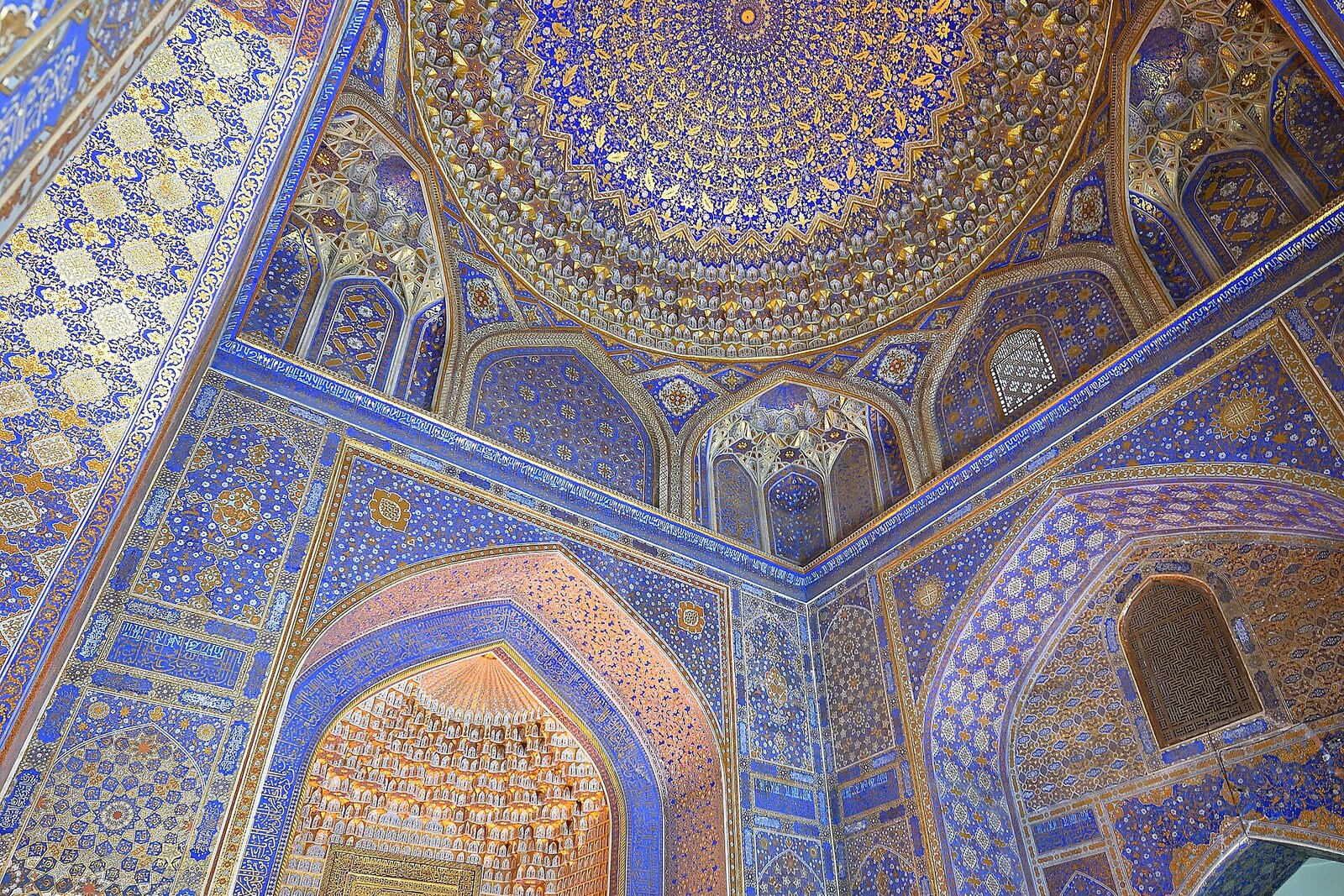
Look around first
What to notice
- Main portal with the stone date
- Gilded vault of the mosque
- Mihrab
- Emerald dome
The story of the place
Four years after the patron's death, craftsmen were still decorating Tilla-Kori's main portal. His daughter Mah Banu oversaw the madrasa's work and administration. Her father had appointed her mutawalli in advance—the administrator of the lands and revenues that maintained the building.
Her father, the governor of Samarkand and military commander Yalangtush Bahadur, began this construction in the mid-seventeenth century. By then, Samarkand's old congregational mosques lay in ruins. Yalangtush needed to restore a place for the city's shared Friday prayer and, at the same time, open another school of theology.
On the north side of Registan Square stood the dilapidated Mirzoi Caravanserai. The builders used part of its foundations and lower walls. This created a square courtyard with cells for students, while the entire western side was occupied by the city mosque. On Fridays, townspeople came here; on other days, students lived and studied in the cells. The mosque was placed on the western side because worshippers faced toward Mecca.
Yalangtush made his fortune through military campaigns and trade, but paying for the walls was not enough. Teachers needed salaries, students needed support, and the building needed repairs. So the governor granted the madrasa lands he had purchased as a waqf: they could not be sold or divided, and the harvest and rental payments were to support the institution.
Yalangtush did not live to see the work completed. He died in the mid-fifties of the seventeenth century, leaving no son to whom he could entrust the estate he had founded. Mah Banu continued settling accounts with the craftsmen and administered the waqf. The date carved on the stone panel beneath the arch of the main portal shows that decoration was still underway in sixteen sixty.
A little more than two decades later, Mah Banu had to defend the lands of both of her father's madrasas in court. The loss of these holdings would have deprived the schools of a permanent income. In sixteen eighty-four, she won the lawsuit. For her persistence, the townspeople nicknamed her Buri Bibi—“the she-wolf lady.”
Even under her, the builders did not erect an outer dome over the mosque. Inside, however, they covered the walls, mihrab, and vault with gilded relief painting in the kundal technique. This decoration is the source of the name Tilla-Kori—“covered with gold.”
The emerald dome that rises over the mosque today appeared only in the seventies of the twentieth century. Before the restorers' work, the tall drum ended in a flat platform for three centuries. What remains from Mah Banu's time is the gilded vault inside and the main portal, which craftsmen continued to decorate after her father's death.
Useful on site
Open as part of Registan Square according to its seasonal schedule; the prayer hall and separate rooms may close earlier than the square.
Checked: June 24, 2026. Check the official source before visiting.In the mosque section, observe local dress and photography rules; during prayer, view the facade and courtyard.