 Guide On Map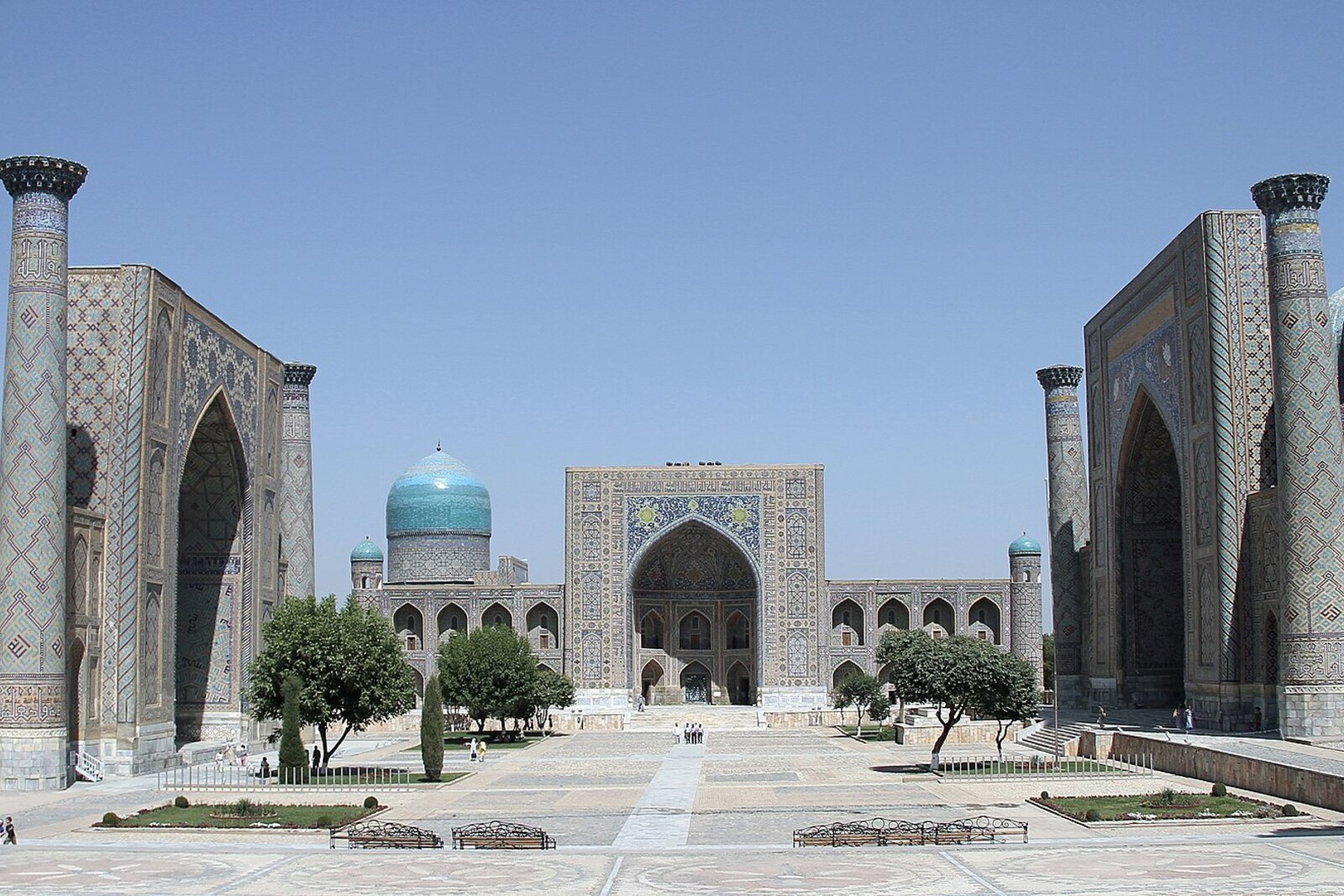
Look around first
What to notice
- Open square
- Three madrasa façades
- Streets radiating from the square
The story of the place
In thirteen sixty-five, a cathedral mosque stood on Registan Square. Townspeople gathered beside it, faced with the decision of whether to defend Samarkand themselves. The army of Ilyas Khoja, khan of Moghulistan—a state east of the region between the Amu Darya and the Syr Darya—was advancing on the city. Samarkand had no functioning fortress walls. Timur and his ally Amir Husayn had already tried to stop Ilyas Khoja near Tashkent, suffered defeat, and retreated beyond the Amu Darya.
Among those gathered was Mawlana-zada, a madrasa teacher who called for the city’s immediate defense. He proposed that prominent townspeople lead it, but no volunteers came forward. Mawlana-zada then took command himself. He was supported by Abu Bakr Kalavi, headman of the cotton beaters—craftsmen who prepared fiber for spinning—and the marksman Khurdak Bukhari. These were people whose usual occupations were study, crafts, and earning a living in the city. The chronicles called them the Sarbadars: the word meant being ready to see one’s head on the gallows rather than submit.
Samarkand’s main streets radiated from Registan Square, and the defenders used the city’s layout. They blocked narrow lanes with barricades and chains and stationed marksmen on rooftops and behind walls. One broad street was left open. Ilyas Khoja’s horsemen entered along it, after which the townspeople struck from the sides with arrows, stones, and clubs. The cavalry retreated, and subsequent attacks also failed to win the city for the khan. Then an epidemic began among his horses. For an army dependent on cavalry, the loss of its animals made it impossible to continue the siege, and Ilyas Khoja led his army away.
For several months, Samarkand was governed by the people who had organized its defense beside the mosque on Registan Square. Timur and Husayn returned in the following spring. They did not dare attack the city at once. First, they sent the Sarbadars gifts, robes of honor, and a charter recognizing them as lawful leaders; then they invited the leaders to a meeting in the village of Kani-Gil near Samarkand. There, the guests were seized. Abu Bakr Kalavi and Khurdak Bukhari were executed. If the historian Abd al-Razzaq Samarqandi is to be believed, Mawlana-zada was already standing at the gallows when Timur secured mercy for him. There is no reliable information about his later fate.
Registan Square means “sandy place.” This was the name given to open central squares where roads converged, trade took place, and townspeople were gathered. Samarkand’s Registan Square existed as a market and public center long before the present-day ensemble. That is why the decision about defense was made here, and the streets radiating from the square at once became part of the plan.
None of the three present-day façades existed yet in thirteen sixty-five. Construction of Ulugh Beg Madrasa began half a century later; Sher-Dor Madrasa and Tilla-Kori Madrasa appeared another two centuries later. The cathedral mosque beside which Mawlana-zada spoke has disappeared, and no established material trace of it remains. What remains is the open square at the crossroads of the city’s roads and its old name—Registan Square.
Useful on site
The official website lists 07:00–24:00 from 20 February to 20 November and 08:00–20:00 from 20 November to 20 February.
Checked: June 24, 2026. Check the official source before visiting.First, view all three sides from one point: this makes it easier to compare the façades before entering the individual courtyards.