 Guide On Map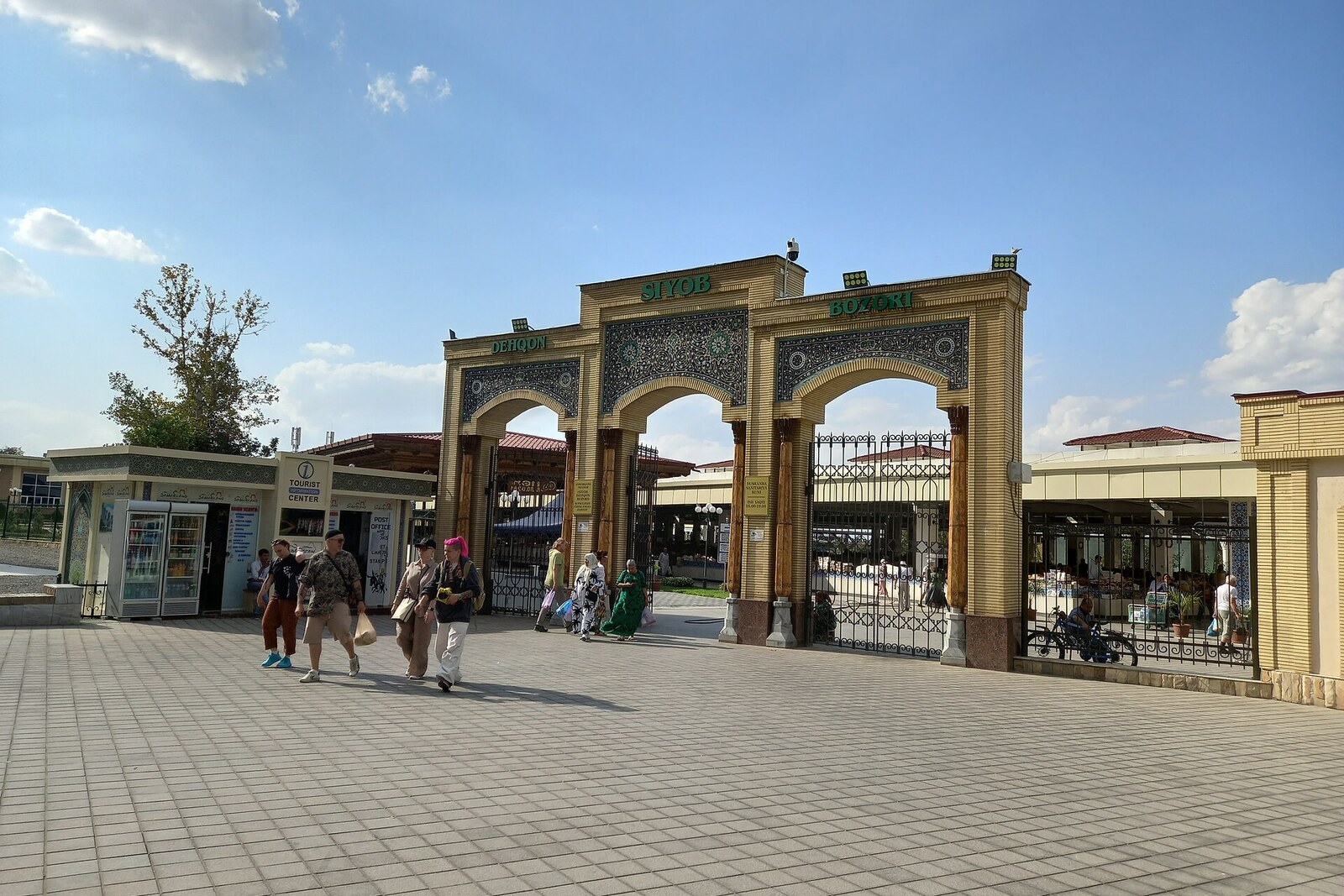
Look around first
What to notice
- Separate market rows
- Covered passageways
- The line of the street toward Registan Square
- The dome of Bibi-Khanum Mosque at the exit
The story of the place
At the northern end of the former commercial route, beside Bibi-Khanum Mosque, the large covered Siab market is in operation. Beneath its covered passageways, goods are not mixed together: bread, fruit, meat, sweets, and spices lie in their own rows. The bazaar takes its name from the district and the neighboring river; it is usually translated as “black water.” From here, the present-day street runs toward Registan Square, preserving the direction of the city's old trade.
In the autumn of fourteen hundred four, the owners of houses by the square in front of Bibi-Khanum Mosque hastily carried out their belongings. Timur ordered a broad commercial street to be laid from here across all of Samarkand—to Chorsu at Registan Square. The houses in its path were ordered demolished, without regard to whom they belonged.
Goods from China, India, Dasht-i Kipchak, and surrounding lands were brought into the city, but there was no single convenient place for such trade. Timur entrusted the construction to two courtiers and warned them: they would answer with their heads for any delay. The city hired as many workers as the overseers required. At night, another shift replaced the daytime one: some dismantled dwellings, others leveled the ground, and still others put up shops.
Ruy Gonzalez de Clavijo, the Castilian ambassador who was in Samarkand at the time, described two connected rooms in each shop, stone counters, fountains, and a common vault with windows for light. Merchants occupied the completed premises at once. In fewer than twenty days, a covered arcade stretched from the congregational mosque to the city's commercial crossroads.
The people who lost their homes nevertheless tried to obtain compensation. They asked respected townspeople, considered descendants of Prophet Muhammad, to speak with Timur. One of them raised the matter while the ruler was playing chess. According to the account recorded by Clavijo, Timur grew angry and declared that the city belonged to him because he had bought it and could produce the deeds. The intermediaries backed down; later, they were surprised that they had not been executed. Clavijo does not report any payments to the owners of the demolished houses.
The commercial street of fourteen hundred four has not survived. The modern Siab Bazaar occupies its northern end near Bibi-Khanum Mosque: here again, the rows of bread, vegetables, fruit, meat, sweets, and spices are kept separate. The name “Siab” did not come from that Timurid arcade—the district and the nearby river bore that name; it is translated as “black water.” From the square in front of the mosque, the medieval shops ran toward Registan Square, along the line of the present-day street.
Useful on site
Current guidebooks agree that it operates from Tuesday through Sunday until about 19:00; Monday is a day off. Sources differ on the opening time.
Checked: June 24, 2026. Check the official source before visiting.Do not stand in the middle of the market passageway, ask permission before taking portraits, and remember that this is a working market.