 Guide On Map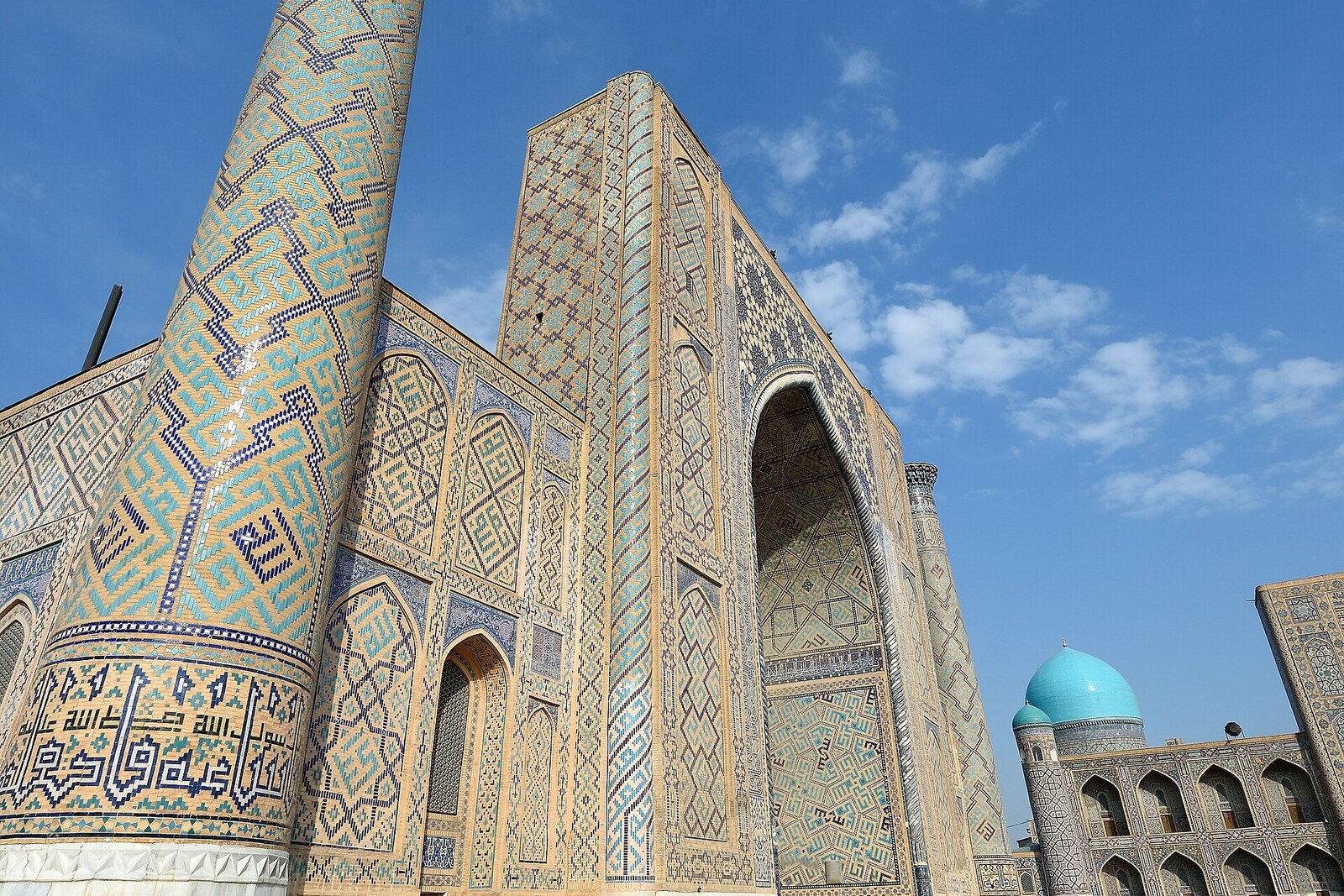
Look around first
What to notice
- The star ornament on the portal
- The inner courtyard
- The hujras around the courtyard
- The corner classrooms
The story of the place
In the early fifteenth century, a madrasa was built on Samarkand’s main square, where study was not separated from everyday life: the students lived here too. Beyond the portal with its star ornament lies a courtyard surrounded by rows of doors leading to hujras. More than a hundred students lived in fifty such rooms, while the corner classrooms were used for theology, law, logic, mathematics, geometry, and astronomy. The school has long been gone, and museum exhibitions occupy some of the rooms, but the building’s plan still preserves its former arrangement.
As construction was nearing completion, Ulugh Beg asked who would become the first chief teacher. Timur’s grandson and the ruler of Samarkand was looking for someone capable of understanding all the sciences that were to be taught at the new school.
The sixteenth-century writer Zayn al-Din Wasifi relates that Muhammad Khwafi—a wandering scholar and dervish in dirty clothes, sitting amid piles of bricks—heard the call. Khwafi said that he was qualified for the position. Ulugh Beg began questioning him, satisfied himself of Khwafi’s knowledge, and ordered him taken to the bathhouse and given new clothes. But he set the final test in public.
On the opening day, in fourteen twenty, Khwafi delivered a lecture on the Almagest before ninety scholars—a complex work by Ptolemy on the movement of celestial bodies. According to Wasifi, two people understood its meaning: Qadi-zada al-Rumi, a mathematician and Ulugh Beg’s mentor, and the ruler himself. This is a story written down late, not a record of the opening. But the name of the first teacher is also confirmed by other historical evidence. Khwafi received the position and then mainly taught students.
This story precisely shows the purpose of the building. The madrasa combined an institution of higher learning with a dormitory. More than a hundred students lived in fifty hujras—rooms for living and study. In the corner classrooms, they taught interpretation of the Quran and Islamic law, logic, mathematics, geometry, and astronomy. Ulugh Beg did not limit himself to the role of patron. Two surviving letters by the mathematician Jamshid al-Kashi, whom he invited to Samarkand for scholarly work, describe how the ruler appointed scholars, attended seminars, and took part in calculations.
Muhammad Taraghay received the name Ulugh Beg in his youth: this Turkic title means “great beg,” a great ruler. The madrasa bears his name because he ordered it built on Samarkand’s main square between fourteen seventeen and fourteen twenty, taught here himself, and gathered mathematicians and astronomers around the school.
The star ornament on the portal does not mean that observations were made right in the courtyard. Ulugh Beg later built a separate observatory for them on a hill outside the city. Here, scholars worked through theory and prepared calculations; there, they measured the positions of celestial bodies. This joint work produced astronomical tables and a catalogue of more than a thousand stars.
Which particular classroom hosted Khwafi’s first lecture is unknown. The second floor, now visible from the courtyard, was largely rebuilt by restorers in the nineteen nineties. There is no school here anymore: museum exhibitions occupy some of the rooms. But behind the doors around the courtyard, the old arrangement is still legible—the classes in the center, student living quarters at the sides, and by the portal, the square where a man in dirty clothes once came out and demanded that his knowledge be tested.
Useful on site
Open as part of Registan Square according to its seasonal schedule; access to individual floors and rooms may vary.
Checked: June 24, 2026. Check the official source before visiting.In the courtyard, do not block the passageways, and distinguish the preserved architecture from later reconstruction.