 Guide On Map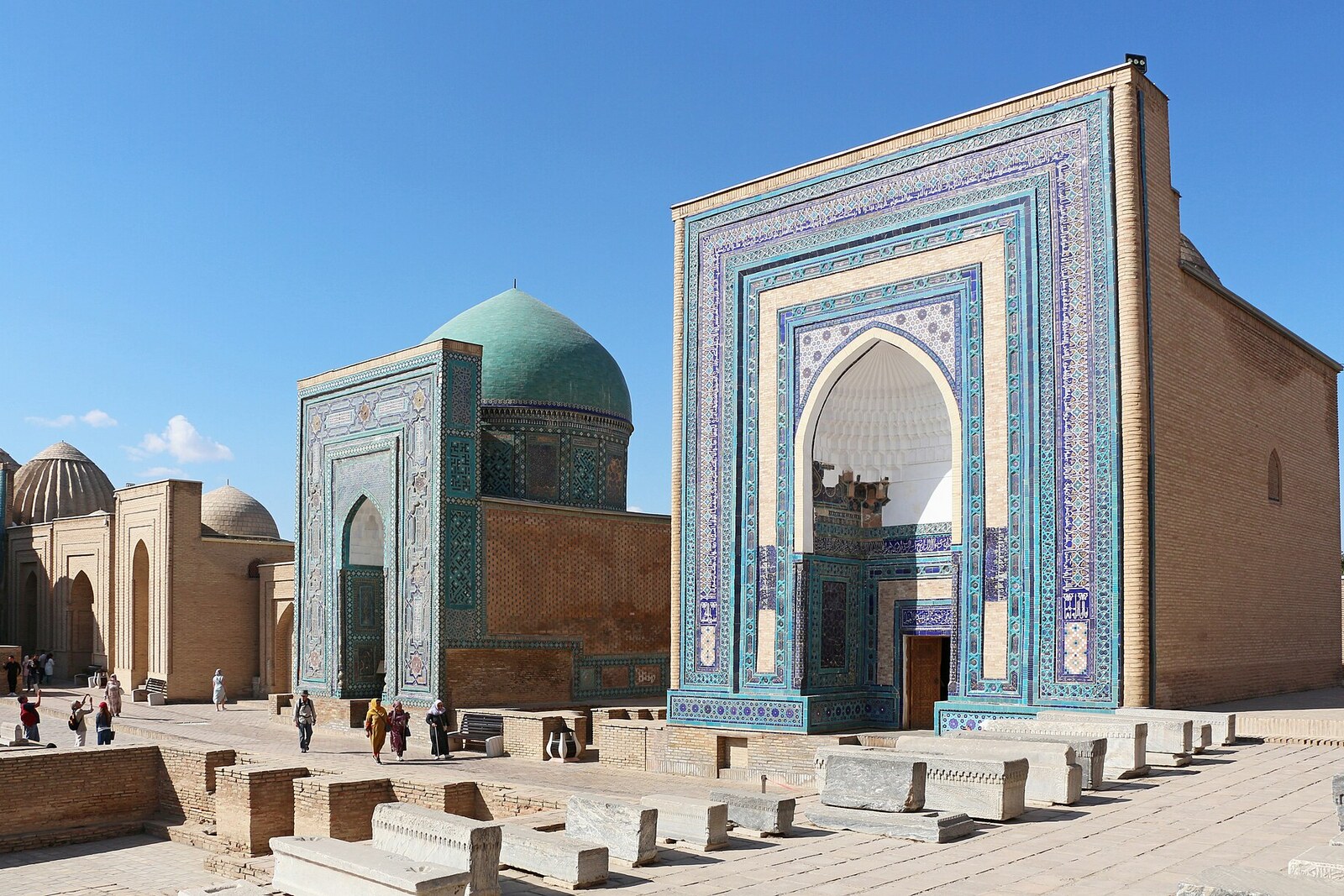
Look around first
What to notice
- A narrow passage between the mausoleums
- Turquoise facades
- A carved wooden lattice
- A tiled tombstone
The story of the place
At the end of the narrow passage, behind a carved wooden lattice, stands the tiled tombstone of Qutham ibn Abbas. Here he is called Shah-i-Zinda—Persian for “Living King.” At first, this name referred to Qutham, then it passed to the entire necropolis.
Qutham was a cousin of the Prophet Muhammad. In the seventh century, he came to Samarkand with an Arab Muslim army and took part in spreading Islam. Sources disagree even on the place of his death: some name Samarkand, others Merv. There is no evidence that his body was buried beneath this sanctuary.
Local legend tells a different ending. Zabur Shah, the defeated ruler of Samarkand, wanted to retake the city. Qutham, appointed ruler by the conquerors, was to hold the city and defend the new Muslim community. Zabur Shah decided to attack during the Eid al-Adha festival prayer: people would gather together and leave their weapons behind.
He made Qutham his main target. While Qutham fought nearby, no one could approach him. Then Zabur Shah ordered shooting from a distance. According to the legend, Qutham asked God for help, and Khidr appeared before him—an ever-living righteous man associated in Muslim tradition with saving travelers. Khidr pointed to a well that had opened in the ground. Qutham descended into it.
Zabur Shah ordered the well filled with stones and rubbish. The legend adds that an angel cast aside everything that fell down. The warriors never found the body. Qutham allegedly remained alive underground and is to emerge from there before the end of time. Hence the name: “Living King.”
This legend arose much later than the campaign itself. Yet by the eleventh century, a sanctuary of Qutham already existed on this slope. Then Samarkand's noble families began building their own burial places nearby: it was considered important to lie as close to the saint as possible. In the fourteenth and fifteenth centuries, dozens of mausoleums were built along the road to his sanctuary for women and men from the circle of the Timurids. Archaeologists have found traces of approximately forty tombs, although not all have survived.
That is why the narrow street between the turquoise facades leads to Qutham's chamber. It is still a place of pilgrimage: prayers are recited at the lattice. The tombstone is visible behind it, while the underground chamber remains inaccessible. It was there that Samarkand legend placed the man whose name the entire necropolis now bears.
Useful on site
Two current independent guidebooks list daily opening hours of approximately 07:00–19:00, but differ on the ticket price—40,000 and 50,000 som.
Checked: June 24, 2026. Check the official source before visiting.Walk slowly, do not touch the tilework, and do not regard the complex only as a photo spot: it is a necropolis and a place of veneration.