 Guide On Map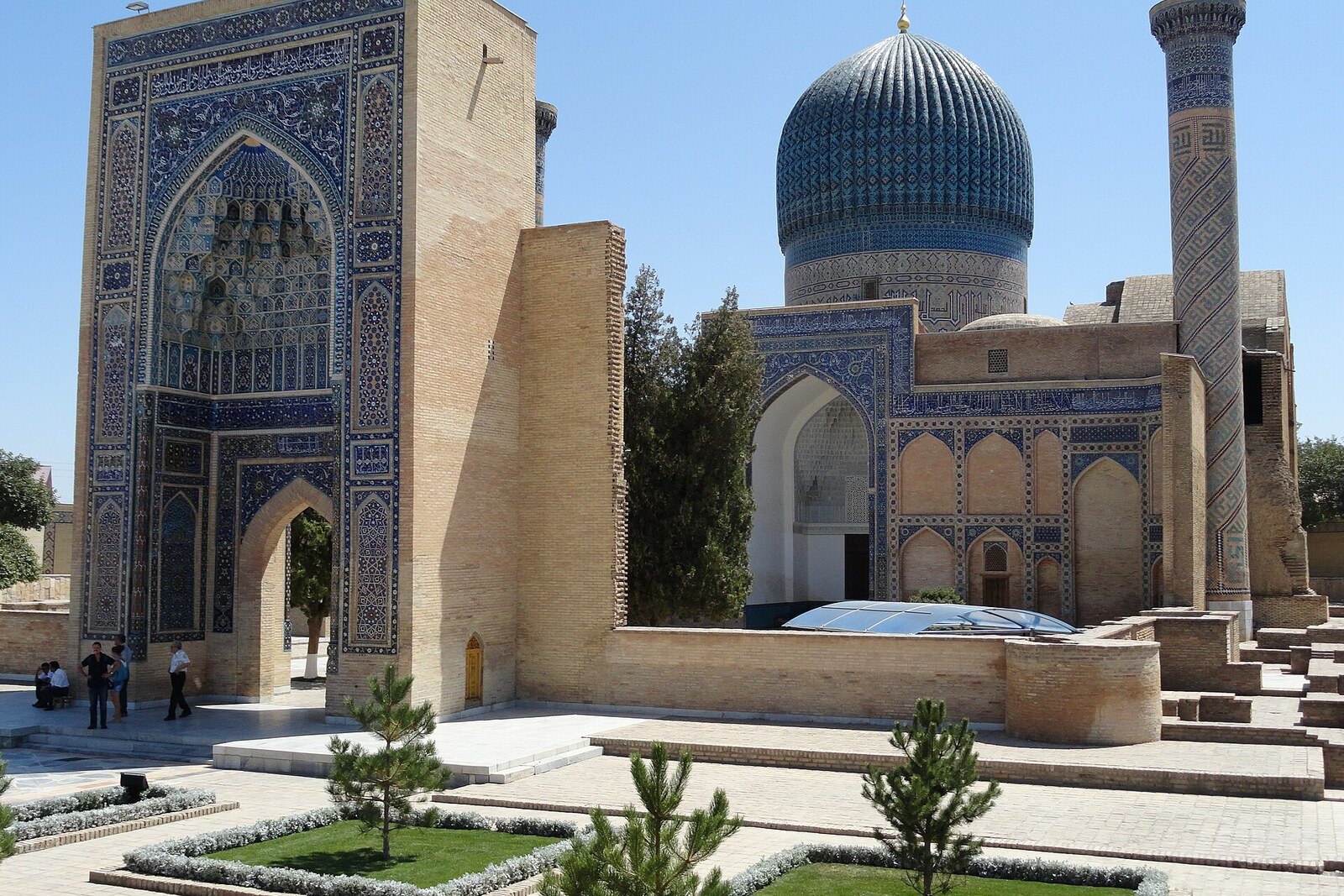
Look around first
What to notice
- Ribbed blue dome
- Octagonal mausoleum structure
- Dark-green jade slab
- Lower sections of the madrasa and khanaqah walls
The story of the place
The blue ribbed dome rises above an octagonal mausoleum built in the middle of an old courtyard. A madrasa for the sons of the nobility and a khanaqah where honored guests stayed and Sufis gathered once stood here; only the lower sections of their walls have survived. Later, the burial section was arranged as the family tomb of the Timurids. Memorial stones lie in the upper hall, while the burials themselves are hidden in a closed crypt beneath the floor.
In the autumn of fourteen oh four, Timur was brought here twice on a litter. The creator of a vast empire could no longer stay in the saddle, yet he personally inspected the construction of the tomb for his designated successor. He considered the already completed burial chamber too low, ordered it dismantled, and gave the builders ten days to make a new one. The Castilian ambassador Ruy Gonzalez de Clavijo, who had arrived on a diplomatic mission to Timur, recorded that work went on day and night and that everything was finished by the memorial ceremony.
The tomb was being built for Muhammad Sultan, Timur's beloved grandson. He was being prepared to govern the empire: during his grandfather's campaigns, he remained as governor, commanded troops, and was responsible for Samarkand. On this site, Muhammad Sultan had managed to create his own complex—a madrasa for educating the sons of the nobility and a khanaqah where honored guests stayed and Sufis gathered. Of both buildings, only the lower sections of the walls around the courtyard now remain.
In fourteen oh three, Muhammad Sultan died near Sivrihisar during the military campaign that followed the Battle of Ankara. His body was brought to Samarkand and temporarily placed in the mausoleum at his own complex. Timur lost the man to whom he had intended to pass on his lands and armies. After returning from the campaign, he ordered a tall octagonal mausoleum with a ribbed dome to be built on the southern side of the courtyard. Thus, the place that the grandson had prepared for living students and guests had to be adapted for his burial.
Less than four months after the ceremony described by Clavijo, Timur also died. He set out on a campaign against China, fell ill in Otrar, and did not reach the border. His body was sent back to Samarkand and buried here, beside Muhammad Sultan. After this, the complex acquired the name Gur-e Amir: in Persian, “gur” means a tomb, and Timur was called an emir—a ruler and military commander. Later, his grandson Ulugh Beg arranged an entrance to the burial section and turned the mausoleum into the family tomb of the Timurids.
The stones in the upper hall are cenotaphs, memorial tombstones without remains. The actual graves are in the closed crypt beneath the floor and are arranged in roughly the same order. A dark-green jade slab marks Timur's burial; Muhammad Sultan's tombstone stands beside it. The layout of the lower crypt preserves the original plan more precisely than the name does: the young successor's grave occupies the center intended for it, while Timur was laid farther west.
Useful on site
The electronic ticket office for the 2026 season shows a window of 09:00–17:00, but this is not a confirmed daily last-entry time.
Checked: June 24, 2026. Check the official source before visiting.Remember that the tombstones in the hall do not correspond to the burials in the lower crypt; do not touch the stones and keep quiet.