 Guide On Map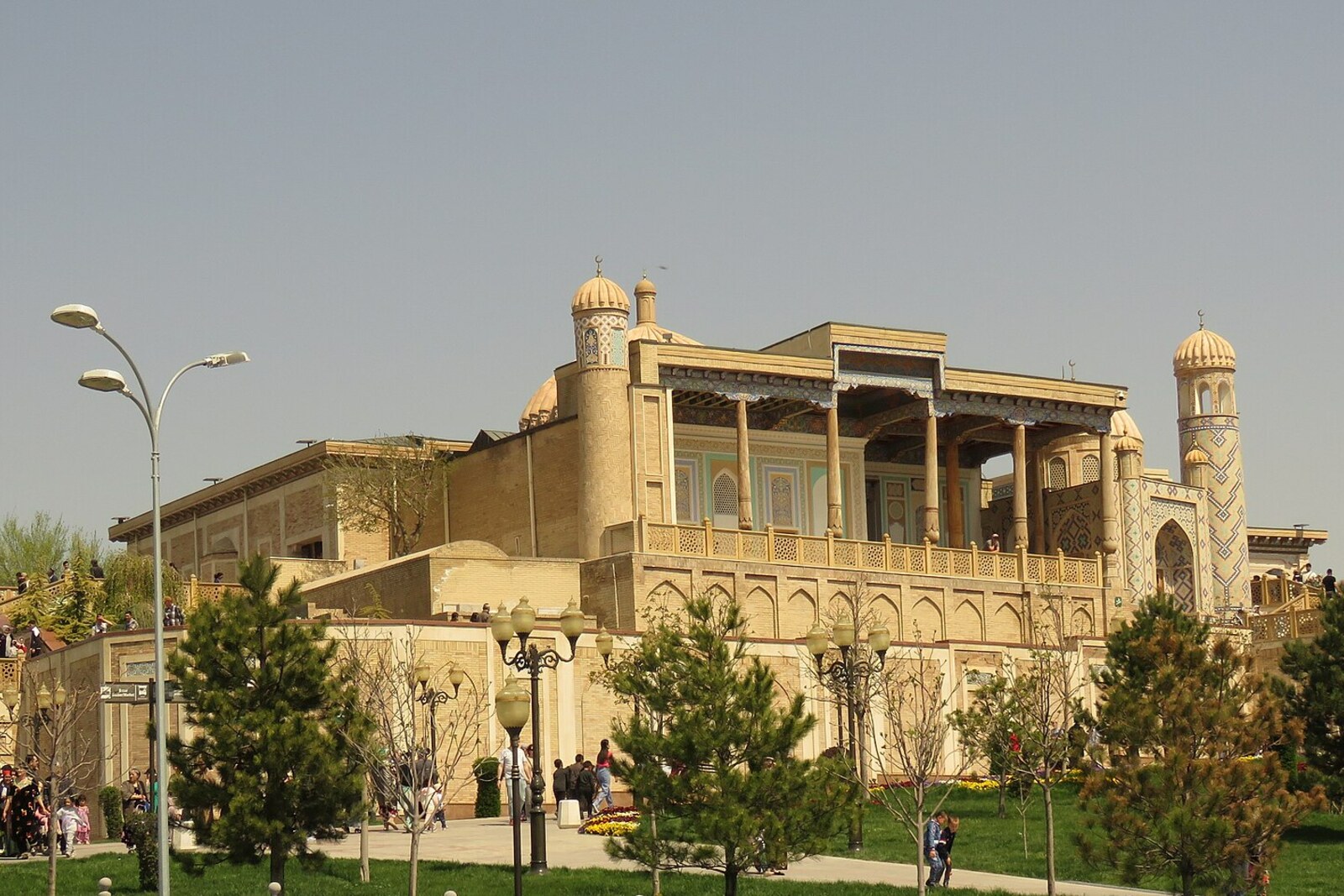
Look around first
What to notice
- The eastern minaret
- The master's signature above the entrance to the staircase
- The white onyx sagana
- The slope of Afrasiab
The story of the place
At the southern edge of Afrasiab, the mosque's eastern minaret is visible, and above the entrance to its staircase is the signature left by a Samarkand master. The shrine by the ancient entrance to the city replaced a revered Sogdian temple; roads and a water canal passed nearby, so it was dedicated to Khidr, the patron of travelers and guardian of the water of life. The present building was erected on old foundations in the nineteenth century, and the minaret was completed later. Nearby lies an old cemetery, where the onyx sagana of the modern memorial stands out white.
This mosque stands where, according to a Samarkand legend, the city once could not be flooded.
In seven hundred twelve, the Arab commander Qutayba ibn Muslim was seeking to subdue Samarkand. His warriors built an embankment across the Jui Arzis Canal, a canal that supplied water to the fortified part of the city. The held-back water was supposed to rush onto the fortress. But a huge white bird supposedly descended onto the embankment and destroyed it, and the frightened warriors scattered. The white bird belongs to legend; the fortress was not flooded.
After this, Muhammad ibn Wasi, a companion of Qutayba, established a Muslim shrine by the Iron Gate, the southern entrance to ancient Samarkand. They chose the site of a revered Sogdian temple for it and dedicated it to Khidr. Hazrat is a respectful form of address for a saint. Khidr is a righteous figure in Islamic traditions, the patron of travelers and guardian of the water of life. Roads passed through the city gates, and a water canal ran nearby, so his name explained both the shrine's purpose and the very choice of the site.
The ancient mosque was destroyed during the Mongol conquest in one thousand two hundred twenty. No walls of that building remain here. The present mosque was built on the old foundations in the nineteenth century, and the portal and eastern minaret were completed in one thousand nine hundred nineteen by the Samarkand master Abd al-Qadir ibn Baqi. His signature has survived above the entrance to the minaret staircase. The canal and embankment have disappeared, but the mosque still occupies the southern edge of Afrasiab, near the ancient line of entry into the city.
The cemetery by the shrine explains the neighboring memorial. Islam Karimov, a native of Samarkand and the first president of independent Uzbekistan, bequeathed that he be buried by Hazrati Khizr Mosque. The graves of his parents and brothers were already in the neighboring old cemetery.
On September third, two thousand sixteen, the day after Karimov's death, funeral participants carried his body to the grave prepared here after the funeral prayer. Later, a mausoleum was built over the burial. At its center stands a sagana, a tombstone of white onyx; the grave itself lies beneath it.
Useful on site
An unofficial visitor guide lists 08:00–17:00; this is an active mosque, and access inside may be restricted during Friday prayer.
Checked: June 24, 2026. Check the official source before visiting.Distinguish between the mosque, the grave, and the viewing point; keep quiet in each space and do not enter closed areas.