 Guide On Map
The Heart of Rome: Squares, the Pantheon, and Fountains
From Campo de' Fiori through Piazza Navona and Trevi Fountain to the Spanish Steps
Guide On Map on your phone
Open the walk like a regular app
It takes about 10 seconds to install. No app store needed.
The whole path
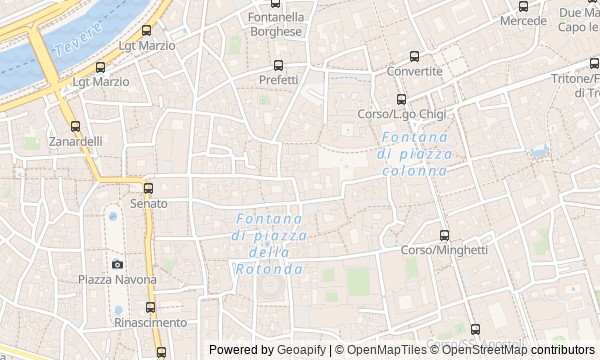
Route map
About the walk
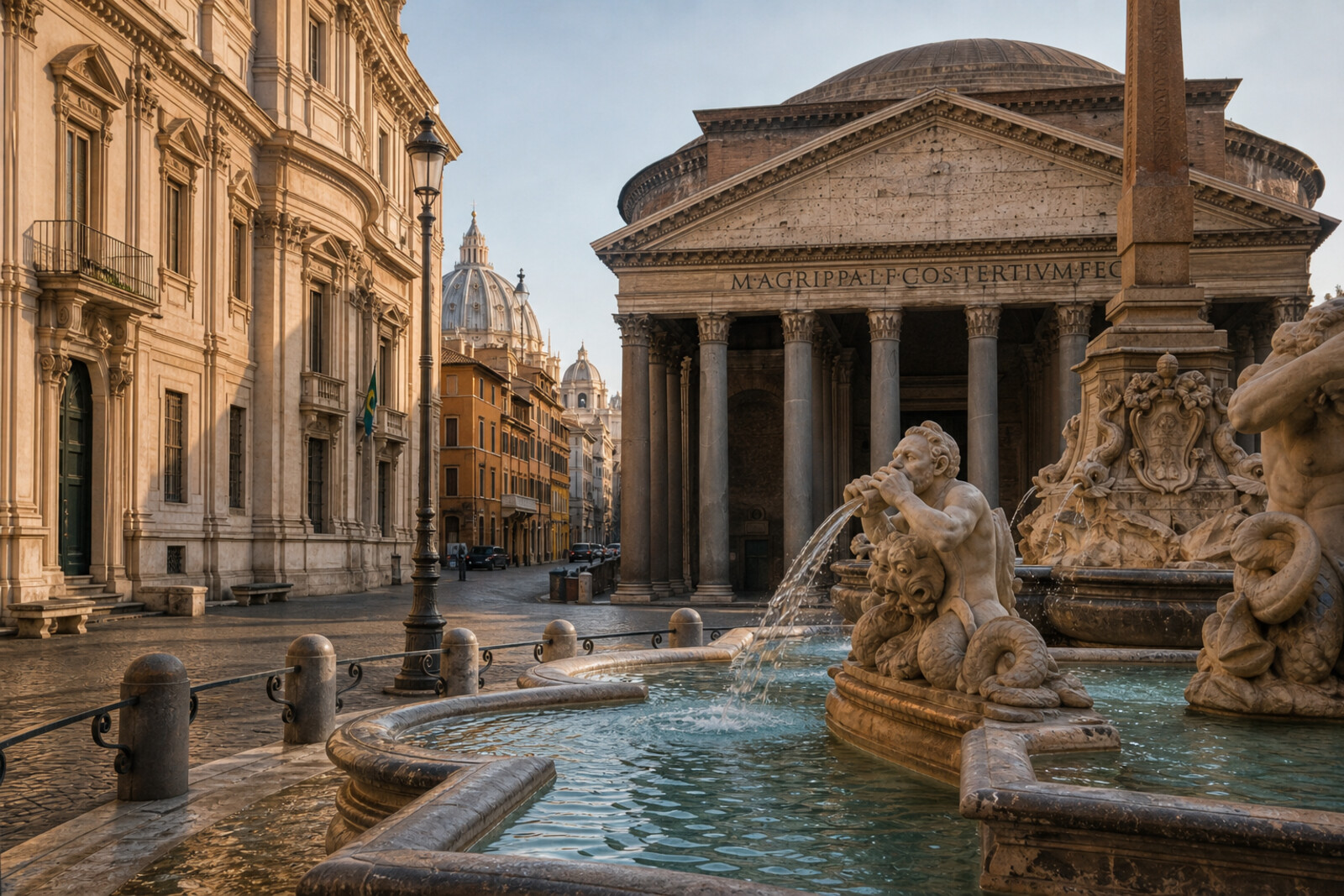
You will cross ceremonial central Rome—from the market at Campo de' Fiori to the staircase above Piazza di Spagna. Along the way come Piazza Navona, the Pantheon, ancient columns set into a later facade, a church with an illusionary dome, and Trevi Fountain, which took over the wall of a palace.
But this is not a route about a succession of masterpieces. You will see these places at the moment when their fate was decided by a denunciation, a will, a papal competition, or a construction error. Why does the bronze philosopher hold a closed book? How did a mutilated marble figure interfere in papal elections? Why was a canvas stretched above a church instead of a dome? And whose coat of arms remained on someone else's palace?
The story will take these disputes apart calmly, separating later legend from what can be established. By the end, you will carry away a different view of familiar Rome: Piazza Navona, the Pantheon, Trevi Fountain, and the Spanish Steps will no longer be timeless scenery, but traces of decisions that might have gone another way.
Why this order
Campo de' Fiori sets the theme of a public sentence and the later response to it. A short walk to Pasquino replaces an official monument with a streetwise retort, and the statue itself at the entrance to Piazza Navona leads to a square where rivalry was played out in stone. From the eastern side of Piazza Navona, the route continues to the Pantheon: after the outline of a vanished stadium, you enter an ancient building where the argument concerned the authenticity of remains. Piazza di Pietra then offers the reverse picture—an outer row of a temple survives, built into a later house. A southern turn brings you to the Church of St. Ignatius of Loyola, where real columns give way to architecture painted in color. From there, the route crosses Via del Corso to Trevi Fountain, where the facade, too, proves to be the result of a struggle for a wall. The final climb to Piazza di Spagna ends at a structure that became both a city stage and a blow to its architect's career.
Those walking through Rome's historic center for the first time Those who care about the human conflicts behind famous facades Those who want to tell documented history from a beautiful legend
Those looking for an overview of ancient Rome without the Baroque Those who prefer quiet streets to the main tourist squares Those who need a route only through interiors and museums
Before you go
The Pantheon and the Church of St. Ignatius of Loyola remain active churches: choose clothing that covers your shoulders and knees, speak more quietly, and be prepared for restrictions during services. Check official sources for entry conditions at the Pantheon and access to the area closest to Trevi Fountain before your walk; these stops may require a separate ticket or waiting. The market at Campo de' Fiori is best observed in the first half of the day, though the square is worth seeing without the stalls as well. Bring water, but do not eat or sit on the Spanish Steps. Entering Trevi Fountain is forbidden, however convincing the scene from a film may look.
When to go
Allow about three hours if you want to enter the Pantheon and take your time with the paintings at the Church of St. Ignatius of Loyola. Without interior visits, you can complete the route faster, but they are what reveal two different ways of creating a dome. Starting in the first half of the day adds a working market at Campo de' Fiori; later, the main squares usually become more crowded. Leave a little extra time for access checks, services, and the line at the Pantheon.
Backup plan
If you cannot enter the Pantheon, look at Marcus Agrippa's inscription and the structure of the portico from outside, then continue the dome theme at the Church of St. Ignatius of Loyola, where the main effect opens up inside without a lengthy visit. If access to the lower part of Trevi Fountain is restricted, the whole composition can be read from the square: there is no need to seek out the nearest point by the water. If time is short, end the walk after the Church of St. Ignatius of Loyola—by then, a complete chain will already have emerged, from urban memory and satire to an ancient framework, a saved temple, and painted architecture. In rain, take extra care on the smooth stone of the squares and staircase.
Route conditions
Surface. Paved — 2.3 km (data covers 93% of the route)
Facilities. Toilets — 2; drinking water — 16
Elevation. Ascent — 28 m; descent — 19 m
OpenStreetMap extract of June 25, 2026: database data, not a check on the ground. Data © OpenStreetMap contributors, ODbL licence
Walk plan
Open in maps ↗- 1
Campo de' Fiori
Here the route begins with a square where, three centuries later, a public sentence received a bronze reply. - 2
Pasquino
The mutilated marble will help explain how Roman mockery became a political tool. - 3
Piazza Navona
The square will show how a fountain model could restore an architect's papal commissions and deprive a rival of the central work. - 4
Pantheon
This stop is needed to examine the investigation after which a venerated relic turned out to belong to someone else. - 5
Piazza di Pietra
The surviving side of the temple links an imperial dispute over succession with a later customs house and the modern chamber. - 6
Church of St. Ignatius of Loyola
Inside, it will become clear how a painter replaced an unbuilt structure with a convincing architectural illusion. - 7
Trevi Fountain
The fountain will help you see how a papal plan took over someone else’s palace and left its own coat of arms on it. - 8
Piazza di Spagna and the Spanish Steps
The finale will show how a major architectural success came with defects, a lawsuit, and a career that never took off.
Route features
Everything you need stays in the browser
Progress, saves and your trip plan are stored on this device.
Add Guide On Map to your home screen so the walk opens outside the browser.
How we handle sources, maps and corrections: our editorial standards