 Guide On Map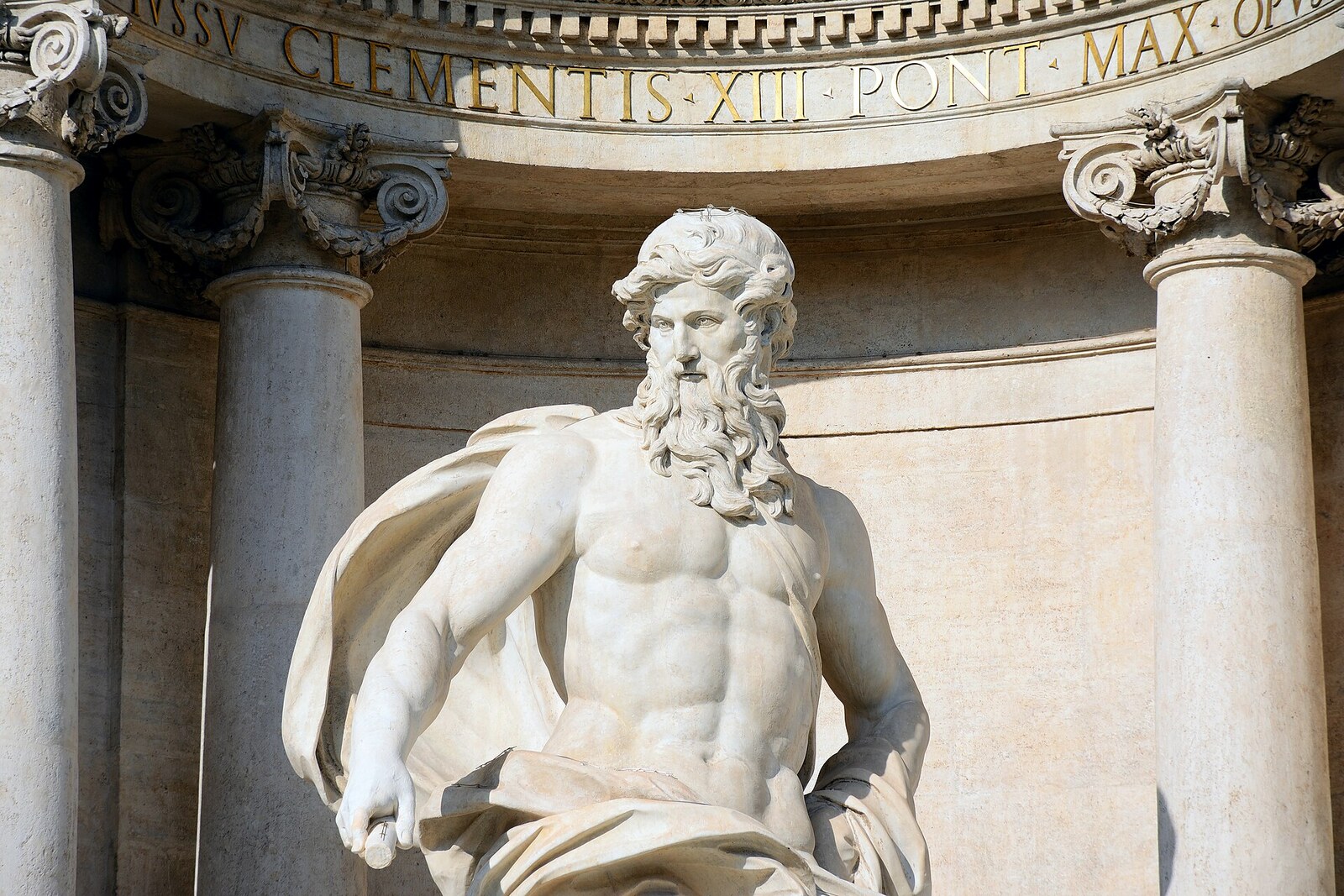
Look around first
What to notice
- The figure of Oceanus on a shell
- Two sea horses
- The coat of arms beneath the papal tiara
- The palace’s side windows
The story of the place
The stone wall above the basin closes off an entire side of the cramped square, but behind Oceanus on his shell and the two sea horses, Palazzo Poli continues: its side windows are still visible at the edges of the composition. Its middle was designed as a triumphal arch, while the niches and reliefs tell the story of the water that reached this point. Work came to a halt several times because of the income, and after the author’s death Giuseppe Pannini brought it to completion; it was finished in seventeen sixty-two. Since then, the palace wall has served as the fountain’s façade.
Here, the water travels the final stretch of a route begun in nineteen BCE. Marcus Vipsanius Agrippa ordered Aqua Virgo to be brought to his baths near the Pantheon. In the Early Modern period, Trevi Fountain became the terminal outlet of the restored aqueduct. Previously, the water emerged here from three pipes into a simple basin. The name is linked either to these three streams or to the intersection of three streets, called Trivium in the Middle Ages. Today, electric pumps circulate the main volume of water in a loop, but the aqueduct continues to supply the fountain.
By seventeen thirty, the Conti family, the Dukes of Poli and owners of the palace standing here, had just finished enlarging their Roman residence. They bought up neighboring houses, joined them to the palace, and brought a new façade out onto the square. For an aristocratic family, such a house was at once a home, property, and a public sign of status. They had owned the central section with its windows for only a few years when Pope Clement XII of the Corsini family laid claim to it for his plans.
The pope wanted to turn the old three pipes into the main Roman fountain of Aqua Virgo. There was no free space in the cramped square, so he ordered the rear wall of Palazzo Poli to be used. The dukes objected: the structure would take windows from the recently completed façade, and the coat of arms of another family—the papal Corsini family—was to appear above their home. Clement dismissed the objections.
From sixteen designs, he chose the work of the Roman architect Nicola Salvi. For Salvi, this was a rare opportunity: until then, he had earned his living through architectural assessments, road surveys, small church commissions, and temporary festive decorations, and shortly before the competition he had lost the commission for the façade of the Basilica of St. John Lateran to another architect. Now he was entrusted with a structure that occupied an entire side of the square.
Salvi left the dukes the side wings with their windows, while turning the center of their palace into something like a triumphal arch. The god Oceanus rides out of it on a shell drawn by two sea horses. On the left, Salvi placed a relief in which Agrippa orders the aqueduct to be built. On the right, a girl shows the spring to soldiers. This latter scene is an ancient legend used to explain the name Aqua Virgo, “Water of the Virgin,” rather than an established fact.
The construction was paid for with proceeds from the papal lottery; the income varied, and work stopped more than once. Pope Clement XII died in seventeen forty. Salvi won recognition, but fell seriously ill and died in seventeen fifty-one without seeing the fountain completed. The architect Giuseppe Pannini brought the work to completion in seventeen sixty-two.
Palazzo Poli remains behind the sculptures. Its windows run along the edges of the composition, and above the central arch, beneath the papal tiara, the coat of arms of the Corsini family remains—on the façade that the palace’s owners tried not to surrender for it.
Useful on site
Lower basin: Monday and Friday 11:30–22:00, other days 09:00–22:00, last entry 21:00; the fountain itself is visible from the square free of charge, hours may change.
Checked: June 29, 2026. Check the official source before visiting.Do not enter the basin or climb over the barriers; if the closer passage is regulated, the entire composition can be viewed from the square.