 Guide On Map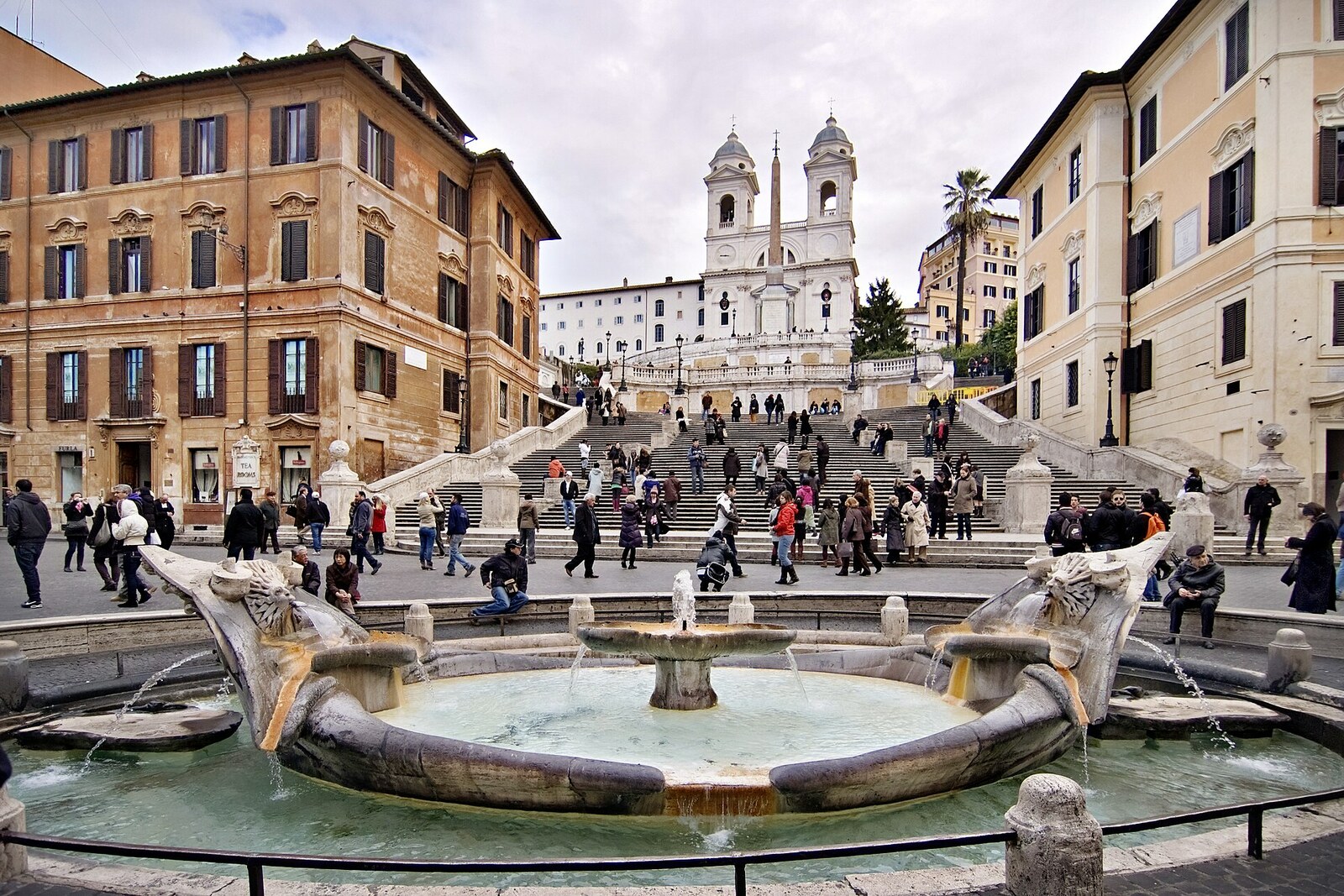
Look around first
What to notice
- Curving stair wings
- Broad landings between flights
- Heraldic lilies
- Eagles on stone pedestals
The story of the place
On Italian maps, this is the Scalinata di Trinità dei Monti—the staircase to the Church of the Trinity on the Hill. The familiar name, “Spanish,” came from below. In sixteen twenty-two, the ambassador of the Spanish king moved into Palazzo Monaldeschi, which stood on the square, and twenty-five years later Spain bought the building. The Embassy of Spain to the Holy See still occupies it. The square was named after the embassy, and then so were the steps.
The church at the top was under the patronage of the French kings. The slope in front of it belonged to the French monks of the Order of Minims, but there was no convenient descent to the square. The French diplomat Étienne Gueffier had lived nearby since sixteen twenty-six and knew this ascent from his own everyday life. When he died in sixteen sixty, he left twenty thousand scudi for the construction of a grand staircase.
Nothing came of the construction. Gueffier’s nephew challenged the will and won half the capital in court. Cardinal Giulio Mazarini, first minister to the French king Louis XIV, tried to dispose of the remaining half and requested designs from Rome’s finest architects. At the center of one of them stood Louis XIV on horseback. Pope Alexander VII refused to permit such a monument to a foreign monarch in Rome. Mazarini died a year after Gueffier, negotiations stopped, and the slope remained without steps for about another sixty years.
In seventeen seventeen, Pope Clement XI ordered a calculation of how much interest had accrued on the surviving half of the inheritance and announced a new competition. Francesco de Sanctis, architect to the Minims, submitted his design. Until then, he had lived on small commissions from monasteries: assessing carpentry work, repairing, and building the income-producing houses they owned. The staircase could become his first major work.
De Sanctis was given an awkward site. The façade of the church at the top, the Barcaccia Fountain below, and the opening of Via Condotti did not stand on one line. The architect rejected a single straight flight. He divided the ascent into short stairways, curving wings, and broad landings, shifting its direction as it rose. People could stop between the flights, and the space on the steep slope became a meeting place rather than a corridor to the church door.
Pope Innocent XIII approved de Sanctis’s model in the autumn of seventeen twenty-three; approval also came from the French king Louis XV. Construction began in November and was completed by the end of seventeen twenty-six.
Two years later, torrential rains and construction defects brought down the retaining walls on the slope of Pincian Hill. Several parts of the new staircase were seriously damaged. The monks summoned de Sanctis and the supervisors of the work to court, demanding that they pay for the restoration. Most of the blame was laid on the stonemasons, but the architect’s reputation took the blow. After his major commission, his career narrowed to modest work for the same churches he had served before.
On the stone pedestals at the base, the heraldic lilies of France and the eagles of the family of Pope Innocent XIII still stand side by side. Louis XIV on horseback was no longer in the final design. The embassy still occupies the palace below, and the steps are called Spanish after its address.
Useful on site
The square and steps are always open; sitting or eating on the steps is prohibited, and fines and temporary restrictions during events are possible.
Checked: June 29, 2026. Check the official source before visiting.You may walk on the steps, but you may not sit or eat on them; plan the Keats-Shelley House as a separate visit.