 Guide On Map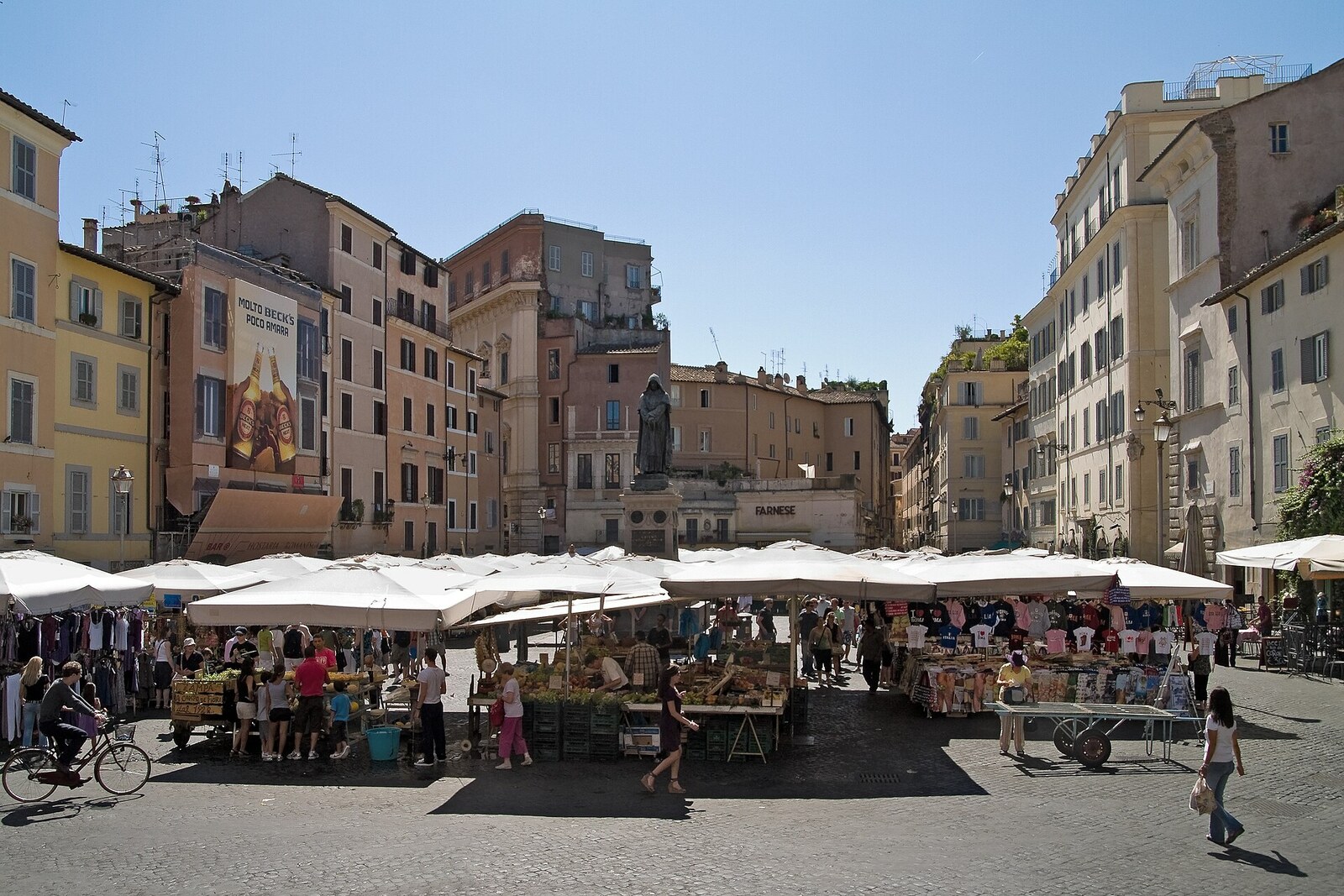
Look around first
What to notice
- Figure in a monk’s hood
- Closed book in crossed arms
- Granite pedestal with portraits and scenes
- Stone fountain basin at the edge of the square
The story of the place
On weekday and Saturday mornings, Campo de' Fiori is occupied by vendors. Among the vegetables, fruit, and flowers, there are now many dried spices, packaged goods, and souvenirs intended for visitors. Once the market closes, the stalls are taken away, and bars and restaurants around the edges of the square welcome visitors. This routine is comparatively recent: the market was moved here from Piazza Navona in eighteen sixty-nine.
The name is much older. Campo de' Fiori means “field of flowers.” Until the fifteenth century, there really was a meadow and vegetable gardens here. Tradition links the name to Flora, the beloved of the commander Pompey, but historians consider this version unreliable. When Pope Callixtus III undertook the improvement of the district, the site was paved. Inns, workshops, and shops appeared around it. A church was never built in the square. Horses were traded here, performances were staged, and sentences of the papal court were carried out in public.
In fifteen ninety, the architect Giacomo della Porta placed a stone fountain basin in the center. Ten years later, a pyre for Giordano Bruno was erected beside it.
Bruno was a former Dominican monk and a wandering philosopher. He had no permanent professorship: he made a living from lectures, publishing books, and lessons he gave to wealthy patrons. In fifteen ninety-one, the Venetian nobleman Giovanni Mocenigo invited him to stay with him. Mocenigo wanted to master the art of memory developed by Bruno—a system of images that made it possible to retain and connect large amounts of knowledge.
The host was troubled by his teacher’s views. When Bruno was preparing to leave, Mocenigo handed his papers over to the Venetian Inquisition and wrote several denunciations. The philosopher was arrested and then, at the request of the Roman Holy See, extradited to Rome. A lesson in mnemonics led Bruno to prison, which he left only seven years later—for this square.
The judges of the Roman Inquisition sought to make him recant propositions deemed heretical. Bruno at first replied with qualifications and submitted written explanations, but at the end of fifteen ninety-nine he declared that he had nothing to recant. The complete list of eight propositions put to him by the court has been lost. The surviving materials discuss both Christian dogmas—the Trinity, the nature of Christ, and the Eucharist—and the eternity of the world, the transmigration of souls, and a multitude of worlds. That is why the familiar phrase, “Bruno was burned for Copernican teaching,” is too convenient: it replaces a long theological trial with a single cosmological idea.
On January twentieth, sixteen hundred, Pope Clement VIII, who presided over the session, ordered Bruno to be handed over to the secular court as an unrepentant heretic. His writings were entered on the list of forbidden books. On February seventeenth, the condemned man was brought to Campo de' Fiori, stripped, tied to a stake, and burned alive. In the center of papal Rome’s trading district, the sentence was carried out so that the public would see it.
Nearly three centuries later, Roman students decided to return Bruno to the place of execution. From eighteen seventy-six, two university committees raised money for a monument; scholars and writers from different countries joined the collection. The sculptor Ettore Ferrari first portrayed Bruno before the inquisitors with his hand raised, as though he were continuing the argument. The city commission rejected this version. Ferrari then removed the gesture and made another figure: a man in a monk’s hood, withdrawn into himself, with his arms crossed over a closed book, looking straight ahead.
The site for the statue had to be won from the project’s municipal opponents. Permission was obtained after a dispute lasting many years, and on June ninth, eighteen eighty-nine, the bronze Bruno was unveiled exactly where the pyre had stood. Eight portraits of other freethinkers and three scenes from his life were placed on the granite pedestal.
For the monument, della Porta’s fountain, which stood here on the day of the execution, was dismantled. The old basin was later taken to another square, while the present fountain at the edge of Campo de' Fiori repeats its design. Market rows now surround Bruno. The judges ordered his writings to be burned; Ferrari left him a closed book in his bronze hands.
Useful on site
The square is open at all times; market stalls traditionally operate in the morning from Monday through Saturday.
Checked: June 29, 2026. Check the official source before visiting.Do not obstruct the vendors, and view the monument from the edge of the market flow; the former central fountain is now elsewhere.