 Guide On Map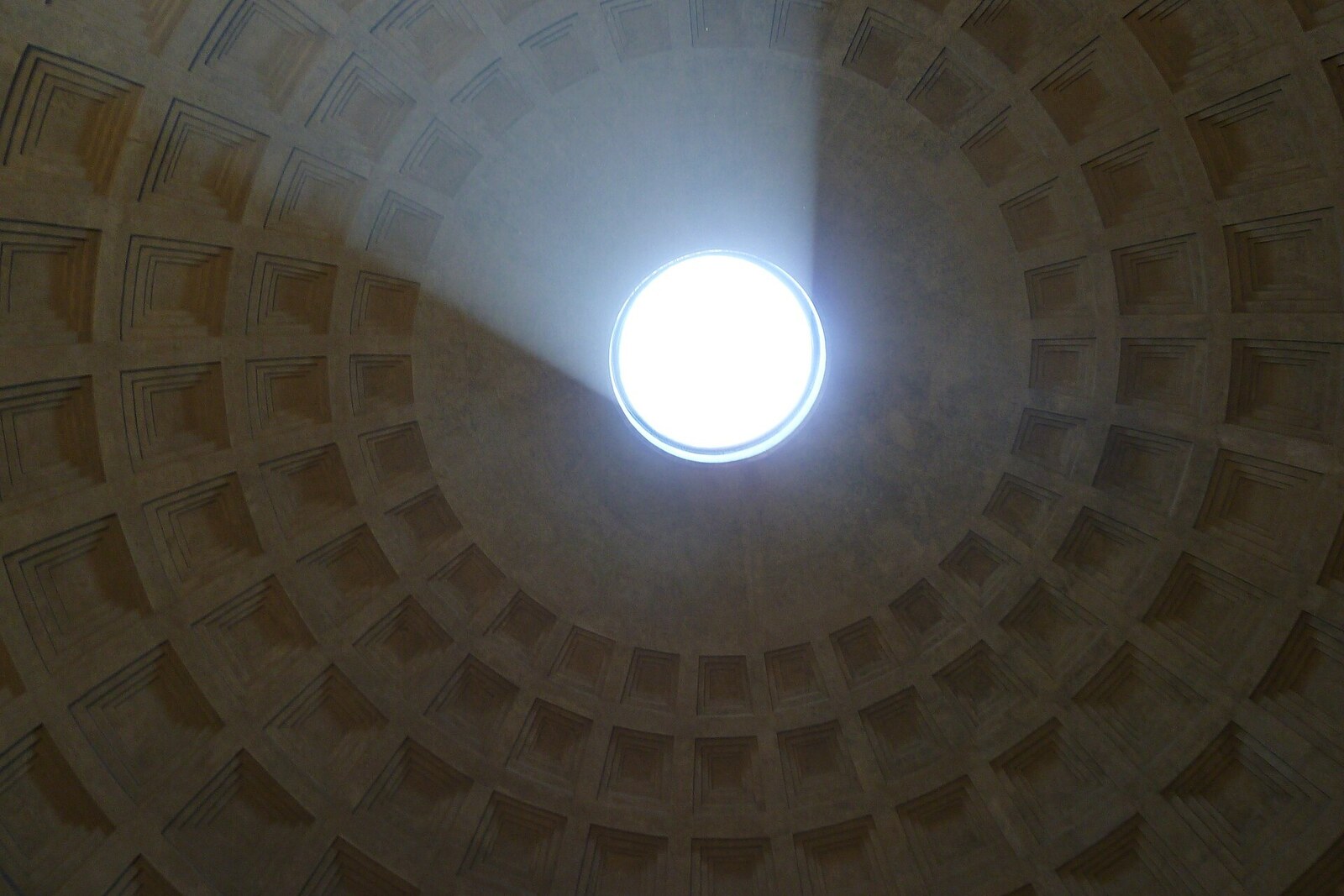
Look around first
What to notice
- The columned portico
- The inscription on the pediment
- The dome of the rotunda
- The sarcophagus beneath the marble Madonna
The story of the place
In the last days of his life, Raphael, artist at the papal court and chief architect of St. Peter's Basilica, arranged to be buried in the Pantheon. He lived on commissions from popes and wealthy Romans, maintained a large workshop, and by the age of thirty-seven could set aside a substantial sum for his own tomb. Yet Raphael required that only a small slab be left beside the ancient niche: the gravestone was not to obscure the building he studied as one of the foremost monuments of ancient Rome.
Even then, the Pantheon combined two functions. Its Greek name means a temple of all gods, although its exact ancient dedication remains disputed. Above the columns, an inscription says that Marcus Agrippa—the commander and son-in-law of Emperor Augustus—built the first temple here in the twenties BCE. The present rotunda with its dome was created under Emperor Hadrian almost a century and a half later, after fires, but Agrippa's name was restored on the façade.
In six hundred nine, the Byzantine emperor Phocas gave the building to Pope Boniface IV. The pope sought to turn the ancient temple into a church and consecrated it in honor of the Virgin Mary and all martyrs. Since then, the Pantheon's official name has been the Pantheon; masses are still celebrated here. Its use as a church helped preserve the walls and dome and made Raphael's burial, rare for this place, possible.
After his death in one thousand five hundred twenty, his body was placed beneath an altar with a marble Madonna made by the artist's pupil Lorenzetto. But confusion arose over time. The Academy of Saint Luke in Rome kept a human skull that it believed to be Raphael's. According to contemporary accounts, pupils touched it with the tips of their brushes and pencils, hoping to acquire the great painter's skill. At the same time, the inscription in the Pantheon stated that Raphael lay here whole.
In one thousand eight hundred thirty-three, the sculptor Giuseppe De Fabris, head of the association of artists at the Pantheon, decided to end the dispute. He received permission from Pope Gregory XVI and ordered the niche beneath the Madonna to be opened. In September, workers reached the burial and found a skeleton together with a skull. Artists, archaeologists, and physicians examined the remains and recognized them as Raphael's. The skull venerated at the Academy of Saint Luke turned out to belong to someone else.
Pope Gregory XVI provided an ancient marble sarcophagus with garlands for the reburial. They placed the former epitaph on it: “Here lies Raphael, during whose life Nature feared to be conquered, and after whose death, to die.” This is the sarcophagus that now stands beneath the Madonna. Raphael had asked for a small slab at the side; three centuries later, his bones were taken from the niche, examined before witnesses, and placed in a tomb where their authenticity could no longer be confused with a relic from another academy.
Useful on site
Daily 09:00–19:00; ticket office until 18:00; last entry for individual visitors 18:30; hours may change during services.
Checked: June 29, 2026. Check the official source before visiting.Check entry conditions in advance and obtain a ticket separately; tourist access may be restricted during services.