 Guide On Map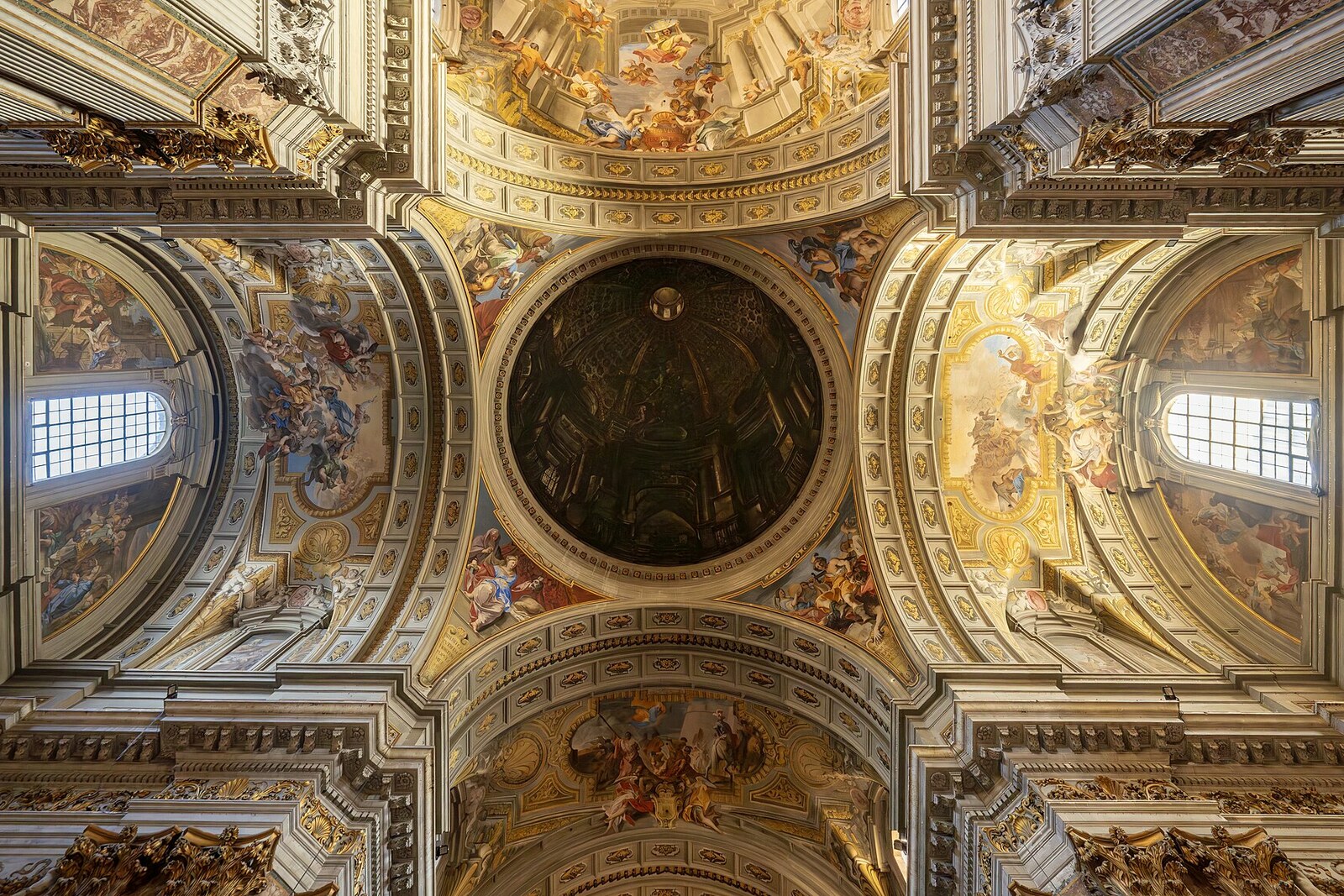
Look around first
What to notice
- Painted dome
- Two round markers on the floor
- Painted columns and cornices
- Figures of the four parts of the world on the vault
The story of the place
The façade bears the name of the founder of the Jesuit order, and the church was built for the Roman College. The college grew out of a free school that trained people who would later set off to preach far from Rome. When the former Church of the Annunciation became too small for the students, a cardinal funded a new church after the founder of the order was recognized as a saint. Two round markers remain in the floor: one in the center of the nave, the other closer to the altar.
In sixteen eighty-five, the Jesuit brother Andrea Pozzo was assigned to correct the main flaw of this church: no dome had ever been built over the crossing of the nave and transept. Pozzo was not ordained. In the Society of Jesus—the official name of the Jesuit order—he served as a painter. His own superiors and fellow brothers were the patrons, and the vast flat surface was above the church where the order trained future priests and missionaries.
Ignatius of Loyola himself founded the school on this site. In fifteen fifty-one, he opened free classes in grammar, the humanities, and Christian doctrine. The school came to be called the Roman College. Ignatius sought to ensure that members of the order he founded received a systematic education before setting out to preach. The college grew, and the former Church of the Annunciation could no longer hold its students. After Ignatius was canonized by Pope Gregory XV, Cardinal Ludovico Ludovisi paid for a new church for the college—in honor of its founder.
The designers provided for a real dome, but after changes made by the builders, raising it became difficult. Several councils of architects tried to find a solution; Francesco Borromini even approved an option with a single interior cupola and a drum concealed from the outside. It was not built after all. A flat ceiling was fixed over the crossing, and several decades later the Jesuits proposed that Pozzo replace the stone structure with painting.
On a huge circular canvas, he painted the ribs, windows, coffers, and lantern of an imaginary dome. Every line was calculated for a single point on the floor. From there, the flat painting comes together as a tall architectural cupola; when you move to the side, it stretches and loses depth. The idea initially drew criticism: Pozzo proposed placing a canvas over the main part of the church where stone masonry had been expected. But the canvas installed in sixteen eighty-five brought him recognition even among Roman academicians. After this success, the Jesuits entrusted the brother-painter with the church’s entire main decoration.
By sixteen ninety-four, Pozzo had painted the altar area and the vault of the nave. On the ceiling, he extended the real columns and cornices with painted ones, and placed Ignatius above them. Christ directs a ray of light toward him, and from Ignatius the light spreads to the figures of Europe, Asia, Africa, and America. In this way, the college’s students were shown the destiny the order offered them: to receive an education here and set off to preach throughout the world known at the time. The name on the façade, the purpose of the church, and the scene overhead all refer to one person and the school he founded.
Two round markers remain on the floor. One brings the painted vault into correct perspective, while the other, closer to the altar, does the same for the dome. Above the second circle, there is still neither a drum nor a stone cupola: the crossing is covered by the canvas that Pozzo put up.
Useful on site
Daily 09:00–23:30; self-guided viewing is free, services may temporarily restrict movement inside.
Checked: June 29, 2026. Check the official source before visiting.This is an active church: keep quiet, do not block the passage, and first look from the marked point, then move to the side.