 Guide On Map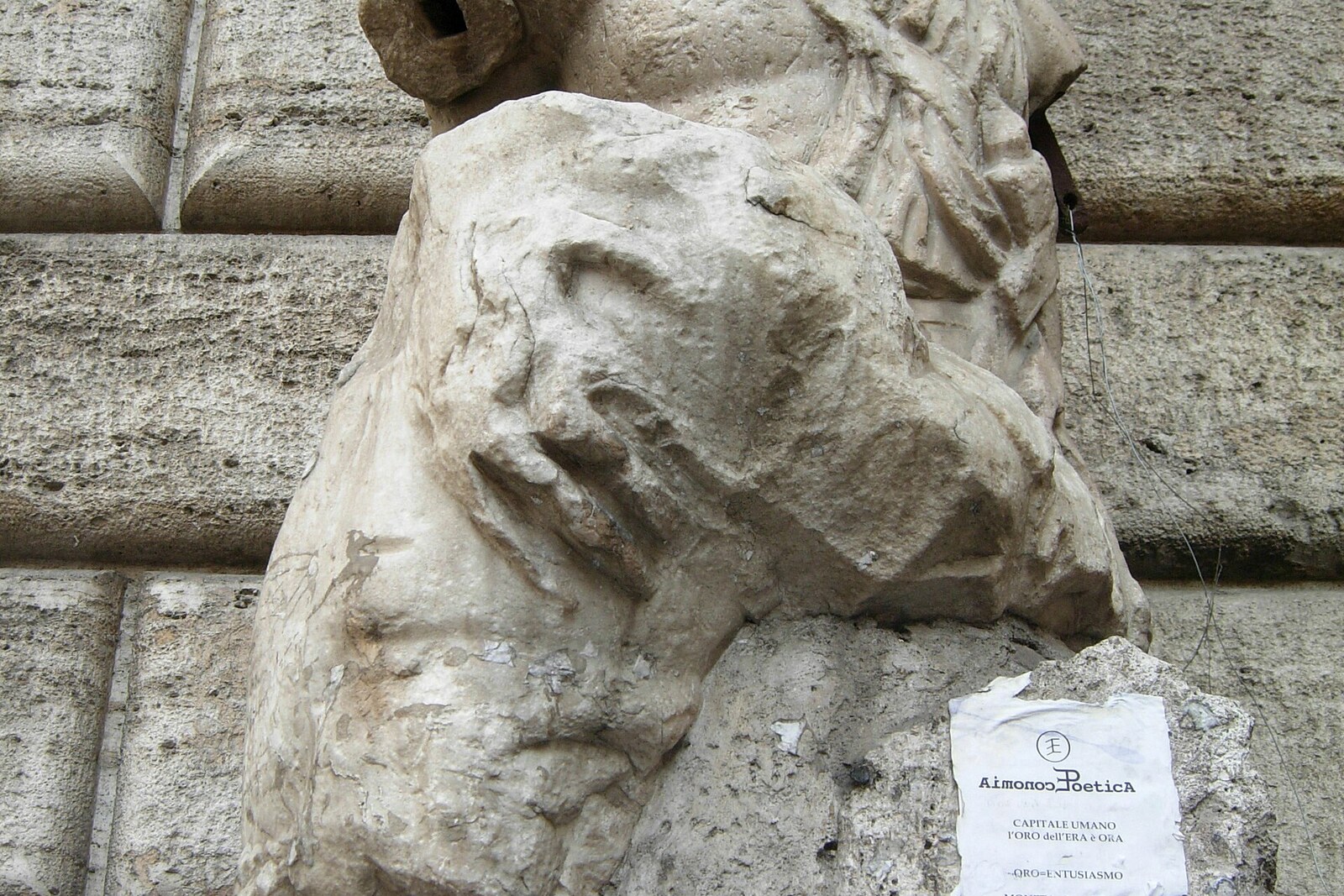
Look around first
What to notice
- Mutilated marble group
- Broken head of the male figure
- Stone pedestal
- Corner of Palazzo Braschi
The story of the place
At the corner of Palazzo Braschi, a severely damaged marble group stands on a stone pedestal. The Orsini Palace once stood here, and the owner of the residence placed the found statue directly at the corner of the house. Gradually, this corner became a place where townspeople brought verses and left them by the pedestal.
Only the center of an ancient scene remains: the Greek king Menelaus holds the fallen warrior Patroclus. Menelaus's head is broken, and almost no arms or legs remain. This marble probably once adorned the Stadium of Domitian—a structure on whose site present-day Piazza Navona now stands.
In fifteen oh one, the fragment was found during excavations. Cardinal Oliviero Carafa, who lived here in the Orsini Palace, ordered the find placed at the corner of his residence. Carafa then established an annual celebration: on the twenty-fifth of April, the statue was dressed as a hero or a deity, and invited poets attached Latin epigrams around it. They were collected and printed in separate booklets. This is how this particular corner became a customary place for public verse.
Who gave the statue the name Pasquino is unknown. Later legends name either a biting tailor, or a barber, innkeeper, or schoolteacher who lived nearby. Documents do not allow any of them to be identified as the real Pasquino. One thing is certain: the marble's nickname passed to the square, and then to the sheets left here.
In late fifteen twenty-one, Pope Leo X died, and the cardinals gathered to choose a successor. One of the candidates was Giulio de' Medici—a cardinal who wished to occupy the papal throne. Pietro Aretino, a court satirist without a permanent position, placed his hopes in him: his income and access to the court depended on patrons.
During the conclave, Aretino used the ready-made street stage. His verses against Medici's rivals appeared on Pasquino. Carafa's learned amusement became an open campaign: biting texts were read here, copied, and passed on, while their author spoke in the name of the mutilated statue.
The campaign did not help. Pope Adrian VI was elected pope. Aretino continued his mockery and, even before the new pontiff arrived, thought it best to leave Rome together with Giulio de' Medici. Two years later, Medici nevertheless gained the papal throne under the name Pope Clement VII. Aretino returned, and his former support won him the new pope's favor.
Other Romans continued to use the same device. They attached anonymous verses in Latin, Italian, and the Roman dialect to the pedestal—against popes, cardinals, and prominent townspeople. After the statue, such texts came to be called pasquinades.
The Orsini Palace, beside which Carafa placed the marble, was later demolished; Palazzo Braschi now stands here. Pasquino remained at the corner chosen by the cardinal. Nothing from the sheets of the conclave of fifteen twenty-one remains on the pedestal, but the square still bears the statue's nickname.
Useful on site
The statue stands on the street and is accessible around the clock; paper messages appear irregularly.
Checked: June 29, 2026. Check the official source before visiting.The statue can be viewed from the street; do not expect attached texts to be present on any particular day.