 Guide On Map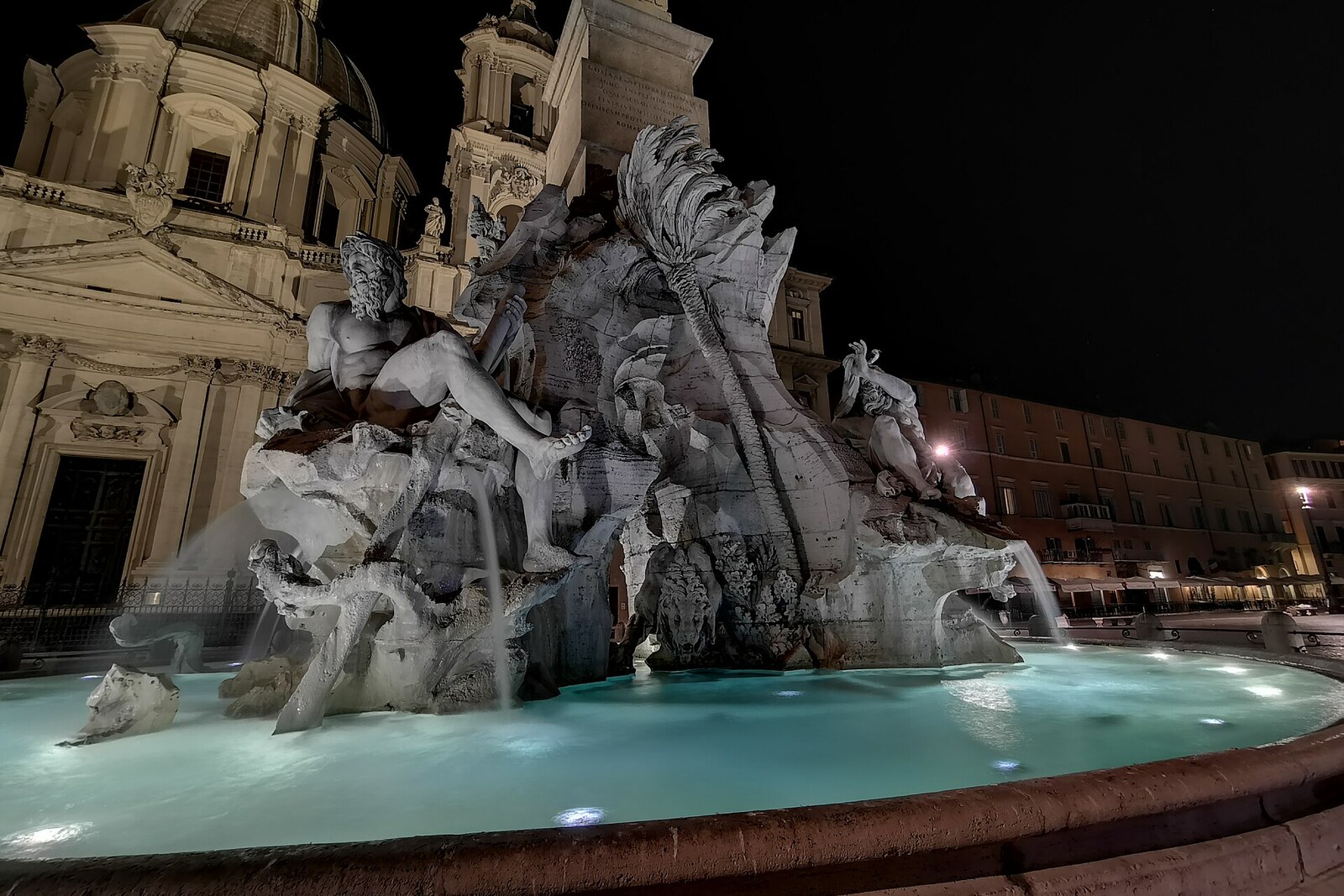
Look around first
What to notice
- Granite obelisk
- Hollow travertine cliff
- Four river figures
- Bronze dove with an olive branch
The story of the place
The elongated square, with a semicircle on its northern side, continues the outline of the ancient stadium: residential façades stand above the places where the spectator tiers once stood. Here, people ran, wrestled, threw the discus, and competed in the pentathlon according to the Greek custom that seemed foreign to many Romans. When the stadium disappeared, its open middle remained in the city's layout, and the old name of the field of games gradually became the name Navona. The remains of the ancient stands still lie several meters below the pavement, beneath neighboring buildings.
In sixteen forty-eight, Gian Lorenzo Bernini had to win back the right to work for the pope. He depended on major church and princely commissions, but after the death of his patron, Pope Urban VIII, he fell from favor. The bell towers he built for St. Peter's Basilica developed cracks; the new pope, Pope Innocent X, ordered them dismantled, and the architect was required to pay a fine. At first, Bernini was not even invited to take part in the remaking of Piazza Navona.
Before his election, Pope Innocent X bore the name Giovanni Battista Pamphilj. His family's palace stood beside the square, and the pope intended to turn the whole ensemble—the palace, church, and central fountain—into a monument to the Pamphilj family. Francesco Borromini, the architect hoping to receive the fountain commission as well, was already bringing water to the square. His design included an obelisk and four river gods.
Bernini was helped by Prince Niccolò Ludovisi, the husband of the pope's niece and an admirer of the disgraced master. According to the account of Bernini's biographer Filippo Baldinucci, the prince persuaded the sculptor to make a model and then placed it where Pope Innocent would pass. The pope saw the design and gave the commission to Bernini. This striking scene of a staged encounter is known specifically from the biographer's account; what is certain is that Bernini presented a model, possibly made of silver, and it decided the outcome of the competition.
In three years, he built the Fountain of the Four Rivers. Light can be seen through the hollow travertine cliff, although a heavy granite obelisk stands over the void. Around it lie the Nile, the Ganges, the Danube, and the Río de la Plata—four rivers representing the parts of the world then known to Europeans. Bernini regained papal commissions; Borromini lost the square's central work, although water reached this place through a branch of the aqueduct he designed. Pope Innocent received a family monument: the Pamphilj coat of arms is carved on the cliff, and at the top of the obelisk stands their bronze dove with an olive branch.
A legend later arose that the Nile covered its face so as not to see Borromini's church, while the Río de la Plata raised its hand out of fear that its façade would fall. The chronology prevents this: the fountain was completed in sixteen fifty-one, when the present façade did not yet exist. The Nile's face is covered because European geographers at the time did not know where this river began.
Pope Innocent placed his fountain in an arena created long before the Pamphilj family. In eighty-six, Emperor Domitian opened a stone Stadium of Domitian here for the Capitoline Games. He wanted to accustom Romans to Greek athletics and personally presided over the games in a purple toga and a golden crown. Professional athletes competed in running, wrestling, discus throwing, and the pentathlon; victory could bring a foreigner Roman citizenship, exemption from taxes, or exemption from military service. Many Romans despised Greek exercises as unworthy of a man, but Domitian continued the games.
Such contests were called agones. Long after the stadium disappeared, Romans still called its former arena Campo Agone—the field of contests. In everyday speech, “in Agone” gradually became “Navona.” The houses along the sides of the square stand above the ancient seating tiers, and the open space occupies the former running arena. Its northern curve still shapes the bend of Piazza Navona; the remains of the stands lie several meters below, by Tor Sanguigna and beneath Sant'Agnese in Agone.
Useful on site
The square is open at all times; the stadium's underground archaeological area is closed for restoration, and the official website must be checked again before visiting.
Checked: June 29, 2026. Check the official source before visiting.Walk around the edge of the square and cross it from side to side: the shape of the former stadium is easier to read while moving.