 Guide On Map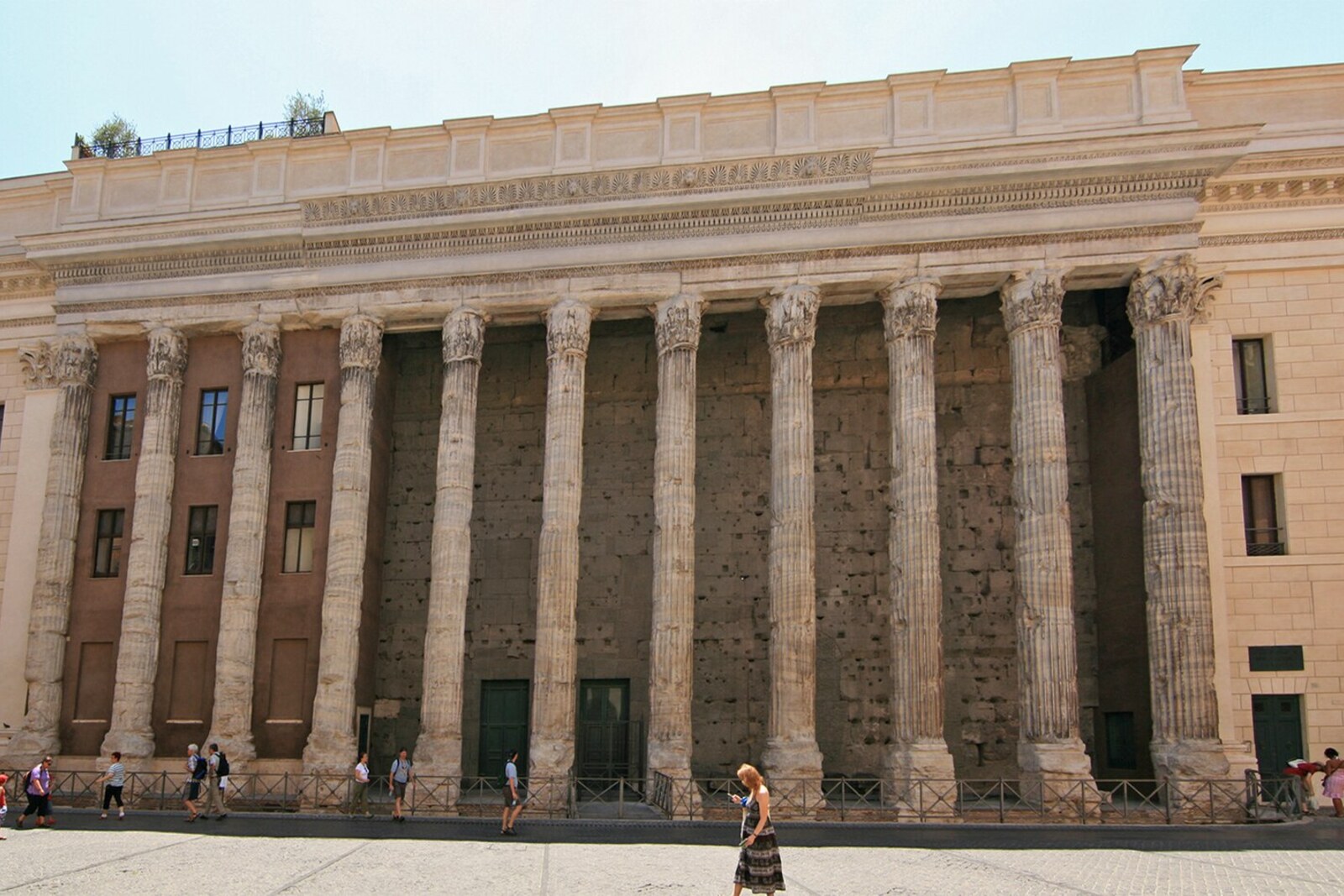
Look around first
What to notice
- Eleven ancient columns
- Corinthian-order capitals
- Windows between the columns
- The level of the ancient paving below the square
The story of the place
In Piazza di Pietra stand eleven columns—the surviving side row of the Temple of the deified Hadrian. In February one thirty-eight, the gravely ill Emperor Hadrian adopted the fifty-year-old senator Antoninus Pius and named him his successor. For Antoninus Pius, this adoption was the only legal basis for taking the imperial throne. Just over four months later, Hadrian died, and his final wishes almost turned against his heir.
The Senate—a gathering of the Roman aristocracy—approved divine honors for a deceased emperor. For a long time, the senators refused to proclaim Hadrian a god. They remembered the executions of noble Romans that he had ordered at the beginning and in the final years of his reign. Antoninus Pius faced a choice: to abandon his unpopular adoptive father or defend the man without whose decision he himself would never have become emperor.
Antoninus Pius objected to the senators that refusing to recognize Hadrian as a god also called the dead emperor’s other orders into question—including Antoninus Pius’s own adoption. The Senate yielded. Hadrian received the title of the deified, a public cult, and priests. The senators called Antoninus Pius Pius—the Dutiful—linking the epithet to his loyalty to his adoptive father. He kept the throne and ruled for another twenty-three years.
In one forty-five, Antoninus Pius dedicated a temple here to the deified Hadrian. Inside was a sanctuary with an image of the deceased emperor, and the whole complex occupied a large square with porticoes. Here, sacrifices were offered to Hadrian as a Roman god. The temple was decorated with reliefs personifying the provinces and with military trophies; the surviving slabs are now in museums.
The modern official name of the building beside Hadrian also mentions Vibia Sabina. She was Hadrian’s wife, who died and was deified two years before him. Researchers suppose that Hadrian had time to begin a sanctuary here for Sabina, and that Antoninus Pius completed the building after Hadrian’s death for both deified spouses. No unequivocal ancient inscription that would settle this question has survived.
By the end of the seventeenth century, mainly the columns and part of a wall remained of the temple. Pope Innocent XII ordered a land customs house to be established among the ruins—a warehouse and an institution where goods arriving in Rome by road were recorded. The architect Francesco Fontana closed the spaces between the ancient columns with walls and windows. Later, the building was occupied by the Rome Stock Exchange, and then by the Rome Chamber of Commerce, which remains here today.
Facing the square stand eleven columns of the temple’s long northern side. The main entrance was not here: a broad staircase faced what is now Via del Corso, and the ancient paving lies several meters below the modern surface. The name Piazza di Pietra—“Stone Square”—is commonly associated with the temple blocks that remained among the houses for centuries. Neither the cult statue nor the dedication to Hadrian has survived; of the sanctuary built after the dispute over his posthumous fate, only this side row remains.
Useful on site
The colonnade is always visible from outside; the hall and multimedia programs are available only during cultural events or exhibitions, and the schedule should be checked again.
Checked: June 29, 2026. Check the official source before visiting.The main features are visible from the square; step back to the opposite side to distinguish the ancient row from the building incorporated into it.