 Guide On Map
Nara: Temples, Deer, and Kasugayama Primeval Forest
From Kōfuku-ji Temple through Tōdai-ji Temple and Kasugataisha Shrine to the forest edge
Guide On Map on your phone
Open the walk like a regular app
It takes about 10 seconds to install. No app store needed.
The whole path
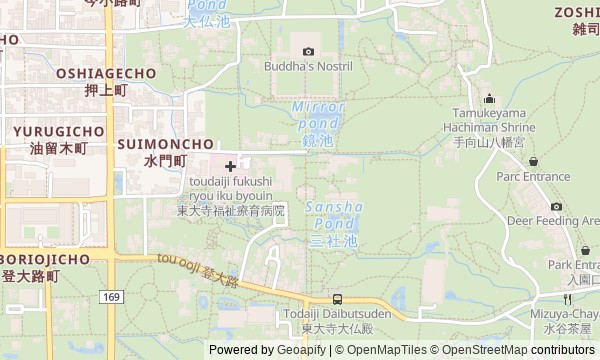
Route map
About the walk
You will begin on the open lawns around Kōfuku-ji Temple and descend to Sarusawa Pond. Then you will pass through the museum, the deer lawns, and the gates of Tōdai-ji Temple to Vairocana. From there, you will climb to Nigatsu-dō Hall, cross the temple side of the park, and finish at Kasugataisha Shrine and the dark edge of Kasugayama Primeval Forest.
This will not be a string of antiquities and pretty views. Behind every familiar place lies someone's decision: to leave a monastery, demand access to closed treasures, rebuild a colossal figure, plant a tree for an autumn park. Why does a small shrine turn away from the water? Whose names will you find inside wooden guardians? Why do young trees need netting?
The story will be calm and precise. A legend will remain a legend, and a document a document. By the end, you will see that the park, temples, deer, and forest do not exist side by side out of ancient habit: their present boundaries were drawn by particular people after particular clashes.
Why this order
Kōfuku-ji Temple sets the opening change: former monastery grounds became an open park. The descent to Sarusawa Pond shows that beside a large religious estate, a personal courtly story endured. From the pond, the road returns through Kōfuku-ji Temple lands to the museum, where temple and imperial treasures move from closed storage into public space. Beyond the museum buildings, the deer lawns begin: here the question of access becomes one of protecting a living herd. The route approaches Nandaimon Gate through this area, because the gate turns the park into a temple approach, and its central passage leads straight to the Great Buddha Hall. After the story of restoring the statue and hall, the climb to Nigatsu-dō Hall reveals another way of preserving a rite after a fire. From Nigatsu-dō Hall, the path continues along the foot of the mountain to Kasugataisha Shrine: a separate monastic brotherhood gives way to a shrine established by courtly power. Beyond its vermilion gates, the route ends at Kasugayama Primeval Forest, where an old ban on logging collided with the consequences of recent park plantings.
Those encountering the main sacred sites of Nara Park for the first time Those who care about the human decisions behind famous monuments Those who want to connect temples, deer, and forest into one story
Those looking only for a short encounter with deer Those who need a route without temple climbs Those who prefer a sightseeing overview without historical stories
Before you go
Choose comfortable shoes: the stops are connected by temple paths, steps, and a noticeable climb. Before setting out, check access to Nara National Museum, the Great Buddha Hall, and the inner parts of Kasugataisha Shrine—outdoor stops still make sense, but some important works are inside. Put paper maps, bags, and food into a closed bag: deer may reach for them insistently. Feed the animals only crackers intended for them, do not hold food back for a photograph, and do not block a deer's path. Near the forest, stay on marked roads and take the forbidden boundary literally.
When to go
It is best to set out in the first half of the day: the first three stops call for close attention, and a museum visit or temple interiors may slow the walk. Save some energy for Nigatsu-dō Hall, and do not leave the stretch by Kasugayama Primeval Forest until dusk. If a major ceremony falls on the day of your walk, check access changes in advance and be ready for crowds, temporary barriers, and a different pace of movement.
Backup plan
If the museum is closed or you do not want to go inside, look at its old western facade and focus on the very idea of a sacred object moving from altar space into a public collection. If the interiors of Tōdai-ji Temple or Kasugataisha Shrine are inaccessible, continue along the gates, outer galleries, lanterns, and approaches: they support the route's main thread. In rain, if you are tired, or if you start late, you can skip the climb to Nigatsu-dō Hall. If little time remains, finish your walk at Kasugataisha Shrine; go to the forest edge only when you can return calmly along the permitted road before dark.
Route conditions
Surface. Paved — 1.8 km; unpaved — 696 m (data covers 42% of the route)
Stairs. Flights: 7, 210 m in total
Access. Wheelchair — no; stroller — limited (stairs)
Facilities. Toilets — 16; drinking water — 2
Elevation. Ascent — 107 m; descent — 42 m
OpenStreetMap extract of July 9, 2026: database data, not a check on the ground. Data © OpenStreetMap contributors, ODbL licence
Walk plan
Open in maps ↗- 1
Kōfuku-ji Temple
Here you will see why lawns and park paths now lie between the restored temple buildings. - 2
Sarusawa Pond and Uneme Shrine
The story of an unnamed court lady explains the unusual position of the small shrine by the water. - 3
Nara National Museum
The museum will show how a closed imperial collection became a public matter. - 4
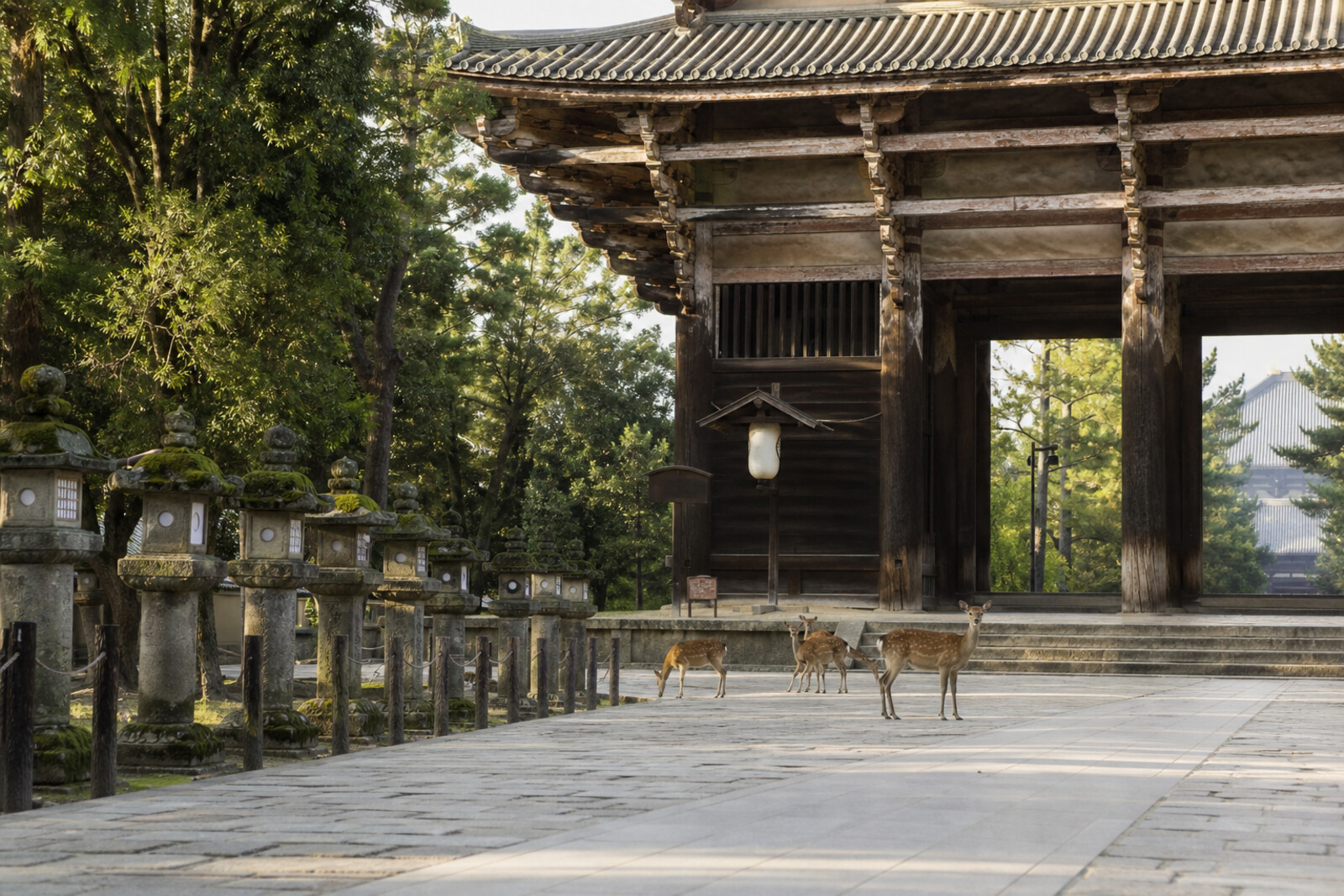
Deer Lawns of Nara Park
The free-ranging herd is the result of a long dispute between animal protection and the defense of surrounding fields. - 5
Nandaimon Gate
Documents hidden inside the guardians will make it possible to reconstruct the history of their joint work. - 6
Great Buddha Hall
The size of the facade and the details of the statue will show what the monk managed to complete himself and what his disciples finished. - 7
Nigatsu-dō Hall
This stop will link the building's layout to the rite that continued even after a fire destroyed the hall. - 8
Kasugataisha Shrine
Four neighboring buildings preserve an arrangement that arose from a choice at court and the interests of the Fujiwara clan. - 9
The Edge of Kasugayama Primeval Forest
The final stop will show how a successful park planting became an ongoing effort to protect an ancient forest.
Route features
Everything you need stays in the browser
Progress, saves and your trip plan are stored on this device.
Add Guide On Map to your home screen so the walk opens outside the browser.
How we handle sources, maps and corrections: our editorial standards