 Guide On Map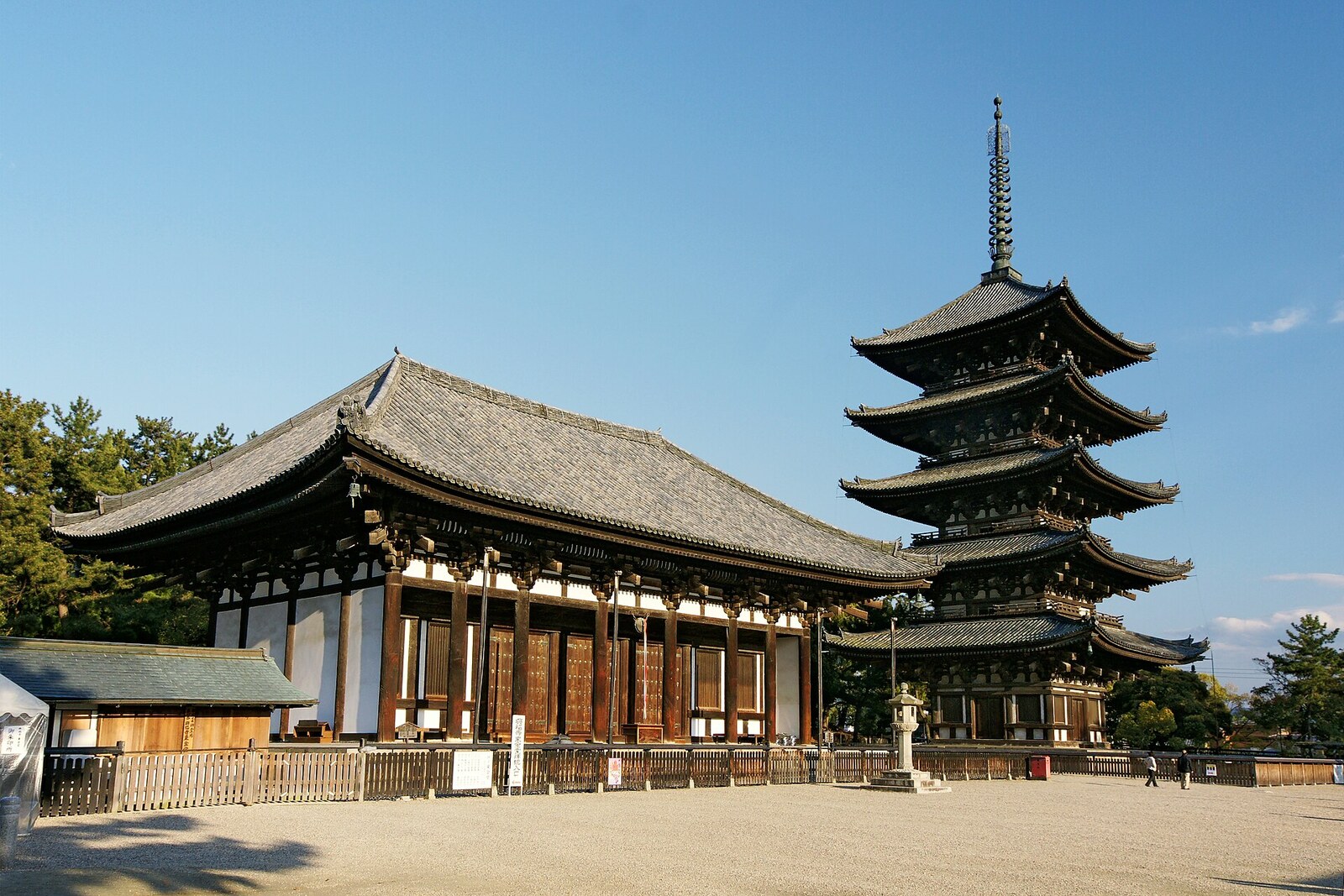
Look around first
What to notice
- The red columns of the Central Golden Hall
- Open lawns
- Freestanding temple buildings
The story of the place
In the spring of eighteen sixty-eight, the monks of Kōfuku-ji Temple filed petitions one after another to renounce their Buddhist ordination. They included the heads of two aristocratic sub-temples, scholar-monks, and junior attendants. The former monks were appointed kannushi—attendants of the neighboring Shinto shrine of Kasuga, associated with the Japanese religion. Almost no one remained in Kōfuku-ji Temple's ninety-six small sub-temples.
This transition was possible because the Buddhist temple and the Shinto shrine had formed a single religious establishment for centuries. Kōfuku-ji Temple belonged to the Fujiwara clan. In seventeen ten, the courtier Fujiwara no Fuhito moved the family temple to the eastern part of the new capital—present-day Nara—and gave it a name that can be translated as “the temple that brings blessings.” At Kasuga, the same clan venerated its divine protectors. The monks recited sutras at the shrine, took part in its rites, and regarded the local deities as earthly manifestations of Buddhas. Income from the shared lands paid for their upkeep. The boundary between the two institutions, familiar today, then existed only on paper—if it existed at all.
Officials of the new government demanded that Buddhism and Shinto be separated. Buddhist attendants at shrines were ordered to remove their robes, become kannushi, or leave. For the people of Kōfuku-ji Temple, this was a choice of profession and livelihood: temple lands provided them with housing and support, and many had no other trade. They chose service at Kasuga. There, they retained a position; here, the community for which the cells, kitchens, and study rooms had existed disappeared.
The officials then took almost all of Kōfuku-ji Temple's land, leaving only the plots beneath individual halls and pagodas. The monastery lost its income. The following year, they ordered its furnishings to be sold or transferred and the entire complex to be closed. Some buildings were dismantled, while statues and manuscripts were dispersed to other temples and private collections. For a time, Kōfuku-ji Temple could not officially use even its own name.
That is why the site looks open today. There are no former walls or gates between the halls; lawns now cover the sites of the many sub-temples, and paths run through them. In eighteen eighty, the former monastery grounds were turned into the core of the new Nara Park. A year later, officials allowed Kōfuku-ji Temple to be restored as a Buddhist institution, but not all the confiscated land returned.
Today monks serve here again; Kōfuku-ji Temple leads the Hossō school. The large Central Golden Hall with its red columns was consecrated in two thousand eighteen—the first full-scale building on its historic foundation in more than three centuries. And around it still lies the park that arose where ninety-six sub-temples stood empty after the monks left.
Useful on site
The grounds are open; the Treasure Hall and Central Golden Hall are usually 9:00–17:00, last entry 16:45. The Eastern Golden Hall is closed; the five-story pagoda is enclosed in construction sheeting for long-term restoration.
Checked: June 24, 2026. Check the official source before visiting.You can walk around the outside of the complex without turning this stop into a visit to every hall. Check access to the museum sculptures and interior spaces separately.