 Guide On Map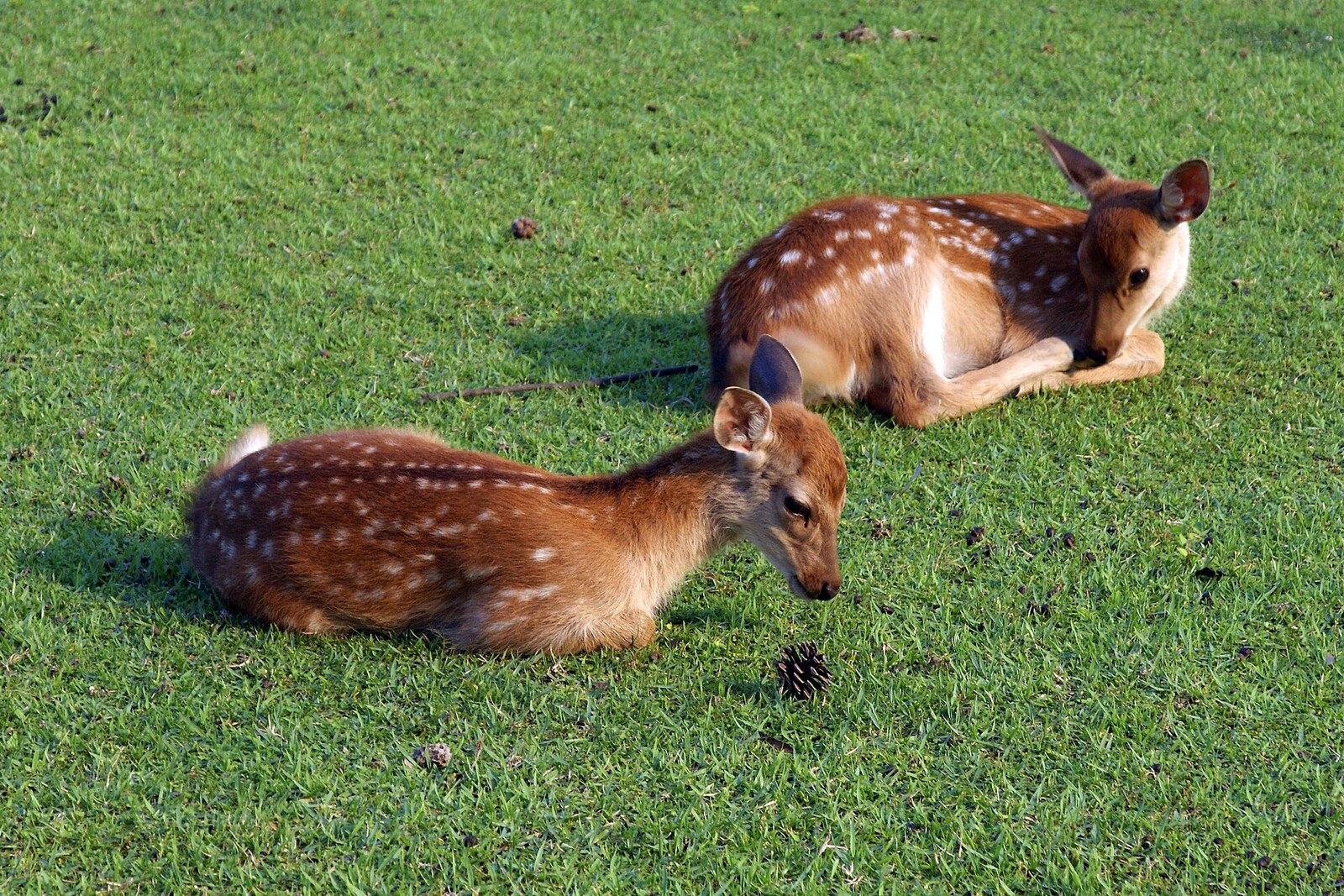
Look around first
What to notice
- Low grass cover
- Herds of deer
- Shika senbei cakes
The story of the place
Here, the city park with its lawns adjoins the lands of Kasuga Shrine and the mountain beyond it; together they form a space where deer are protected but not kept in stalls. The old wooden pen near Yukige-no-sawa pond has disappeared, though it once served only as a nighttime refuge for the herd. During the day, groups of animals remain on the low grass, and the boundary of their refuge still almost coincides with the line drawn around the park.
The deer on these lawns are feeding on their staple diet. The shika senbei cakes people buy are only treats; they live chiefly on noshiba grass, a local kind of lawn grass, as well as leaves and acorns. Constant grazing keeps the grass cover low, while dung beetles carry droppings into the soil. So the lawn serves as deer pasture, although it lies within the city's most visited park.
After Kōfuku-ji Temple was abandoned, the former supervision of the deer disappeared. They were revered as messengers of the deity of Kasuga, but for farmers beyond the city limits they remained animals that entered fields and ate the crops. In eighteen seventy-one, Nara Prefecture Governor Shijō Takauta, seeking to end the crop damage, declared the deer harmful animals and authorized their shooting.
Two years later, Shijō chose another method: he ordered the herd gathered behind a wooden fence. Pens were set up by Yukige-no-sawa in what is now the park and on the approach to Kasuga Shrine. More than seven hundred deer were driven there. There was not enough food for such a herd. By November, only thirty-eight were still alive.
The new governor of Nara Prefecture, Fujii Chihiro, inherited not the problem of an overlarge herd but the threat of its disappearance. He prepared a protection plan; the pens were transferred to Kasuga Shrine, and the White Deer Society was created under its auspices. In eighteen seventy-six, the surviving animals were released. Two more years later, officials prohibited the killing of deer over a large area around Nara, and the herd began to recover.
The crop damage returned as well. In eighteen ninety, residents of seven farming villages submitted a petition: the expanded protection zone deprived them of the ability to defend the fields on which their income depended. Officials reduced it to the park, the lands of Kasuga Shrine, and the mountain behind the shrine. Thus a human dispute drew the boundary of a deer refuge around these lawns.
The following year, Nara Mayor Hashii Zenjirō and twenty-eight townspeople established the Kasuga Sacred Deer Preservation Society. They had to keep the animals from dying out while not bringing back the earlier disaster of permanent confinement. The new pen was used only at night: the deer were lured in with food and the signal of a horn, then released again in the morning. Today's Nara Deer Preservation Foundation descends from this society; part of the proceeds from authorized shika senbei cakes goes to it.
The first wooden pen at Yukige-no-sawa has not survived. The outline of the main protection zone still almost follows the line drawn after the petition from the seven villages. Healthy deer belong to no one, receive no daily ration in stalls, and feed themselves on open grass within this boundary.
Useful on site
Open park area without a ticket; best visited during daylight hours. Rules for handling deer apply at all times.
Checked: June 24, 2026. Check the official source before visiting.Do not show food in advance, do not tease the animals, and let go of the cracker immediately if a deer reaches toward your hand. Keep bags and paper put away, especially near several animals.