 Guide On Map
Mostar: Bridges, Crafts, and a Rebuilt City
From Crooked Bridge through the Old Bridge to Musala Square
Guide On Map on your phone
Open the walk like a regular app
It takes about 10 seconds to install. No app store needed.
The whole path
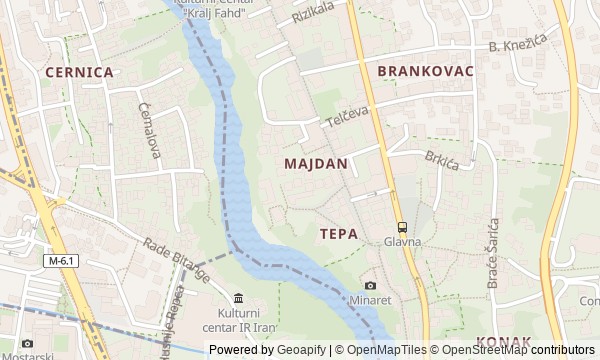
Route map
About the walk
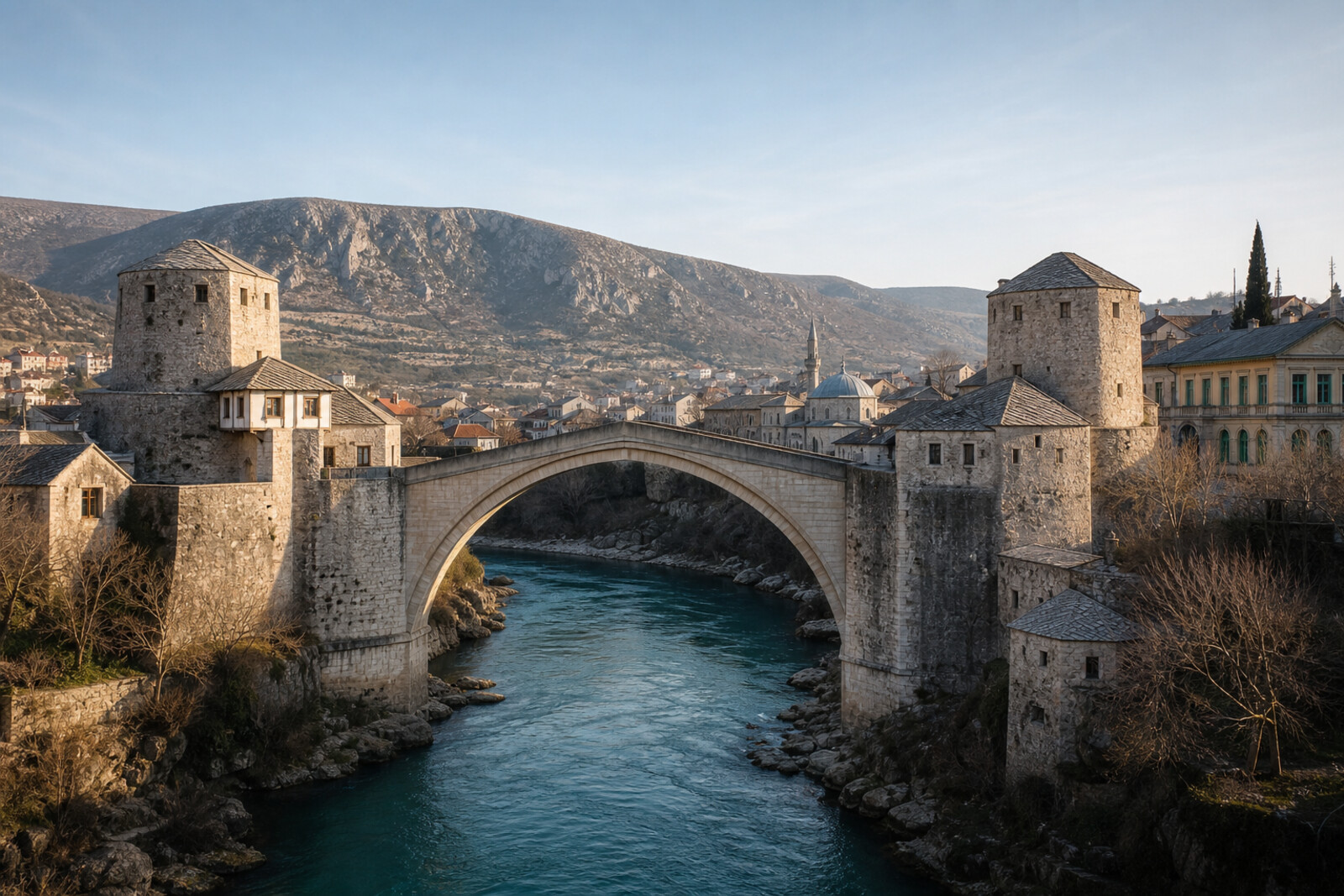
You will begin at a small arch over the Radobolja, pass through the courtyard of former leather workshops, and descend to the Neretva. Then you will climb to the towers of the Old Bridge, cross the river, and continue along Kujundžiluk to a mosque and Musala Square.
This is a walk about repair in the broadest sense. You will learn why two townspeople left the income from their estates to one bridge, why a master watched his neighbor through a hole in the ceiling, and what divers were looking for among the wreckage in the fast current. Then come a gunpowder store, spoiled copper plates, and someone else's construction project that had to be finished by a brother.
The story will separate documents from legends, and old masonry from an exact reconstruction of what was lost. By the end, you will be able to explain why rebuilt Mostar cannot be divided into originals and copies with one straight line.
Why this order
At Crooked Bridge, you will first see how townspeople made sure the bridge could be repaired continuously; in neighboring Tabhana, the same principle of shared benefit appears in a craft. From the workshops by the Radobolja, the route descends to the Neretva, where care for a working crossing gives way to work with the wreckage of a destroyed one. From the lower platform, you will climb to Halebija Tower: after the stones recovered from the water, the tower's old foundation and later reinforcement become easier to distinguish. Halebija Tower stands at the entrance to the Old Bridge, so the story of guarding the crossing naturally leads to the people who tested themselves on the arch itself. On the opposite bank, Tara Tower adds another threat to the bridge—fire beside gunpowder—and reveals archaeological layers of earlier crossings. From the tower, you will step straight into the shops of Kujundžiluk, where the bridge's reconstruction brought back customers and apprentices. The market street then leads to a mosque completed after its patron's death and assembled again after damage. The final move to Musala Square widens the frame: from individual bridges, towers, and workshops to a square and a hotel that changed along with the city center.
Those who want to understand the Old Bridge beyond the postcard view Fans of engineering stories, urban crafts, and archaeology Those who care about telling documented fact apart from local legend
Those looking only for a short photo route to the Old Bridge Those who prefer an architectural overview without stories of destruction and rebuilding
Before you go
Wear shoes with grippy soles: the arches are steep, and polished stone is especially treacherous after rain. Check access to the museum, mosque, and minaret before you set out; they are separate spaces, and an open area nearby does not mean you can go inside. The mosque is active: clothing should cover shoulders and knees, shoes come off before entering, and visits should wait during prayer. Bring water, but do not expect to stop everywhere in the middle of narrow passages. Treat the lower platform as optional: the condition of the approach depends on the water, barriers, and current restrictions.
When to go
Allow about 2 hours 45 minutes for the full route. If you visit the museum, climb the minaret, or spend a long time looking at the workshops of Kujundžiluk, add another 20–30 minutes. It is best to walk the old part of the city in daylight: the masonry is easier to see, and uneven stone is easier to navigate with confidence.
Backup plan
A closed interior does not mean skipping the stop: at Tara Tower, continue the story outside while looking at the tower and bridge, and at the mosque, stay in the courtyard or by the entrance without entering prayer and service spaces. If the descent to the Neretva is closed, flooded, or looks unsafe, do not go around barriers: take in the height of the arch from an accessible embankment or parapet, then continue to Kujundžiluk. In rain, spend less time on steep arches and skip the minaret if the climb is restricted. View Hotel Neretva only from public space; the construction site is not part of the route.
Route conditions
Surface. Paved — 1.2 km; unpaved — 39 m (data covers 88% of the route)
Stairs. Flights: 4, 45 m in total
Access. Wheelchair — no; stroller — limited (stairs)
Facilities. Toilets — 2; drinking water — 6
Elevation. Ascent — 19 m; descent — 12 m
OpenStreetMap extract of July 3, 2026: database data, not a check on the ground. Data © OpenStreetMap contributors, ODbL licence
Walk plan
Open in maps ↗- 1
Crooked Bridge
Here you will see how private income supported a public crossing for centuries and why the famous legend of a trial arch remains only a legend. - 2
Tabačica Mosque and the former Tabhana
This stop will connect the workings of the tanning quarter with a legend about a master who obtained someone else’s secret and passed it on to the entire guild. - 3
Lower Platform by the Neretva
From here, the engineering story of lifting the rubble begins, and it becomes clear why the recovered stones were not enough for the former arch. - 4
Halebija Tower
Different sections of masonry help distinguish the medieval tower from the rebuilding after which the crossing acquired a permanent garrison. - 5
Old Bridge
The route's main point will tell of the fear of a first jump and of the decision that separated an old champion from the reconstructed arch. - 6
Tara Tower and the Museum of the Old Bridge
Here, the fire at the powder magazine meets the excavation that revealed the supports of earlier crossings beneath the tower. - 7
Kujundžiluk
Copper reliefs trace the path from ruined apprentice plates to a craft that once again became a source of income. - 8
Koski Mehmed Pasha Mosque
The inscription, dome, and restored minaret preserve traces of two instances when work begun was brought to completion by other people. - 9
Musala and Hotel Neretva
The finale will show how an enclosed prayer area was turned into a city square, and how a damaged hotel had its lost decoration restored.
Route features
Everything you need stays in the browser
Progress, saves and your trip plan are stored on this device.
Add Guide On Map to your home screen so the walk opens outside the browser.
How we handle sources, maps and corrections: our editorial standards