 Guide On Map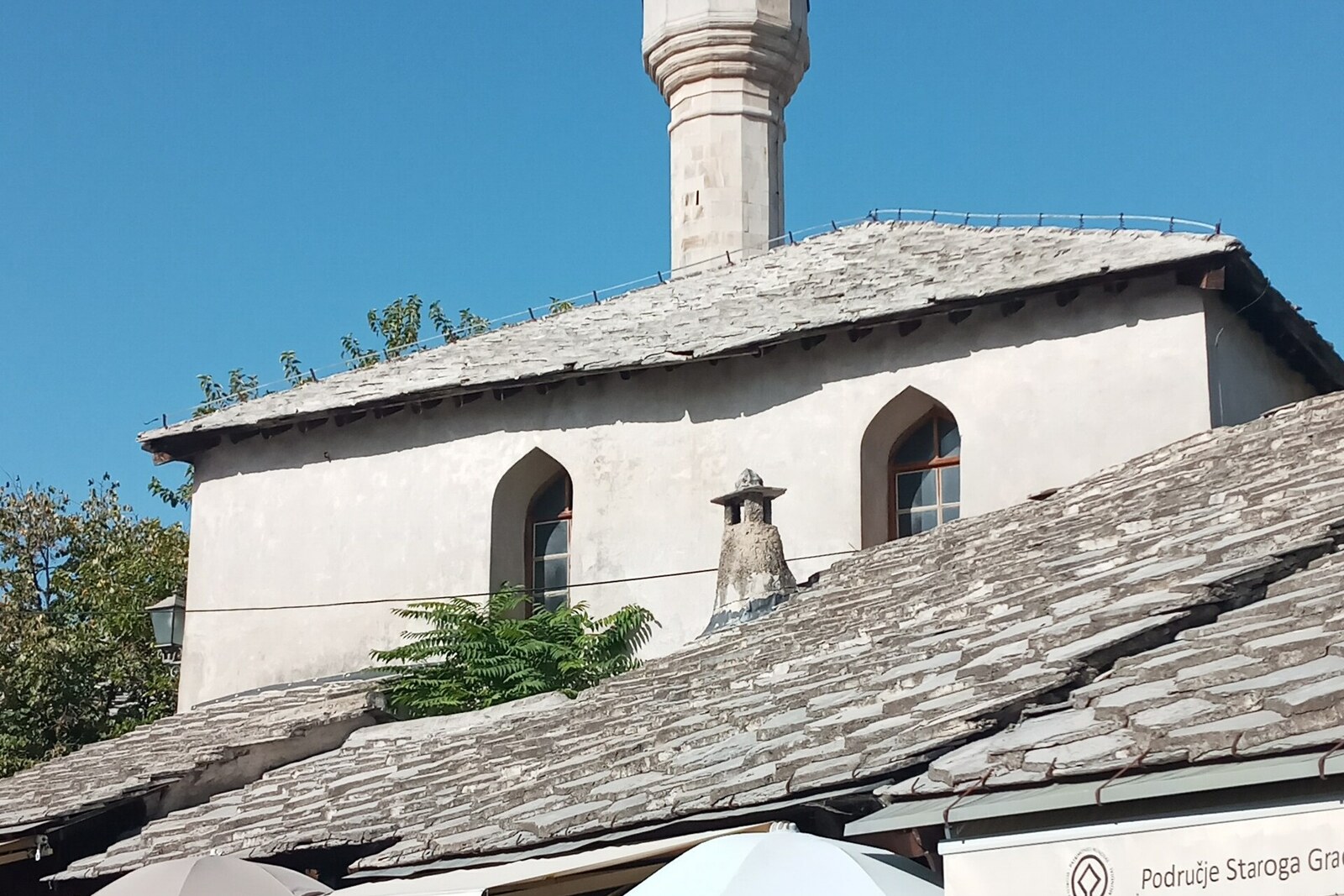
Look around first
What to notice
- Tabačica Mosque
- Open courtyard
- Rooms around the perimeter
- Stone vaults over a branch of the Radobolja
The story of the place
Tabačica Mosque grew up beside a tanning quarter by the water, where processing sheep and goat hides required a constant flow. Masters gathered at the guild mosque, while workrooms stood around the open courtyard; an old description mentions a large basin in the middle and twenty workshops along the sides. Cafés and restaurants now operate around the courtyard, but a branch of the Radobolja still passes beneath the mosque, concealed by stone vaults. The name Tabačica has preserved the name of the tabaks, as tanners were called in Mostar, for whom this place brought together work and community.
According to a Mostar legend, at the end of the eighteenth century, the tanner Smajo Gološ made his way to the wooden ceiling of another workshop in this Tabhana. A dyer from Shkodër was working below. He knew how to give goat leather an even red color and kept the composition of the dye secret. This leather was called kaysar and sold well far beyond Mostar. As long as the recipe remained with the competitors, local masters could not reproduce their result on their own.
Gološ made a hole in the ceiling and watched the dyer for several days. He then mixed the substances he had seen, tested them on leather, and obtained the desired shade. The stolen secret could have secured an income for him alone. Gološ did otherwise: he gathered the entire tanners’ guild and gave the recipe to the other masters. After that, his colleagues gave him the most honored place among Mostar’s tanners. The legend links the flourishing of red kaysar to his act; from here, it was sent to Sarajevo, Dubrovnik, and Istanbul.
Gološ’s story was recorded from the words of an old resident of Mostar, so it is an oral tradition, not a court record. The scale of the craft itself is confirmed by documents. A court register from sixteen thirty-two to sixteen thirty-four names thirty-nine local masters. They were called tabaks, the association of masters was called an esnaf, and the complex of workshops was called a Tabhana.
The tabaks received sheep and goat hides from butchers, washed them, soaked them in slaked lime, removed the wool, tanned them, and left them to cure for a long time, sometimes for a full year. The work required a great deal of running water, so the workshops were built beside branches of the Radobolja before it flows into the Neretva. The mineral composition of this water was considered one reason for the high quality of Mostar leather.
In sixteen sixty-four, a traveler described Upper Tabhana as a sturdy building with iron windows, a large basin in the middle, and twenty small workshops along the sides. Some of these structures form today’s courtyard. Cafés and restaurants now operate there instead of tanners, but the arrangement of rooms around the open space remains from the production complex.
At the beginning of the seventeenth century, the wealthy tanner Haji Kurt established a mosque beside the workshops. Named for its founder, it is called Haji Kurt Mosque; however, the masters prayed here as an entire guild, and the townspeople gave it another name—Tabačica Mosque, meaning the mosque of tabaks, or tanners. At one time, up to eighty masters gathered here at the same time.
A small pounding mill stood by the mosque’s left wall. Sumac, used in tanning, was crushed in it, and a branch of the Radobolja drove the mechanism. That same branch still runs beneath the mosque, covered by two stone vaults. Leather is no longer tanned here; what remains of the craft are the former workshops around the courtyard, the water beneath the floor, and the name Tabačica—the name of the people to whom Smajo Gološ gave the recipe he had watched being made.
Useful on site
Accessible outdoors without fixed hours; the interior depends on prayers and local arrangements.
Checked: June 24, 2026. Check the official source before visiting.This is an active public space among local establishments; listen in a way that does not block passageways or entrances.