 Guide On Map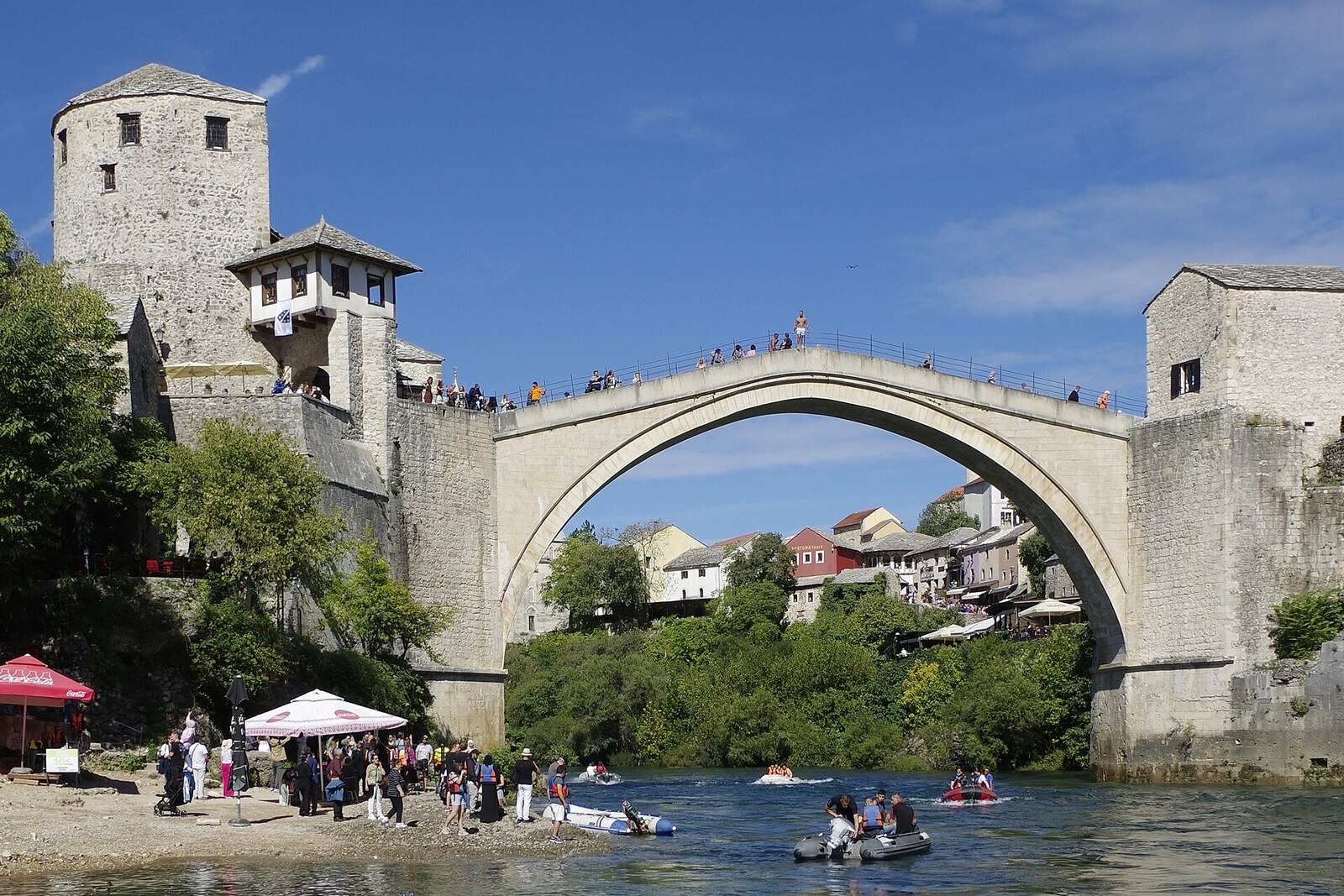
Look around first
What to notice
- Lower Platform
- Stone bridge piers
- Arch of the Old Bridge
- Rocky banks of the Neretva
The story of the place
Below, between the rocky bank and the stone piers of the Old Bridge, lies a level platform right beside the Neretva. It was protected from the river's usual rise and arranged so that heavy stone could be received directly from the water, measured, and laid out in sections. The arch runs high above it, and the platform comes almost right up to the base of the bridge. Fragments of the original arch once lay here in rows.
In late September nineteen ninety-seven, thousands of Mostar residents gathered on the banks of the Neretva. They were waiting for the first fragment of the Old Bridge, destroyed by artillery fire four years earlier, to emerge from the water. City leaders hoped to raise the stones from the riverbed and rebuild the former arch from them.
Robert Veress, chief engineer of the Hungarian sapper contingent of the peacekeeping forces, was assigned to determine whether this was possible. Veress had served for twenty years in a pontoon regiment, then taught military engineers. Now his men were to work in a narrow river channel with a fast current, among fragments weighing many tons.
An ordinary floating crane would not have been able to maneuver here. Divers mapped the positions of the stones, while engineers assembled a catamaran from sections of a pontoon bridge and installed a steel hoist on it. They first tested the structure on the Sava River with concrete loads. Then they dismantled it and transported it to Mostar: the three-hundred-kilometer route taken by the long vehicles ran along mountain roads, beside which minefields still remained.
On September twenty-ninth, divers fastened a cable to the first large fragment, and the sappers pulled it to the surface. Hungarian and French military cranes transferred the stone to the bank. Mostar residents decorated it with yellow lilies. Until the end of November, the team worked eight to ten hours a day and raised about one hundred forty cubic meters of stone.
A platform protected from the river's usual rise was arranged by the water for these fragments. That is why it is here, at the foot of the bridge piers: stone found by the divers could be received directly from the floating hoist, sorted, and measured.
But rebuilding the bridge proved impossible. Of all the stones from the arch, only about nine percent had both remained intact and could be precisely matched to their former positions. Engineers examined the grooves for iron clamps, pins, and channels through which sixteenth-century builders had poured molten lead on the raised blocks. For the new arch, stonemasons cut most of the blocks anew—from limestone from the same local quarry and to the reconstructed dimensions.
A few years later, Veress returned to Mostar as a retired officer. A local resident stopped him in the street: he had stood by the Neretva on the day of the first lift and recognized the engineer.
There are no rows of recovered stone on the lower platform now. Fragments of the real arch once lay here, while the bridge above the river is built mainly of stone cut after the arch was destroyed.
Useful on site
Access depends on the water level, the condition of the stairs, and temporary barriers; there are no fixed hours.
Checked: June 24, 2026. Check the official source before visiting.Do not go down when barriers are in place, the water is high, or the approach is slippery. Do not enter the river or imitate the jumps of local athletes.