 Guide On Map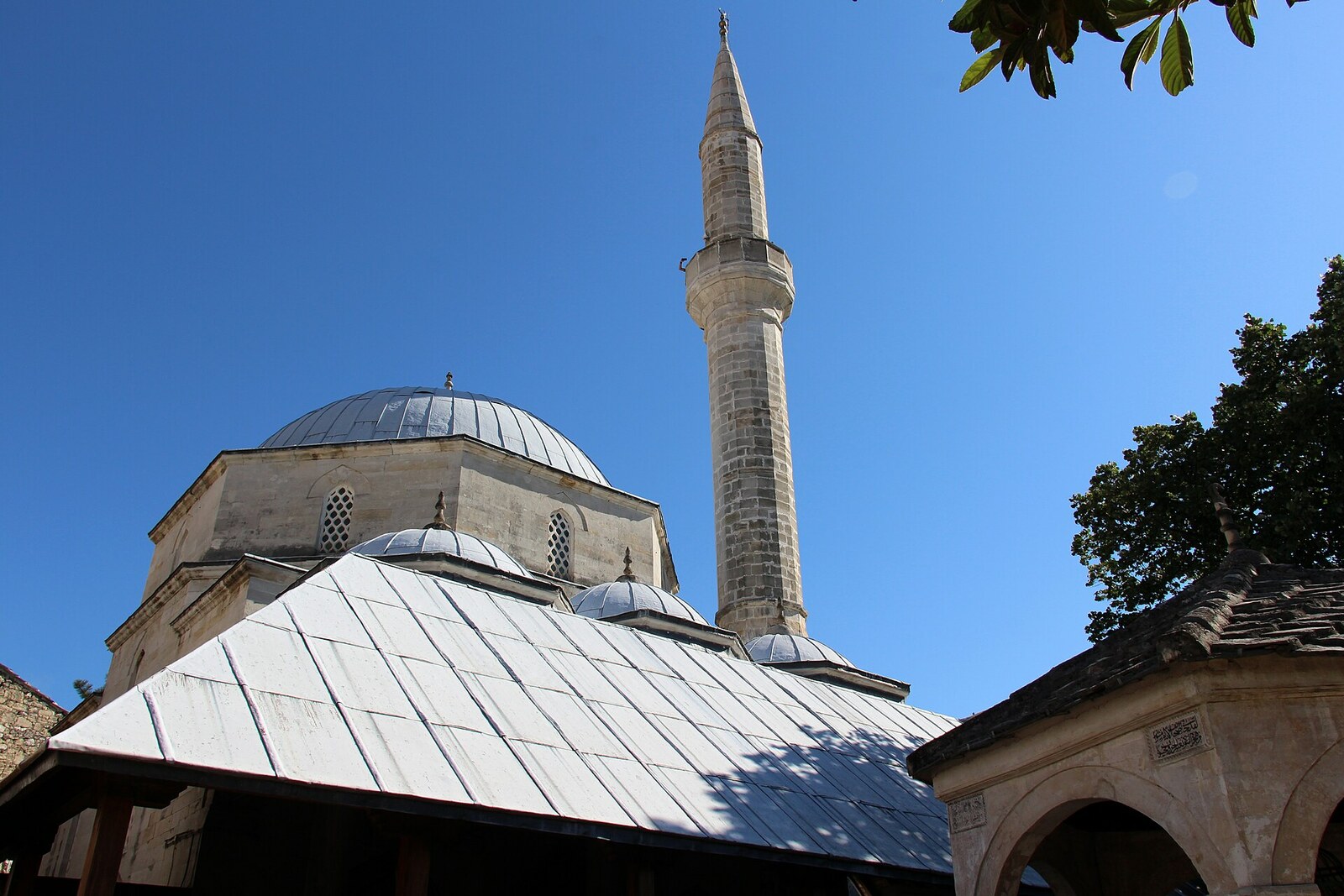
Look around first
What to notice
- Inscription above the entrance
- Dome
- Minaret
- Stone portal of the minbar
The story of the place
Above the entrance to the mosque, a stone slab names Koski Mehmed Pasha as its builder. Mehmed himself did not live to see the work completed. The dome and minaret above the Neretva appeared because another person took up his plan—his younger brother, Sheikh Mahmud Efendi.
Mehmed was a native of Mostar, but he earned his living far from home. At first, he served as a ruznamçe—a secretary who kept the daily records of Grand Vizier Lala Mehmed Pasha Sokolović. Together with him, Mehmed went on military campaigns through Hungary and Austria and compiled a campaign diary. He then became a military defterdar, an official responsible for the field treasury. His position depended on the accuracy of the accounts and on the outcome of the campaigns in which he accompanied the army.
Mehmed decided to return part of what he had earned to his native city. He allocated two hundred thousand akçe, Ottoman silver coins, and ordered that a mosque be built first, with the remainder spent on a khanqah—a house for a Sufi community. Poor dervishes were to live in nine rooms, and communal prayers were to be held in a separate hall. From the income of the waqf, an inalienable charitable endowment, each resident was entitled to two akçe a day for food, while the sheikh was to receive a salary for sermons and lessons. The fund was also supported by income from real estate in Mostar and nearby settlements.
Mehmed died in sixteen eleven. He had entrusted the management of the money and construction to his learned brother Mahmud in advance, giving him the authority to decide the affairs of the waqf himself. Mahmud saw the mosque through to completion; the inscription above the door dates it to sixteen eighteen–sixteen nineteen. He likely also became the first sheikh of the khanqah. Thus, near Mala Tepe, the first Sufi lodge of this kind in Herzegovina arose. Later, the khanqah became a madrasa and trained mosque servants until nineteen twenty-five.
The present minaret and painted decoration went through another instance of other people's work being brought to completion. During the war of the nineteen nineties, the minaret was knocked down to its foundation, five holes remained in the main dome, and the stone portal of the minbar—a pulpit for the Friday sermon—split into pieces. Restorers closed the holes with matching stone, rebuilt the minaret, joined the fragments of the minbar, and restored the vegetal ornament on new plaster. The work was paid for by the Turkish Directorate of Religious Affairs; in nineteen oh one, the mosque reopened for prayer.
It still remains an active mosque, although visitors are admitted here and allowed to climb the minaret. Mehmed, who provided the money and the rules, is still named above the door, while east of the building stands a türbe that local tradition associates with Mahmud Baba—the brother who completed Mehmed's mosque.
Useful on site
Published hours: 09:00–20:00 from 1 April to 1 October and 09:00–16:00 from 1 October to 1 April; visits may be interrupted for prayer.
Checked: June 24, 2026. Check the official source before visiting.Observe the rules of an active mosque: cover your shoulders and knees, remove your shoes, and do not enter during prayer. Check separately whether it is possible to climb the minaret.