 Guide On Map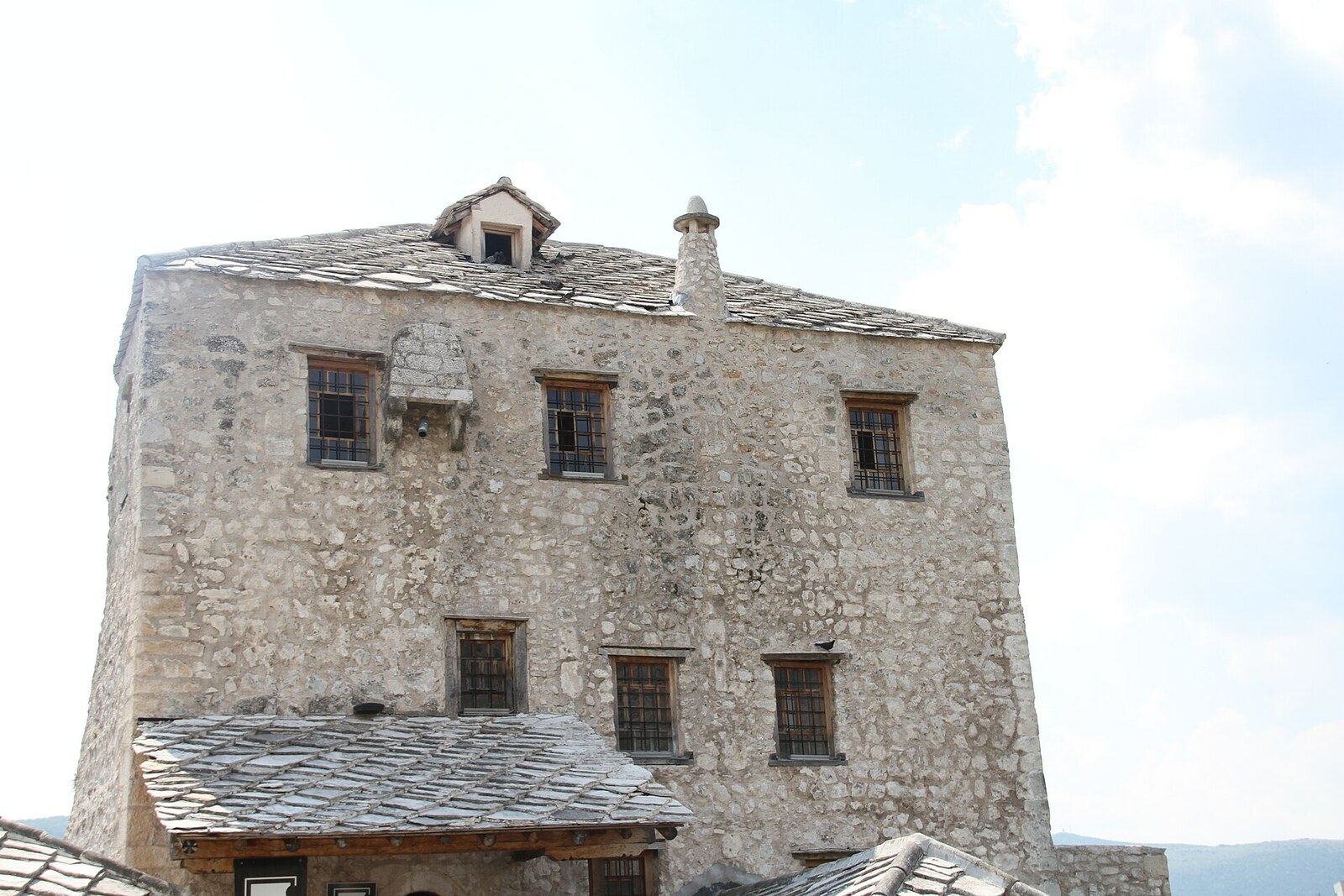
Look around first
What to notice
- Semicircular base
- Filled-in crenellations
- Loopholes
- Covered top
The story of the place
Halebija Tower stands at the western entrance to the Old Bridge. Its name became established thanks to a person, but the masonry itself is almost two centuries older than him. Archaeologists dated the semicircular base to the middle of the fifteenth century: the tower already existed when a wooden suspension bridge still crossed the Neretva.
The right, western bank was especially vulnerable. The road from the Venetian possessions approached the crossing from here. At the beginning of the seventeenth century, the bridge was guarded by small watches, mainly at night, and the city fortifications were considered weak. Then Venetian detachments began reaching Mostar itself.
In sixteen eighty-seven, a detachment led by Stojan Janković—a Venetian frontier commander attempting to capture the fortified center—broke through to the city gates. The defense was led by Osman Halebija, an influential Mostar elder entrusted with the most important city affairs. He assembled the fortress garrison and armed townspeople. The attackers managed to ravage part of the western districts, but did not get past the gates.
The war continued, and Halebija set about strengthening this very tower. He filled in the gaps between the medieval crenellations, cut new loopholes, raised the walls by about one and a half meters, and added a roof. Rooms for soldiers appeared on the upper floors. Previously, the guard came here mainly at night; now the garrison could remain by the crossing around the clock.
The townspeople began calling the rebuilt tower Halebinovka, later Halebija Tower. Local tradition even attributed the entire structure to Osman Halebija, but a study of the masonry separated his work from the medieval base. The present covered top repeats the guard barracks he built, while the lower semicircular part belongs to the tower that guarded the wooden bridge. There is no permanent garrison here anymore; its commander's name has remained at the western entrance to the crossing.
Useful on site
The exterior and the passage by the bridge entrance are accessible at all times; the interior rooms are not part of the route.
Checked: June 24, 2026. Check the official source before visiting.The main point of this stop can be understood from outside; do not enter the closed rooms or linger in the flow of people by the bridge.